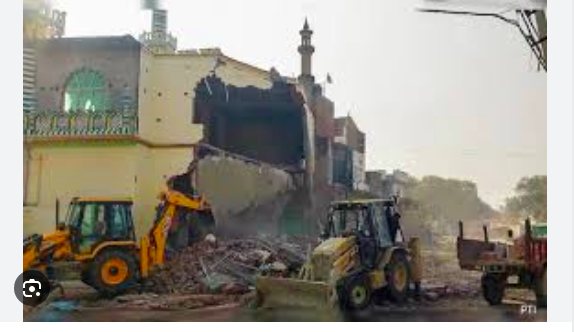

Authorities in Uttar Pradesh have demolished a decades-old Muslim shrine in Agra, raising alarms among local Muslim communities who see this action as part of a broader trend of discrimination against Islamic sites under the current political regime. The demolition, carried out under the guise of infrastructure development, has sparked outrage and calls for equitable treatment of all religious structures.
The Demolition Incident
The removal of the shrine, located on Mahatma Gandhi Road, one of Agra’s busiest commercial hubs, has drawn significant attention. Eyewitness accounts reveal that the demolition proceeded under heavy police presence, ostensibly as part of a road-widening initiative. Local reports indicate that residents were discouraged from documenting the event, although images of the destruction circulated widely on social media platforms.
Community members have expressed their frustration, questioning the selective enforcement of demolition policies. While the shrine was taken down, other religious structures along the same street remain intact. Critics argue that genuine developmental motives should apply uniformly across all structures, irrespective of religious affiliation. This incident has been described as emblematic of a broader pattern of selective targeting by authorities.
Community Response and Concerns
The local Muslim community has reacted with anger and disbelief over the authorities’ actions. Representatives of the shrine’s management expressed a sense of powerlessness, citing that the heavy police presence stifled protests and dissent. Many observers were left to witness the demolition from a distance, unable to intervene or voice opposition due to fears of repression.
This episode fits into an unsettling trend in India, where demolitions of Muslim religious sites and homes have been reported, particularly in states governed by the Bharatiya Janata Party (BJP). Rights observers have flagged these incidents as part of systemic discrimination, raising concerns about the implications for religious freedom and community relations in a diverse society.
Political Context and Larger Implications
The demolition has garnered attention not just locally but also within the broader context of Indian politics. The BJP government has faced accusations of promoting policies that marginalize Muslim communities across various states, leading to heightened tensions. Instances of demolishing Muslim properties under anti-encroachment drives are increasingly common, prompting questions about fairness and equity in governmental practices.
Critics argue that these actions contribute to a climate of fear and exclusion for Muslim populations, eroding trust between communities and the state. The narrative of a ‘Hindu-first’ agenda has been suggested as a driving force behind such targeting, fueling concerns of sectarianism in a historically pluralistic society.
Why It Matters
The demolition of the Agra shrine and similar incidents have significant implications for India’s socio-political landscape. They signal a troubling trend of religious intolerance that can undermine social cohesion and destabilize communities. The international community is increasingly observing these actions, which could affect India’s image as a secular democracy. For businesses and investors, the socio-political climate may also impact economic stability and growth, particularly in diverse regions where communal polarization is a concern.
Frequently Asked Questions
What triggered the demolition of the shrine in Agra?
The shrine was demolished as part of a purported road-widening project, although critics argue that it reflects selective targeting of Muslim religious sites rather than genuine infrastructure development.
How has the local Muslim community reacted to the demolition?
The community has expressed outrage and a sense of helplessness, with many feeling intimidated by the heavy police presence during the demolition that discouraged protest and dissent.
Is this demolition part of a larger trend in India?
Yes, the demolition aligns with a pattern of demolitions of Muslim homes, mosques, and shrines across India, particularly in states governed by the BJP, raising concerns about systemic discrimination.
What are the implications of these actions for India’s political landscape?
The continued targeting of Muslim religious sites contributes to rising tensions and could impact India’s reputation as a secular democracy, potentially affecting economic stability and community relations.