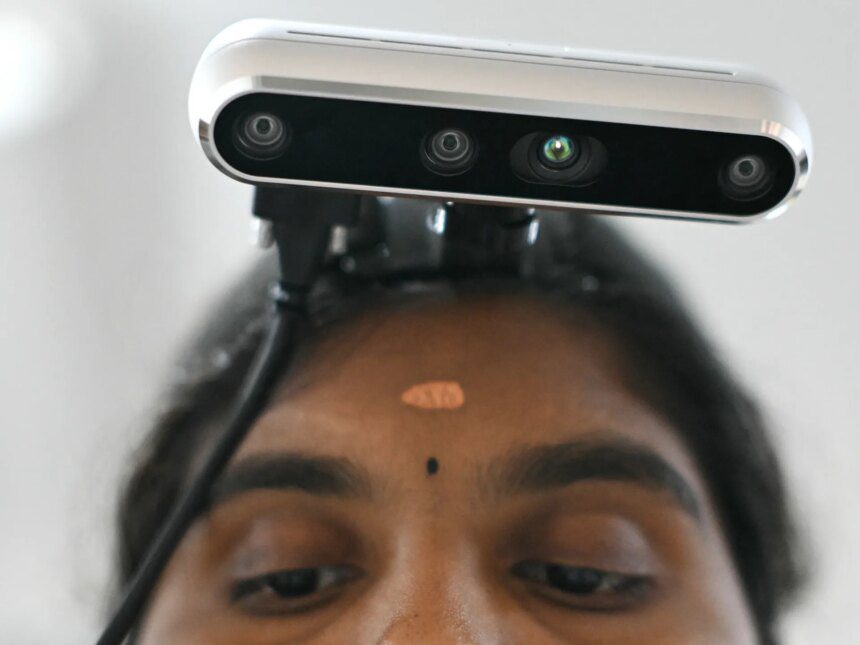

In a remarkable intersection of everyday life and technological advancement, Indian housewives like Nagireddy Sriramyachandra are participating in training AI robots for future household tasks. By filming mundane activities such as slicing mangoes, these individuals contribute to the development of robots that could take over certain domestic chores, earning modest compensation in return.
The Rise of AI Trainers in India
Nagireddy Sriramyachandra, a 25-year-old housewife from Chennai, has joined a growing workforce of AI trainers in India. As she films herself with a smartphone strapped to her head, she provides essential data needed to train robots to mimic human movements. This work, which pays her 250 rupees ($2.6) per hour, utilizes first-person footage to create more effective AI models that can operate in real-world environments.
In India, which is now the world’s most populous nation, thousands of individuals are engaging in similar tasks, often from home or in specialized studios. Using technologies like head-mounted cameras and motion sensors, these trainers are laying the groundwork for a future where AI can take on both mundane and complex tasks within households and industries.
The Economic Implications of AI Training
The increasing reliance on AI for various tasks is indicative of a growing market for humanoid robots. Projections suggest that over one billion humanoid robots will be in use by 2050, primarily for industrial and commercial functions. India has positioned itself as a key player in this sector by serving as a middleman for the creation and annotation of AI data, appealing to global tech companies around the world.
Experts indicate this trend is likely to continue, with the demand for data collection services rising. Digital labor expert Aditi Surie from the Indian Institute for Human Settlements posits that India’s workforce will increasingly play a critical role in teaching AI to navigate complex physical tasks, which could transform employment landscapes across industries.
Concerns About Automation and Employment
While the rise of AI offers new opportunities for some, it also raises significant concerns about job displacement for many low-wage workers. Government think tank NITI Aayog has highlighted that discussions surrounding AI often focus on the implications for white-collar jobs, leaving informal workers, who number around 490 million, without much attention or support. Many of these workers perform essential roles that contribute to the country’s economy.
Ponni, a 55-year-old flower garland maker from Bengaluru, reflects on how automation could affect her livelihood and that of future generations. She, too, has participated in training AI by filming her work, aware that the next generation may face challenges similar to those posed by the adoption of AI in their fields.
What This Means
The integration of AI into daily life raises critical issues for India’s workforce. While some individuals may find new opportunities as AI trainers, many more informal workers may be at risk of job displacement as automation becomes increasingly capable. Policymakers must focus on creating supportive frameworks that help these workers adapt to technological advancements.
Furthermore, the burgeoning market for AI and robotics presents an opportunity for India to establish itself as a leader in technology while also addressing the socio-economic challenges posed by automation. The narrative surrounding AI must evolve from a focus solely on efficiency and innovation to include considerations of its impact on human labor.
Frequently Asked Questions
What kind of tasks are AI trainers filming?
AI trainers are recording everyday activities, such as cooking, cleaning, and various household chores, to help robots learn how to perform these tasks in a human-like manner.
How much do AI trainers earn for their work?
AI trainers can earn around 250 rupees ($2.6) for one hour of video recording, which is relatively modest, but provides income opportunities for those partaking in this work.
What is the future of the humanoid robot market in India?
Forecasts suggest that over one billion humanoid robots will likely be in use worldwide by 2050, mainly in industrial and commercial applications, with India positioned as a key contributor to AI data generation.
What precautions should be taken regarding job displacement by AI?
It is crucial for policymakers and industry leaders to create transitional strategies for affected workers, offering reskilling opportunities and a social safety net to mitigate the impact of automation on informal labor markets.