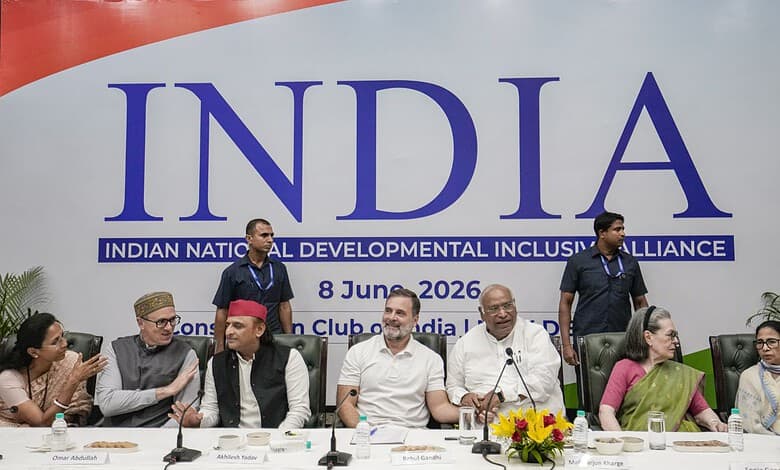

The opposition INDIA bloc in India convened on June 8, 2023, to address significant national concerns, including electoral integrity and demands for ministerial accountability amid rising social and economic disparities. Key leaders, including Congress President Mallikarjun Kharge and Rahul Gandhi, outlined a strategic plan for joint action involving multiple parties to counter pressing issues affecting the nation.
Electoral Integrity and Accountability
During the meeting at the Constitution Club, opposition leaders unanimously decided to reach out to the Chief Justice of India regarding the Special Intensive Revision (SIR) of electoral rolls. This action arises from serious allegations of “vote loot,” indicating detrimental practices that could undermine democratic processes. Moreover, the bloc called for the immediate resignation of Union Education Minister Dharmendra Pradhan, citing irregularities in the NEET and CBSE examinations as a critical area of concern.
Social and Economic Concerns
The INDIA bloc has also pinpointed pressing socio-economic issues affecting the populace, including skyrocketing unemployment rates, inflation, and distress among farmers. Kharge emphasized the need for the central government to convene an all-party meeting aimed at addressing what he termed a “precarious economic situation.” This reflects a growing awareness that economic challenges disproportionately affect marginalized communities, suggesting a linkage between governance and social equity.
Strategies for Unity and Coordination
In a bid to enhance collaboration, Kharge announced that leaders from the bloc will convene every two months to fortify their coordination. The next assembly is slated for August in Hyderabad. As part of their strategy, daily morning meetings are scheduled at the Leader of Opposition’s office during the upcoming Monsoon Session of Parliament. This forms part of a broader effort to ensure a unified front against the ruling Bharatiya Janata Party (BJP), especially following electoral losses for key constituents like the Trinamool Congress in West Bengal and the DMK in Tamil Nadu.
Why It Matters
The discussions and resolutions made by the INDIA bloc hold significant implications for India’s political landscape. With a fragmented opposition facing the BJP’s stronghold, their collective strategies could be crucial for addressing systemic discrimination and social exclusion. The bloc aims to bring marginalized voices, including those of Indian Muslims and other oppressed sections, to the forefront of national discourse, influencing policy and governance in a more inclusive direction. For onlookers, particularly those interested in the dynamics of Indian politics and social justice, these developments underscore ongoing tensions and the need for accountability in governance.
Frequently Asked Questions
What is the INDIA bloc?
The INDIA bloc is a coalition of opposition parties in India aimed at presenting a unified front against the ruling Bharatiya Janata Party (BJP) and addressing key socio-economic issues affecting diverse communities.
What are the main concerns raised by the opposition in their recent meeting?
The opposition raised concerns about electoral integrity, accountability of the Union Education Minister over examination irregularities, rising unemployment, inflation, and the need to address farmers’ distress.
Why are the demands for the minister’s resignation significant?
The demand for Union Education Minister Dharmendra Pradhan’s resignation is significant as it points to broader issues of governance, transparency in public examinations, and accountability, reflecting a crisis of trust in public institutions.
How does the INDIA bloc plan to strengthen its efforts?
The INDIA bloc plans to strengthen its efforts through regular meetings to enhance coordination, setting up daily meetings during parliamentary sessions, and focusing on crucial socio-economic issues affecting marginalized communities.