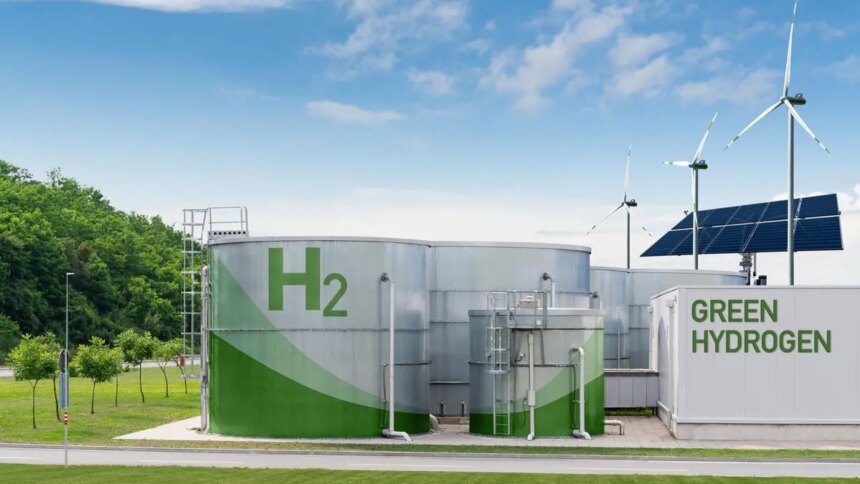

Researchers at the Indian Institute of Technology (IIT) Guwahati have introduced a novel coating technology aimed at enhancing the efficiency and durability of solar-powered green hydrogen production systems. This innovation has the potential to reduce costs and increase the reliability of clean hydrogen generation.
Published in the journal Small, the study centers on photo-assisted electrochemical (PAEC) water splitting, a method that harnesses sunlight to split water into hydrogen and oxygen. Green hydrogen produced through this process is increasingly recognized as a vital energy source for decarbonizing various sectors, including refining, fertilizers, steel, and heavy transport.
A significant challenge facing current solar water-splitting systems is the gradual detachment of catalyst coatings from electrodes, which negatively impacts performance over time. Additionally, gas bubbles generated during the reaction can adhere to electrode surfaces, obstructing active sites and decreasing hydrogen output.
The IIT-Guwahati team tackled these issues by developing a composite coating that integrates graphitic carbon nitride, a two-dimensional photocatalyst, with a bubble-repellent hydrogel layer on porous nickel foam. Unlike traditional methods that merely coat photocatalysts on electrode surfaces, the researchers embedded the catalyst within the coating structure. This innovation reportedly improved adhesion and surface activity, allowing gas bubbles to detach more efficiently during reactions.
The team found that their new coating achieved a 51% increase in hydrogen production and a 44% increase in oxygen production compared to conventional systems.
In a related development, India’s accelerated renewable energy initiatives are projected to create a $10–15 billion opportunity in land aggregation and acquisition by 2030, opening new avenues for the real estate sector. According to a report by Colliers titled “The Green Shift: Renewable Prioritization Reshaping Indian Real Estate,” an estimated $110–120 billion will be invested in solar and wind energy projects in the coming years.
Land acquisition and aggregation typically account for 10–12% of the total project costs in renewable energy development. The report indicated that in solar projects, most land is acquired directly by private developers or through state and central nodal agencies for large solar parks. In wind projects, land is primarily needed for substations and associated infrastructure, with turbine locations often secured through lease agreements.
Beyond land transactions, the renewable energy expansion is expected to generate broader opportunities for the real estate sector, including industrial and warehousing demand from original equipment manufacturers and services such as site surveys, feasibility assessments, engineering procurement and construction, and operations and maintenance.
India has set ambitious renewable energy capacity targets as part of its energy transition and decarbonization strategy, leading to increased demand for extensive land parcels in regions with high solar irradiation and wind potential. According to Colliers, the growing scale of renewable deployment is increasingly positioning real estate and infrastructure players as crucial enablers of the clean energy transition.
Published on May 25, 2026.