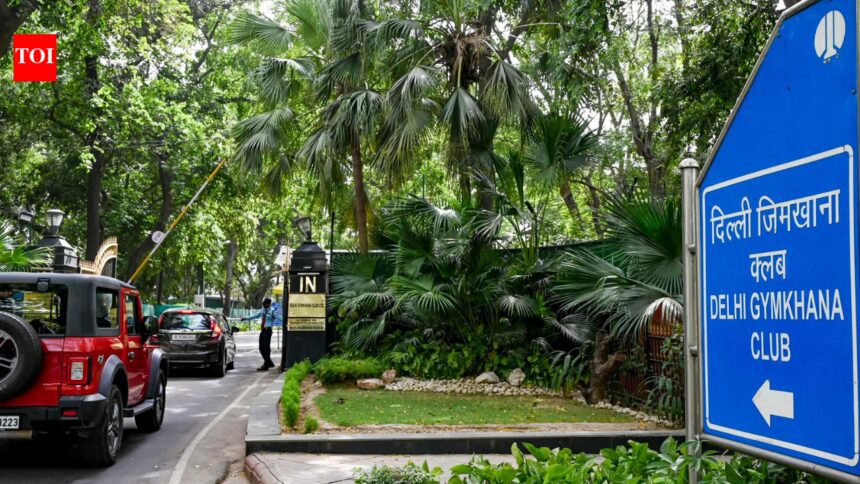

Delhi Gymkhana Club Members Prepare for Legal Action Against Land Acquisition Order
NEW DELHI: Permanent members and employees of the Delhi Gymkhana Club (DGC) are poised to challenge the Central government’s directive to relinquish the club’s 27.3-acre prime land in the Delhi High Court. Members have rejected the government’s justification, which asserts that the club is situated in a “highly sensitive and strategic area” required for “strengthening and securing defense infrastructure and other vital public security purposes.”
Senior advocate and Congress MP Abhishek Manu Singhvi has been retained to represent the club’s members, who have held their premises at 2, Safdarjung Road for over 113 years. Two petitions are expected to be filed: one by members and another on behalf of roughly 600 employees.
The club’s permanent members convened a lengthy meeting on Sunday evening to chart a legal course, following the Land and Development Office (L&DO) directive mandating DGC to vacate its entire premises, including buildings, structures, lawns, and fittings, by June 5—effectively terminating its “perpetual lease.”
A government-appointed general committee (GC) on Saturday informed members that it would seek clarity from ministry officials regarding their concerns. However, a source closely involved in these discussions suggested that the committee might struggle to effectively contest the government’s order. As a result, the members have largely resolved to turn to the judicial system, citing a lack of transparency and ethical concerns regarding the future of employees. Many members noted that a significant portion of the club’s members are pensioners.
In correspondence to the L&DO, the GC has urged for no dislocation until clarity is provided on several issues, including the potential allocation of a substitute plot, acknowledgment of investments made for infrastructure improvements, and the safeguarding of all employees’ positions.
General P.K. Sehgal (retd), a club member since 1972, stated that there was unanimous consensus among members to legally challenge the eviction order. The “sudden decision” to reclaim the land has left members deeply concerned about the club’s future and the potential relocation options.
Public figures, including Kiran Bedi, India’s first woman IPS officer and former Puducherry Lt Governor, have labeled the government’s actions as “tragic and unfortunate.” Some members have described the official reasons given in the order as “frivolous.” A former DGC general secretary noted that since the club’s establishment in the 1930s and the relocation of the Prime Minister’s residence in 1984, security concerns have not materialized.
The Gymkhana Employee Welfare Association has opposed the government’s decision, with employees expressing fears about job loss. Association President Nandan Singh Negi conveyed the distress felt by employees, many of whom have worked at the club for 25 to 26 years, questioning their prospects in light of the impending changes.
Member Nitin Verma criticized the government’s claims as “fictitious,” emphasizing the club’s well-maintained facilities and screening processes. He commented, “What security concern is there? Because nothing has happened till now.”
Kiran Bedi took to X to express hope for the reconsideration of the proposal, stressing that DGC is part of the collective sporting heritage and history of the nation. She noted that the community deserves thoughtful preservation of its legacy amid potential changes.
Some members accused the government of insufficient notification and consideration for the club’s employees. Sehgal pointed out that the abrupt government order threatens hundreds of jobs, although ministry officials assert that due process was followed, providing a two-week notice.
Former diplomat K.C. Singh described the destruction of the club as “untenable,” emphasizing its historical significance and cultural offerings. Members are actively gathering signatures for a petition against the government’s decision, as former RAW chief A.S. Dulat, a past president of the club, reported.
Historian Swapna Liddle commented on the club’s evolution, recalling that it was once exclusive to British officials and evolved significantly post-Independence, offering insight into its complex history and significance within Indian society.