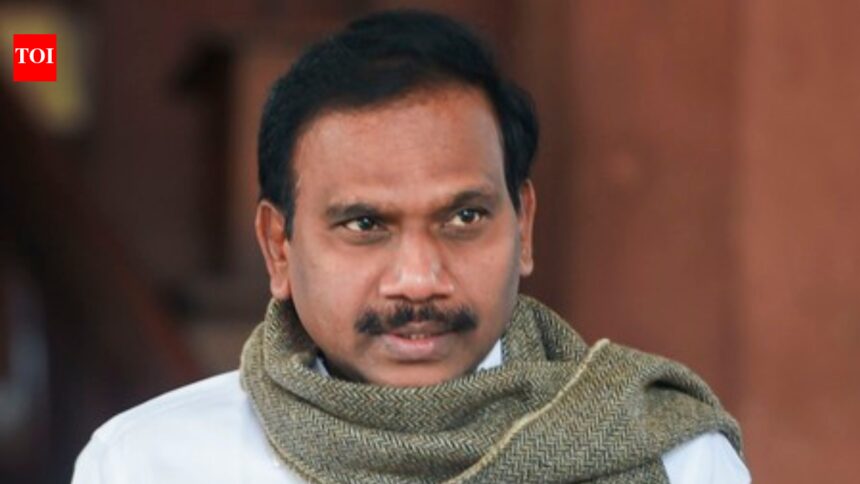

NEW DELHI: Tamil Nadu is currently embroiled in a literary and political conflict between the Viduthalai Chiruthaigal Katchi (VCK) and the Dravida Munnetra Kazhagam (DMK) following remarks made by senior DMK leader A. Raja. Raja employed the metaphor of a “coconut tree bending into a neighbour’s house” to criticize the VCK and Indian Union Muslim League (IUML) for joining the cabinet of Chief Minister Vijay, head of the newly formed Tamilaga Vettri Kazhagam (TVK).
This political skirmish emerges amid significant realignment in Tamil Nadu politics after recent assembly elections, where actor-turned-politician Vijay’s TVK became the single largest party with 108 seats, marking an end to decades of dominance by the DMK and the All India Anna Dravida Munnetra Kazhagam (AIADMK). Tensions heightened following the induction of VCK MLA Vanni Arasu and IUML MLA A.M. Shahjahan into Vijay’s cabinet upon the chief minister’s recommendation.
A Raja’s online metaphor referenced the Tamil literary expression “muttatthengu,” which loosely describes a coconut tree that bends to offer fruits and water to a neighbor. Raja wrote: “If the coconut in my home garden bends over and offers tender water to the opposite house, in literature, that would be named ‘muttatthengu’! What name should we give it in politics? Long live Tamil!”
The DMK leader’s comments prompted immediate backlash from VCK leaders as well as the ruling TVK camp. In a rebuttal, VCK accused the DMK of arrogance and treating alliance partners merely as vote banks, despite relying on their support to secure electoral victories. In a pointed social media post, the VCK stated: “The VCK did not grow because of the mercy of other parties! It was the hard work of the Panthers… that helped alliance parties secure victories.”
The VCK also challenged the DMK’s criticism regarding “party hopping,” questioning the qualifications of other leaders to speak on the matter. They stated: “Who allied with the Sangh Parivar (BJP) to defeat the Congress? Who was part of the Vajpayee cabinet and later opposed the very same BJP?” The party criticized the DMK for failing to extend power-sharing and representation to marginalized communities, emphasizing their own grassroots struggles over the years.
VCK leader S.S. Balaji also adopted a poetic approach in his response to the DMK leadership, highlighting themes of power and justice.
Following the escalating confrontation, the TVK accused the DMK of displaying “arrogance of power.” In a statement on social media, the TVK characterized Raja’s remarks as “the height of indecency,” condemning the DMK for mocking the VCK and IUML regarding their positions on power-sharing, which they argued undermined political decency and ethics.
The ongoing conflict arises from significant political shifts in Tamil Nadu. Although no party secured a clear majority in the recent elections, both the VCK and IUML, traditional allies of the DMK-led Secular Progressive Alliance, pledged support to Vijay’s government to prevent political instability and possible President’s Rule.
VCK chief Thol Thirumavalavan indicated that the party’s decision to back the TVK was made after consultations within the party and was largely supported among members. The VCK, which enjoys substantial support from Dalit communities, previously contested the assembly elections in alliance with the DMK and secured two seats.
Initially, the party offered outside support to Vijay while remaining part of the DMK-led alliance. Thirumavalavan explained that their decision aimed at ensuring political stability and averting President’s Rule in Tamil Nadu. “We are extending support to TVK for two reasons: VCK should not hinder Vijay from becoming CM, and Tamil Nadu should not come under President’s Rule,” he stated after formalizing their support.
Despite this nuanced political maneuvering, VCK leaders maintained that their backing was a functional necessity and not indicative of an ideological shift, with VCK General Secretary D. Ravikumar asserting that the support was intended to prevent a constitutional vacuum rather than validate any ideology.