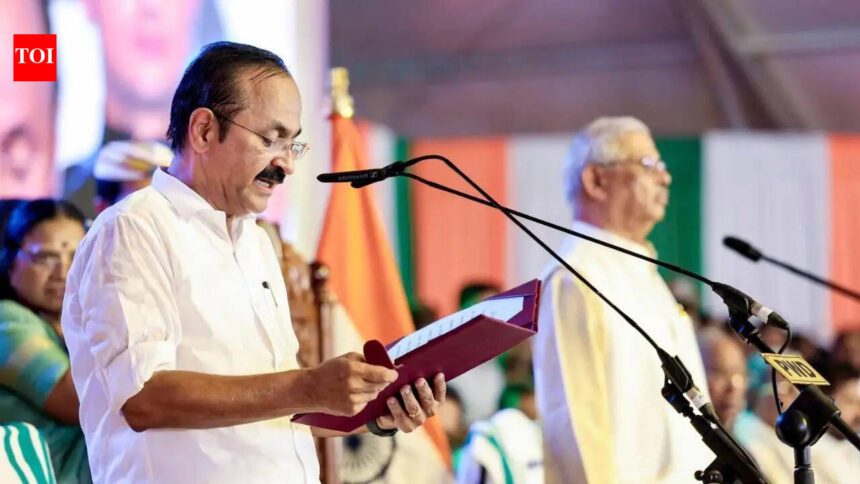

NEW DELHI: A new political controversy has emerged in Kerala following the recitation of the complete version of “Vande Mataram” during the swearing-in ceremony of the new United Democratic Front (UDF) cabinet led by VD Satheesan. The Communist Party of India (Marxist) [CPI(M)] has criticized this move, labeling it inappropriate for a pluralistic society.
The CPI(M) state secretariat stated that the decision to present the entire national song contradicts previous positions held by the Congress Working Committee, which in 1937 recommended omitting certain sections. The party referred to discussions in the Constituent Assembly from 1950, which reflected a consensus that only the first eight lines of “Vande Mataram” should be recognized as the official national song.
CPI(M) argued that specific lines in the song reflect particular religious beliefs and that including these in official ceremonies goes against India’s pluralistic traditions. The party claimed that sections of the song, previously excluded from official usage, were included in the swearing-in ceremony. They also pointed out that even in BJP-governed West Bengal, full renditions are not performed during such ceremonies, emphasizing the need for governments to avoid actions that could undermine the secular character of society.
The CPI(M) further highlighted the sensitive timing of the event, noting that attempts to polarize society along communal lines are becoming more pronounced. They urged all governments to uphold India’s secular framework.
In response, the BJP strongly criticized the CPI(M), accusing the party of “insulting” the national song and catering to specific “vote-bank forces,” including Jamaat-e-Islami and SDPI. State BJP president Rajeev Chandrasekhar called the CPI(M)’s stance “dangerous appeasement politics,” asserting that questioning “Vande Mataram” is an attempt to mask the party’s rejection by the public. He insisted that “insulting the nation for mere political survival can never be called secularism,” and emphasized the importance of unity and harmony for a developed Kerala.
Amid this political debate, sources within the newly formed Kerala government clarified that the organization of the event was handled entirely by Lok Bhavan and that the government was not involved in the selection of the program.
CPI(M) leader PA Mohamed Riyas expressed concerns on social media, stating that traditionally only specific portions of “Vande Mataram” are performed. This remark received sharp pushback from BJP leaders, who questioned the basis of the party’s objections.
The controversy in Kerala parallels a similar incident in Tamil Nadu, where questions arose regarding the order of songs played during CM Vijay’s swearing-in ceremony. CPI state secretary M Veerapandiyan objected to the procedure, asserting that traditional protocol dictates that Tamil invocation songs be played first, followed by the national anthem, rather than opening with “Vande Mataram.” He argued that the arrangement was a violation of established convention, which bore historical and ideological significance, noting that during the freedom struggle, “Vande Mataram” was not accepted in its full form due to concerns over religious references.
Veerapandiyan called for a public explanation from the Tamil Nadu government regarding the misstep and advocated for the restoration of the Tamil invocation song to its traditional position, with the national anthem concluding the ceremonies in accordance with historical practices.