
Outside the specialized realm of agribusiness, the Olam Group may not be widely recognized. However, based in Singapore and predominantly owned by Temasek, it stands as a formidable global entity with revenues surpassing $50 billion. Olam is among the world’s leading suppliers of food and industrial raw materials, with operations spanning over 60 countries.
In April, Wipro, India’s fourth-largest IT services firm by revenue, secured a significant eight-year, $1 billion-plus strategic transformation agreement with Olam. Wipro intends to provide comprehensive transformation services through its AI-powered suite, Wipro Intelligence, across Olam’s entire ‘farm-to-fork’ value chain, encompassing farming, forecasting, trading, supply chain operations, and customer engagement.
This arrangement is emblematic of ongoing changes in the industry.
The Indian IT services sector is presently undergoing a substantial structural transformation driven by AI, which is redefining the nature of the services offered, pricing models, talent recruitment, team structures, and global competition. Venu Lambu, CEO and MD of LTM, noted that AI is fundamentally reshaping the landscape.
At Wipro, during the company’s Q4 earnings conference call, CEO and MD Srini Pallia discussed a strategic shift: “We have launched a dedicated AI-native business and platforms unit to move beyond a services-only model to a services-as-a-software approach. This unit will function with dedicated leadership, targeted investments, and a unique operating model designed to accelerate enterprise-grade agentic AI solutions.
“When combined with core services, this dual-engine model will facilitate large-scale transformations while cultivating AI-native platforms that distinguish services, enable repeatable deployments, and unlock non-linear growth,” he stated.
In parallel, Tata Consultancy Services CEO and MD K Krithivasan asserted that AI presents “an opportunity rather than a threat.” He emphasized that “while AI models exist, large enterprises require partners to safely and effectively integrate them into complex, legacy systems.”
Threat or Opportunity?
The Indian IT sector has experienced remarkable growth since the 1991 liberalization of the economy, accounting for nearly 6 million white-collar jobs and contributing around 8 percent of India’s GDP. Industry body Nasscom estimates that Indian IT services firms collectively generated revenues of $283 billion last year, with $224 billion derived from exports alone. Between 2010 and 2019, prior to AI becoming a focal point, Indian IT services experienced growth rates of 10–12 percent. Currently, those growth rates have nearly halved.
Historically, Indian IT scaled according to a classic pyramid model, relying heavily on a broad base of junior engineers billed on an hourly basis to manage repetitive development, testing, maintenance, and support tasks. However, AI has disrupted this model, as automation increasingly handles functions such as code generation, testing, documentation, migration, application maintenance, and customer support.
Five years ago, launching a large-scale SAP deployment or comprehensive ERP transformation involving multiple modules such as finance, supply chain, and analytics would typically take 24-36 months. In contrast, AI can now facilitate rollouts within a timeframe of 6–9 months.
DD Mishra, VP Analyst at Gartner, observed that decision-making cycles for small-scale GenAI pilot projects have contracted from several months to just 2–4 weeks. Enterprises are eager to “fail fast” or swiftly capitalize on productivity enhancements, often financing these initiatives through innovation budgets rather than conventional IT allocations. This shift allows projects to evade protracted procurement processes and places AI deal approvals under the scrutiny of CFOs and CEOs.
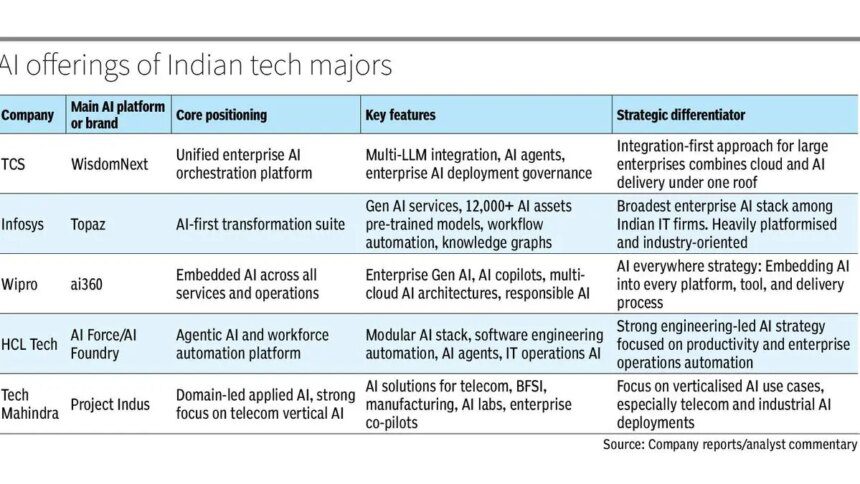
Previously, in traditional IT services, the correlation between workforce size and revenue was clear; more personnel meant more income. AI has disrupted this correlation, with clients now expecting fewer engineers, reduced costs, productivity-linked pricing, and expedited delivery. Consequently, Indian IT firms are evolving from mere service providers to AI-driven transformation partners. Historically reliant on services revenue, they are now focusing on AI orchestration platforms, domain-specific co-pilots, reusable enterprise AI agents, and industry AI stacks.
Mishra noted that Indian IT companies are swiftly re-evaluating their AI strategies, shifting from traditional labor arbitrage models toward platform-driven and outcome-based solutions. Unlike many global counterparts pursuing consulting-centric and acquisition-heavy strategies, Indian firms are concentrating on integrating AI through scalable platforms and measurable results.
Jimit Arora, CEO of Everest Group, remarked that the competition centers on the capability to reinvent operating models. “Indian IT firms possess a structural advantage in delivery scale and process depth. In contrast, global competitors such as Accenture and the Big Four excel in business advisory and access to C-suite executives. The firms that bridge this gap will be the ones to watch. We already see a K-shaped divergence in growth trajectories among Tier-1 firms, and further separation will likely occur through effective execution—execution fosters trust, enabling increased business opportunities, which in turn drives further execution,” he stated.
AI-Tagged vs AI-Led
Biswajeet Mahapatra, Principal Analyst at Forrester, noted that most AI offerings currently represent extensions of existing digital, data, and automation practices rather than being genuinely new AI-first service lines.
Although there are instances of genuine AI-led engineering, most client-facing portfolios reflect a re-bundling and repositioning of prior capabilities, with incremental AI components incorporated into service delivery.
“A minority of active pipelines are authentically AI-led, where AI serves as the primary purchasing driver. A significantly larger portion is AI-tagged, where AI is presented as an enhancement to transformation, modernization, or productivity efforts,” Mahapatra stated.
He added that, for the foreseeable future, AI will likely remain a modest contributor to overall revenues. A more substantial revenue impact will materialize only when AI evolves from incremental feature-level additions to transformational operating models and business processes at scale. This transition relies on clients financing structural changes rather than merely incremental automation.
Over a timeframe of 3-7 years, significant growth in service offerings is anticipated, even as the nature of leading firms changes, according to Arora. Historically, each era of service—including outsourcing, offshoring, and digital—has followed a similar growth pattern.
“Firms poised for success in this era will adopt a tripartite strategy. They will play defense by intelligently managing the decline of their legacy businesses, play offense by capturing vendor consolidation deals as clients reduce their supplier counts and centralize spending, and innovate by shaping client demand through evolving operating models rather than merely responding to requests for proposals. The critical challenge will be how much new growth can be harnessed from these shifts before resources dwindle,” he concluded.
Looking ahead over the next 3-5 years, Mahapatra remarked that providers capable of effectively productizing intellectual property, standardizing AI delivery, and aligning AI with industry workflows will likely emerge as leaders in the AI landscape, compared to those who remain focused on labor-based scaling.
More Like This
Published on May 11, 2026