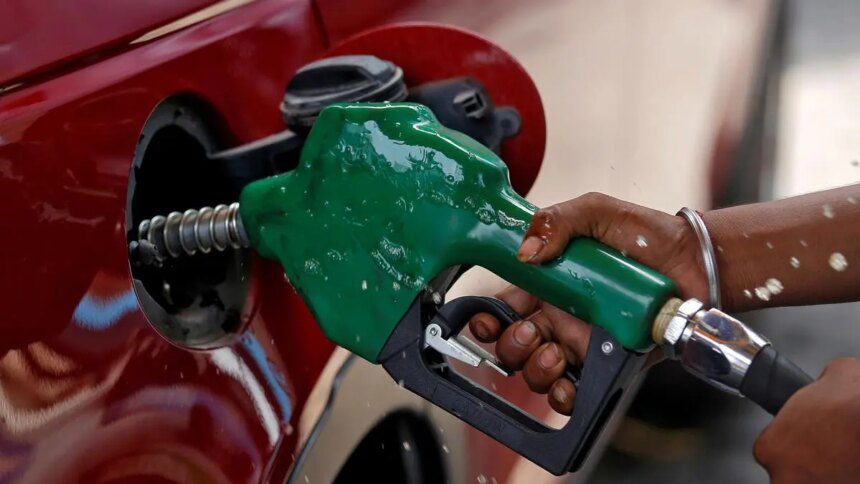

India’s state-owned oil marketing companies — Indian Oil Corporation, Bharat Petroleum, and Hindustan Petroleum — increased petrol and diesel prices by ₹3 per litre on Friday, marking the end of a 49-month freeze on retail fuel prices. In Delhi, the price of petrol is now ₹97.77 per litre, while diesel is priced at ₹90.67. The updated prices in other major cities include ₹106.68 in Mumbai, ₹108.74 in Kolkata, and ₹103.67 in Chennai.
This price hike follows a significant rise in global crude oil prices, which escalated from approximately $69 per barrel in February to surpass $120, largely due to the ongoing conflict in West Asia and supply disruptions in the Strait of Hormuz. As of Friday morning, Brent futures were trading at $106.91, reflecting a 1.13 percent increase, while June crude futures on the MCX reached ₹9,445, an increase of 1.02 percent.
Despite the increase, analysts have expressed concern that the revision is inadequate. Prashant Vasisht from ICRA noted that oil marketing companies continue to incur daily losses of around ₹500 crore on auto fuel and domestic LPG sales, even following the price hike, at crude oil levels of $105–110 per barrel. Arun Kailasan of Geojit Investments pointed out that cumulative under-recoveries amount to ₹1,98,000 crore, stressing that a correction of ₹10 per litre for petrol and ₹15 for diesel would be necessary to reach a break-even point.
Dr. Manoranjan Sharma, Chief Economist at Infomerics Ratings, emphasized the broader economic risks associated with the fuel price increase. As India imports nearly 85 percent of its crude, the hike is expected to elevate transportation and production costs, contributing to rising prices for essential goods. A weakening rupee exacerbates these import expenses.
According to Jateen Trivedi of LKP Securities, the price revision indicates the government’s intention to manage fuel subsidies and safeguard foreign exchange reserves. Ajit Mishra of Religare Broking cautioned that the increase may intensify inflationary pressures, with higher logistics costs likely to affect household budgets.
Kailasan characterized the ₹3 increase as “…less like a solution and more like an opening step in a staggered strategy,” a sentiment echoed by Sharma, who described the situation as “…both an economic and strategic challenge.”
Khushi Mistry, a Research Analyst at Bonanza, described the price increase as “…directionally correct but financially inadequate,” noting that the subdued market response is rational. Mistry suggested that for a sustained rerating of oil marketing company stocks, at least two of three conditions must be met: Brent crude must fall below $95, there should be additional price hikes of ₹4–5 per litre, or there must be a significant LPG compensation top-up. “Until then, the stocks trade as a high-beta short proxy on the West Asia conflict,” she concluded.
The article is published on May 15, 2026.