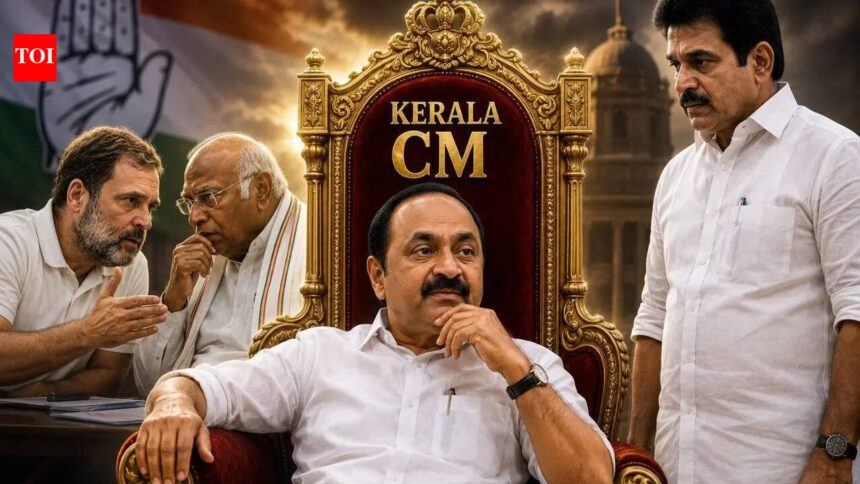

NEW DELHI: After extensive discussions and negotiations spanning 10 days, the Congress party has officially announced VD Satheesan as the chief ministerial candidate for Kerala, concluding the speculation surrounding the leadership decision. Satheesan triumphed in a closely scrutinized competition against prominent figures KC Venugopal and Ramesh Chennithala, with the Congress high command evaluating alliance dynamics, public opinion, and electoral strategies prior to the announcement.
Venugopal had been regarded as a formidable contender, garnering significant support among MLAs and party leadership in Delhi. However, several political factors ultimately swayed the decision in favor of Satheesan, notably his role as a vocal critic of the Left Democratic Front (LDF) government led by Pinarayi Vijayan. Although Congress did not formally endorse a chief ministerial candidate before the elections, Satheesan had cultivated his public persona as the opposition’s face against the LDF over the past five years.
His popularity among grassroots Congress workers significantly bolstered his candidacy, especially as party members advocated for the leader who spearheaded the election campaign to also lead the government. Critical to Satheesan’s selection was the backing from key allies within the Congress-led United Democratic Front (UDF), particularly the Indian Union Muslim League (IUML), which holds 22 of the 102 seats in the UDF. The IUML’s robust support positioned Satheesan as their preferred leader, linking his leadership track record to their electoral success.
Support from the Kerala Congress (Joseph) and Revolutionary Socialist Party further solidified his standing within the alliance. The Congress leadership recognized that sidelining the IUML’s preference could risk complications for the incoming government, given its historically significant partnerships in Kerala politics.
Concerns surfaced within the party regarding Venugopal’s aspirations for the chief ministerial role, especially considering earlier indications during the campaign that he was not seeking position. Bypassing Satheesan after the UDF’s notable victory could have led to perceptions that he was denying political credit to a leader who played a pivotal role in securing the win. Additionally, Congress’s recent electoral setbacks in various Hindi-speaking states under Venugopal’s leadership as AICC organization secretary were widely discussed.
At the constituency level, internal pressure mounted, with several newly elected Congress MLAs facing backlash from local party workers aligned with Satheesan. Criticism directed at young leaders, such as Shafi Parambil and Mathew Kuzhalnadan, for their alleged opposition to Satheesan further exemplified the internal strife.
Another reason influencing the decision was the potential for multiple by-elections if Venugopal had been appointed chief minister. As a sitting Lok Sabha MP, Venugopal would have needed to resign and contest an assembly by-election, potentially triggering further bypolls—a scenario the UDF aimed to avoid soon after its recent electoral gains. Party leaders were wary of the risks associated with a by-election for a sitting chief minister, preferring to maintain political stability.
Public perception played a significant role in Satheesan’s ascent. His consistent critique of the LDF government’s governance and corruption issues has contributed to his reputation as a staunch advocate for secularism in Kerala politics. By challenging controversial remarks from notable Hindu leaders, Satheesan established a reputation for taking political risks, winning support from those who appreciated his boldness.
His declaration during the campaign that he would retire from politics if the UDF did not secure over 100 seats also resonated with supporters, reinforcing his image as a reliable campaign leader. Despite backing from many Congress MLAs for Venugopal and his close ties with the central leadership, the delay in naming the chief ministerial candidate indicated a deliberate balancing act by the party between organizational interests and political realities.
Satheesan, who has been elected six times as an MLA for Paravur in Ernakulam district, ultimately emerged as the candidate with broader public appeal, greater alliance support, and deeper grassroots backing. Following his appointment, Satheesan emphasized unity within the party, acknowledging the contributions of both Venugopal and Chennithala and expressing a desire for collective collaboration to shape a new Kerala.
Venugopal accepted the decision publicly, reinforcing party unity. “Satheesan has been appointed as chief minister… the decision of the High Command will prevail, and I will ensure it is respected and implemented,” he stated.
Satheesan’s trajectory to the chief ministerial role has been marked by years of internal political battles. Following his exclusion from a ministerial position in 2011 and his unsuccessful bid for the Kerala Pradesh Congress Committee chief post in 2016, he faced formidable contenders again in this leadership race. Even with the UDF’s significant victory, Satheesan was not initially the automatic choice of the party high command, given concerns over his relationships with influential community lobbies and his assertive political style, which has sometimes unsettled even his party’s leaders.
The true challenge for Congress in Kerala commences post-announcement. The recent days have revealed factional tensions within the party, even amidst a commendable electoral victory. As Satheesan moves to establish his government, it will be crucial to observe whether all key figures align for a stable UDF government or if Kerala encounters internal strife reminiscent of rivalries seen in other states.