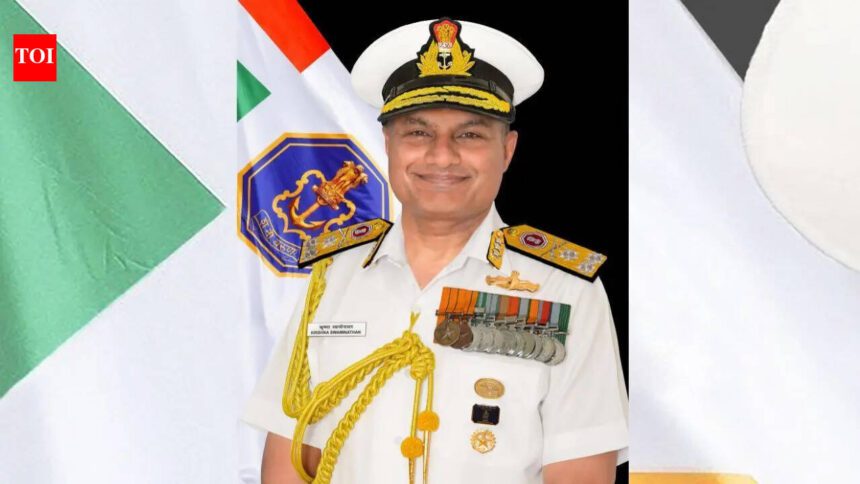

NEW DELHI: In response to a warning from Pakistan’s Field Marshal Asim Munir about potential Indian “misadventures,” Indian Navy chief-designate Vice Admiral Krishna Swaminathan emphasized that such actions do not originate from India. He asserted that India is prepared to address and counter any threats from across the border.
Vice Admiral Swaminathan, who is set to assume command of the Navy following Admiral Dinesh K. Tripathi’s retirement on May 31, stated, “India has always been in a responding kind of mode. Such actions (misadventures) come from across the border. People can say what they want, but as far as we are concerned, India will remain prepared.”
Speaking at a defense event organized by the Bramha Research Foundation in Mumbai, he noted that India has been a longstanding victim of terrorism. He mentioned that Operation Sindoor specifically targets terror camps and perpetrators involved in the Pahalgam terror attack. “The country cannot accept terrorist activities, especially when they emanate from foreign soil,” he emphasized, adding that Operation Sindoor is ongoing.
In light of the evolving global security landscape, Vice Admiral Swaminathan pointed out that nearly 95% of India’s trade by volume and about 70% by value continues to traverse maritime routes. He stated, “The Indian Ocean is, and has always been, India’s arena. Today, the Indo-Pacific has emerged as a defining theatre of 21st-century geopolitics. The Indian Ocean is becoming even more contested, more watched, and more consequential. The Indian Navy is the guardian of this domain.”
Addressing opportunities for Micro, Small, and Medium Enterprises (MSMEs) in defense, he remarked, “I just think that it takes some time for MSMEs to find the momentum. Producing defense-grade equipment in any country is not something that you do fast; you’ve got to do it slowly, methodically. Our specifications are very stringent. You don’t get anything off the shelf. Everything needs to be made from an idea. Therefore, most industries in the world take time for technologies to mature.”