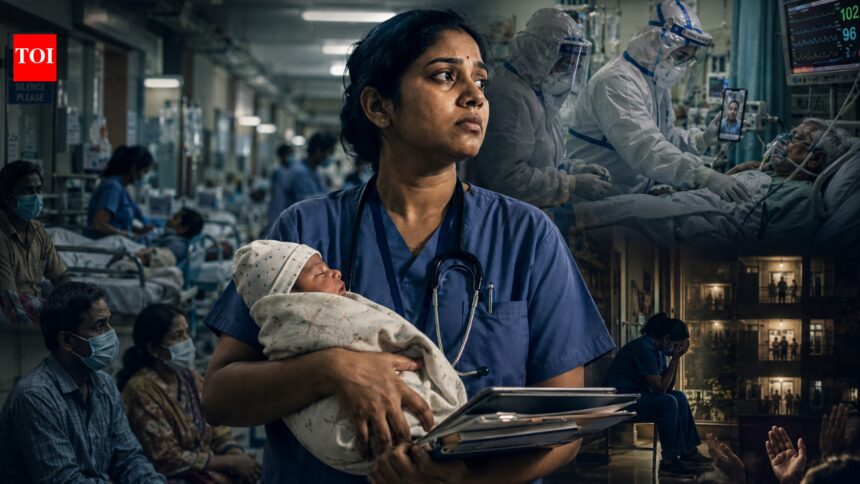

Every morning in hospitals across India, nurses have already conducted vital checks, flagged patients in decline, delivered overnight medications, and made crucial judgment calls before the first doctor completes their rounds. They serve as the first responders in the ward, the last face a patient sees before surgery, and the primary clinical presence for most patients through the night. Yet, within the public structure of healthcare, their visibility is limited.
According to data from the Indian Nursing Council, India has about 3.4 million registered nurses but is facing a shortage of nearly two million. The World Health Organization (WHO) suggests a nurse-to-patient ratio of 1:5 in general wards; however, in many government hospitals, this ratio can be as unfavorable as 1:15. The responsibilities that fall into this gap—monitoring, counseling, crisis management, and family communication—do not disappear; they are simply assumed by the nurse present at the bedside.
Today’s nurses undertake roles far beyond clinical care. They act as translators, converting medical jargon into understandable language for patients and their families, serve as counselors who provide emotional support for fear and grief, and function as the ward’s early warning system for patient condition fluctuations. Studies have shown that early warning signs identified by nurses are among the strongest predictors of patient outcomes, yet institutional acknowledgment of nursing assessments often pales in comparison to that of physicians’ notes.
As World Nurses Day approaches, the pressing issue is not merely celebration but a need for acknowledgment of nurses’ significant contributions. “In nursing, we learn politics, administration, lobbying, and psychology; our curriculum covers all that. But we are a very disorganized human resource,” states Ms. Antonia Pushparaj, who holds an MBA in Hospital Management and an MSc in Nursing, currently working at Apollo Spectra Hospital in Bengaluru. She emphasizes that while India is the largest supplier of nurses globally, the country has yet to develop an adequate framework to recognize their value at home.
The modern nurse often multitasks, managing several responsibilities simultaneously. One might check a post-operative patient’s blood pressure while also addressing questions from family members about surgery delays, monitoring a nearby patient’s unusual breathing, and documenting these observations for future physician review. This depiction of nursing diverges sharply from the traditional image of nurses merely as support staff, focused on carrying out physician orders.
Historical portrayals of nursing, often shaped by hospital dramas, cast nurses primarily as assistants—efficient yet secondary. However, contemporary nursing roles have evolved significantly. Nurses are now key players who interpret clinical information for patients and families and make critical decisions about when to escalate care without immediate physician support. Particularly in psychiatric and palliative care settings, nurses engage in profound emotional labor, aiding patients and families in distress, and managing their own emotional challenges during lengthy shifts.
The profession faces significant contradictions. “Even if I had a daughter, I might not have allowed her to choose this profession,” Antonia admits, reflecting on the type of humiliation nurses endure. Despite the challenges, she finds fulfillment in mentoring emerging nurses, which provides her with a sense of purpose.
The COVID-19 pandemic brought longstanding issues within the healthcare system to the forefront. It revealed shortages and elevated the emotional labor that nurses have silently managed for years. During the pandemic, nurses worked extended shifts in full personal protective equipment (PPE), often without the ability to provide physical comfort through traditional bedside manners. However, they remained on the front lines, even becoming the only human contact for patients during their last moments, allowing families to say farewell through a phone held to their ears.
The global applause for nurses during the pandemic was heartfelt but short-lived. Within two years, many healthcare systems reported significant nursing attrition, driven by burnout and inadequate compensation. In India, this exodus worsened an already critical shortage, resulting in dangerously high nurse-to-patient ratios in public hospitals. The pandemic did not create the nursing crisis; it merely made it impossible to ignore.
Antonia believes the pandemic forced a moment of reckoning that failed to translate into lasting change. “Everyone took a backseat, but nurses were in the forefront. COVID truly changed the trajectory of nurses,” she noted. Still, cultural shifts around nursing recognition remain lacking. “It’s not just about celebrating us during a pandemic or on May 12th, but every time a patient gets discharged,” she emphasizes.
Responsibility for changing perceptions lies with hospital management, nursing councils, and society as a whole. Beneath the systemic frustrations, Antonia finds solace in the moments she cherishes most—when parents entrust her with their newborns, which she describes as a profound responsibility. This trust reflects that patients often turn to nurses not out of obligation, but because, in those moments, there is no one else they would rather have by their side.