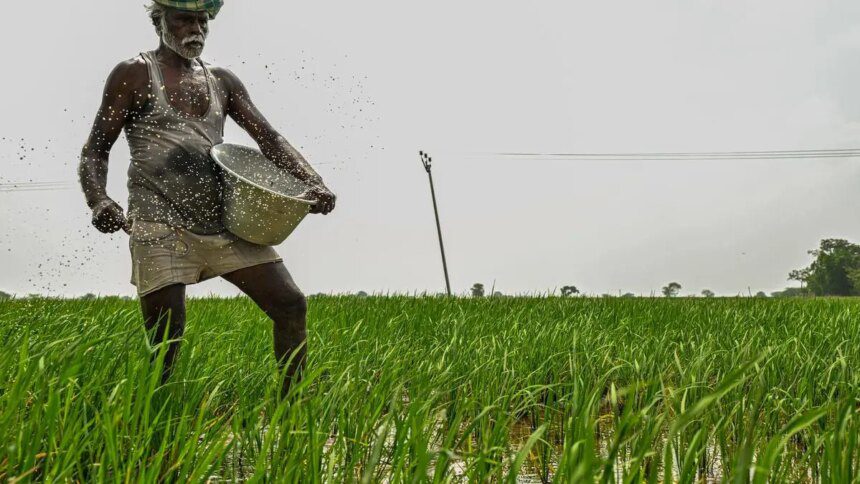

Combined sales of four key fertilisers — Urea, DAP, MOP and complexes — rose 25 per cent to 23.59 lakh tonnes in April 2026 from 18.9 lakh tonnes a year earlier. | Photo Credit: VENGADESH R
In response to increasing fertilizer demand and Prime Minister Narendra Modi’s call for farmers to reduce chemical fertilizer usage by 25-50%, the government announced that India has sufficient fertilizer stocks for the upcoming kharif sowing season.
Agriculture Minister Shivraj Singh Chouhan expressed optimism, stating that it is feasible to cut chemical fertilizer use by half while sustaining productivity levels.
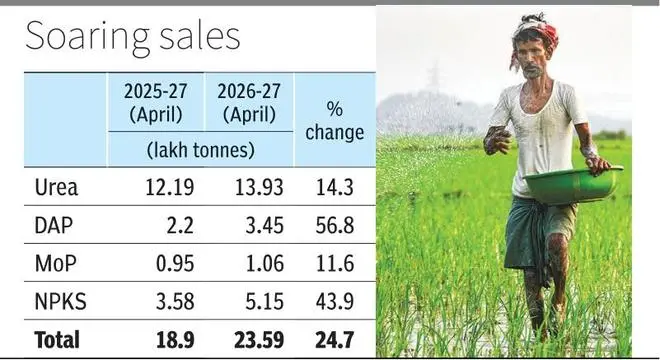
Sales of the four primary fertilizers—urea, di-ammonium phosphate (DAP), muriate of potash (MOP), and complex fertilizers—rose by 25 percent, reaching 23.59 lakh tonnes (lt) in April 2026, compared to 18.9 lt the same month last year. Sales of DAP surged 57 percent to 3.45 lt, complex fertilizers increased by 44 percent to 5.15 lt, urea sales grew by 14 percent to 13.93 lt, and MOP sales rose by 12 percent to 1.06 lt.
Prime Minister’s Appeal
On Sunday, Prime Minister Modi urged farmers to reduce chemical fertilizer usage by 25-50% to conserve foreign exchange and protect soil quality. He indicated that while one bag of urea costs ₹3,000 in other countries, the Indian government offers it for less than ₹300 per bag.
“We need to take a pledge…we have to do it,” Modi emphasized, highlighting the necessity to limit fertilizer application to prevent soil degradation. He warned that if soil health declines, agricultural productivity will eventually falter and advocated for a shift towards natural farming.
Panic Buying Trends
During the inter-ministerial briefing on West Asia, Aparna S Sharma, Additional Secretary in the Department of Fertilizers, noted instances of panic buying following the global conflict. Steps are being taken by both Central and State governments to promote balanced fertilizer usage and mitigate excess. Authorities are working to prevent hoarding and ensure soil nutrients are exclusively used for agricultural purposes.
“India’s fertilizer security remains comfortable and well-managed,” Sharma stated, reporting that current stock levels are above 51 percent of the total demand of 390.54 lt for the Kharif 2026 season, considerably higher than the typical 33 percent. She added that following the conflict, domestic production was recorded at 76.78 lt, complemented by 19.94 lt in imports.
The government previously stated that domestic production for March-April stood at 67.76 lt—comprising urea (40.72 lt), DAP (5.39 lt), and complex fertilizers (13.65 lt). Notably, India relies entirely on imports for MOP.
Subsidy Considerations
Regarding the fertilizer subsidy, Sharma mentioned that the subsidy bill will be addressed timely to ensure liquidity for fertilizer companies. The government previously allocated ₹2.21 lakh crore for the fertilizer subsidy in the last fiscal year, while the Budget Estimate for FY27 is set at ₹1.77 lakh crore.
However, due to rising global fertilizer prices, including nearly doubling costs for urea, the government will account for these fluctuations when finalizing the subsidy.
Published on May 11, 2026