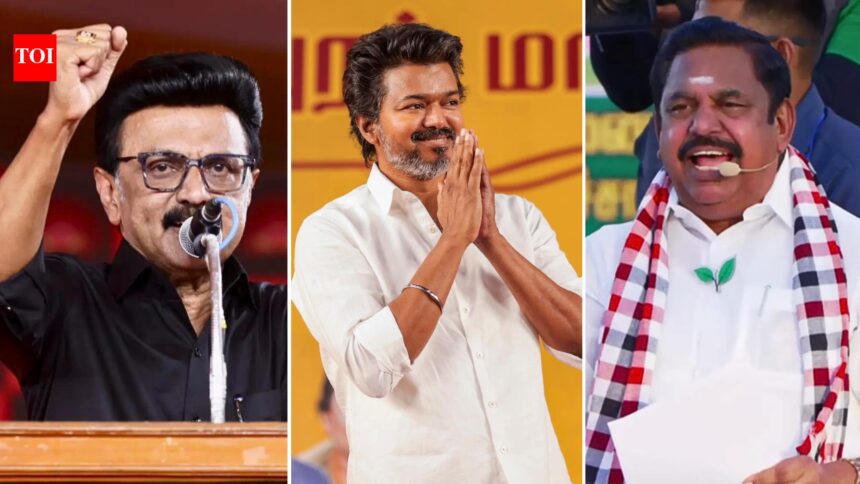

NEW DELHI: The Tamilaga Vettri Kazhagam (TVK), led by film star Vijay, has emerged as a significant political entity in Tamil Nadu, securing 108 of the 234 assembly seats in the recent elections. While this victory positions TVK as the single-largest party, it falls short of the 118 seats needed for a majority. This outcome has disrupted the long-standing political landscape dominated by the DMK and AIADMK.
Despite its strong performance, TVK’s inability to secure a clear majority leaves the formation of the government in limbo. Tamil Nadu Governor Rajendra Vishwanath Arlekar has invited Vijay to discuss the requisite majority support necessary to form a government. According to sources, the governor has requested clarity on the legislators who support TVK’s claims.
While the DMK received 59 seats and the AIADMK garnered 47, TVK enjoys an alliance with Congress, which holds five seats, raising their combined total to 113. However, Vijay is expected to relinquish one of his two seats, effectively reducing TVK’s count to 107, and the alliance to 112—still five seats short of the majority.
The governor’s hesitation to invite Vijay for government formation has faced backlash from TVK leaders and its allies, who accuse him of responding to pressure from the BJP-led Union government. There is mounting pressure from various political factions for the governor to permit Vijay a chance to prove his majority through a floor test in the assembly.
In an unexpected turn of events, the traditionally rival DMK and AIADMK have reportedly initiated discussions to counter TVK’s influence. Caretaker Chief Minister MK Stalin informed DMK legislators of AIADMK’s outreach for potential support against Vijay’s ascension to the chief ministership.
AIADMK General Secretary Edappadi K Palaniswami is expected to meet with Governor Arlekar, while Stalin is involved in discussions with allies, including Viduthalai Chiruthaigal Katchi and Left parties, which could sway the numbers game.
Allies of TVK, including VCK leader Thol Thirumavalavan and representatives from Left parties, have criticized the governor for not extending an invitation to Vijay for government formation. Thirumavalavan emphasized that the governor’s delay could complicate the political situation, urging immediate action to allow TVK to demonstrate its majority.
In summary, as TVK navigates its ascent in Tamil Nadu’s political landscape, the complexity of alliances, rivalries, and institutional procedures underscores the ongoing uncertainty regarding government formation in the state.