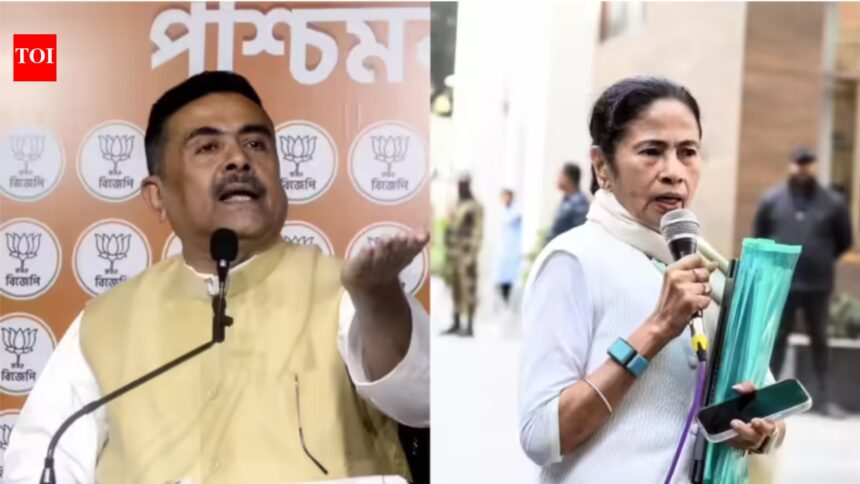

NEW DELHI: The high-stakes electoral contest in West Bengal is drawing significant attention as counting of votes occurs on Monday. Chief Minister Mamata Banerjee, leader of the All India Trinamool Congress (TMC), is re-contesting her seat from Bhabanipur, which participated in the second phase of voting on April 29. Her opponent, Suvendu Adhikari, is campaigning as the Bharatiya Janata Party (BJP) candidate for both Nandigram and Bhabanipur.
Candidates from various parties, including BJP, TMC, Congress, Communist Party of India (Marxist), Socialist Unity Centre of India (Communist), and others, are vying for the Bhabanipur seat. Early trends indicate that Adhikari has established a lead in Bhowanipore.
In the 2021 election, Banerjee contended against Adhikari in Nandigram, where she was defeated by a margin of 1,956 votes. Now, she faces Adhikari in her own constituency, Bhabanipur, a seat she has held since 2011 without experiencing a loss. After taking office as Chief Minister in 2011, Banerjee secured a bypoll victory in Bhabanipur by a substantial margin of 54,213 votes.
In the 2016 elections, her victory margin decreased to 25,301 votes over Congress candidate Deepa Dasmunshi, as the BJP garnered 26,299 votes. In 2021, the TMC maintained control of Bhabanipur, with Sovandeb Chattopadhyay defeating the BJP’s Rudranil Ghosh by 28,719 votes, while the BJP’s vote share increased to 35.2%, indicating a growing influence.
Banerjee later returned to contest the Bhabanipur bypoll, winning by a margin of 58,835 votes, thereby securing her third term as Chief Minister. The Bhabanipur electorate has seen changes, with 41,068 names removed from the rolls, leading to a roughly 20% decrease in the voter base, now around 1.6 lakh.
An analysis by researchers Souptik Halder, Ashin Chakraborty, and Sabir Ahamed found that 56.7% of voters flagged as ‘under adjudication’ are Muslims, despite Muslims comprising only 20% of the constituency’s population according to the 2011 Census. Prior studies indicated that Muslims made up 22.7% of voters marked as ‘Absent, Shifted, or Dead/Duplicate’ (ASDD), with the ‘unmapped’ category representing around 26%, aligning closely with their overall population share. However, this proportion surged to 52% among those categorized as having ‘logical discrepancies.’
Chakraborty noted that while Bhabanipur is a mixed-community constituency, Muslims are disproportionately represented among the scrutinized voters. Halder emphasized that booth-wise data analysis for the 2021 and 2024 elections suggests that if voters under adjudication remain unable to cast their ballots, the TMC’s winning margin could significantly diminish or even disappear in certain booths.