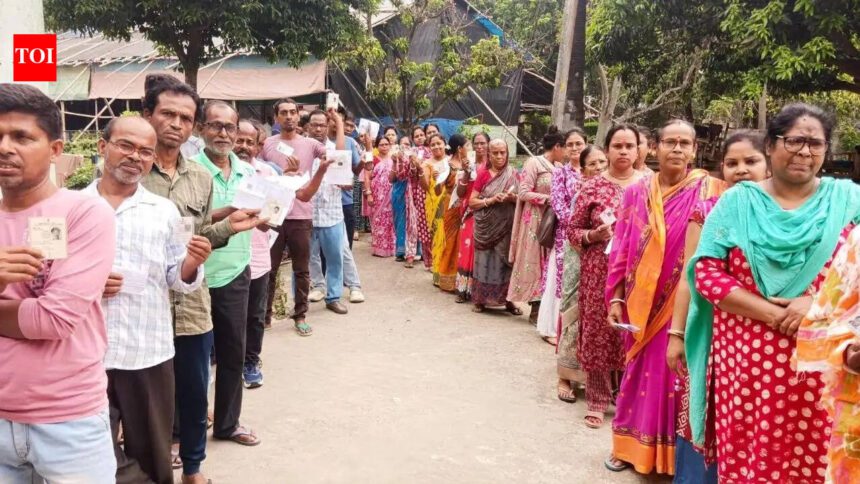

As West Bengal approaches phase 2 of voting on Wednesday, the Matua community is poised to play a pivotal role in the fiercely contested election between the Trinamool Congress (TMC) and the Bharatiya Janata Party (BJP). The Matua-dominated regions of North 24 Parganas and Nadia may significantly influence the electoral outcome.
However, many voters express uncertainty about their ability to cast ballots due to the Special Intensive Revision (SIR) of electoral rolls, which has resulted in substantial deletions of names in Matua-heavy constituencies. Approximately 325,000 names were struck from the voter list in North 24 Parganas alone, with deletion rates ranging from 67% to 88% in Bongaon, a key area for the community.
In instances like Gaighata, 16,222 out of 22,278 flagged voters were removed, while similar high deletion numbers were observed in Bagdah and other constituencies. Administrative estimates suggest that a significant portion of those affected are members of the Matua Namasudra community.
The citizenship status of many Matua members remains uncertain, particularly following the Citizenship Amendment Act (CAA) notification in March 2024. Of the 112,000 citizenship applications filed across West Bengal, only about 15,000 have been approved, with over 50,000 applications originating from North 24 Parganas and Nadia—areas now facing large-scale voter exclusions.
This overlap has raised anxiety among residents who, despite having lived and voted in these regions for decades, find their names marked “under adjudication” or removed altogether. Sukhomoy Haldar of Gaighata expressed frustration, stating, “We were promised citizenship, but it never came. Now we are left helpless.” Ramesh Gayen from Bagdah shared similar concerns, as he fears delays in the citizenship process would prevent him from voting.
The political climate is charged, with the TMC accusing the BJP of deliberately excluding Matua voters through the SIR exercise. Meanwhile, local BJP leaders have also voiced concerns over the deletions. Protests and dissent among party workers have been reported in certain areas, signaling dissatisfaction with candidate selection amid the electoral roll controversy.
Prime Minister Narendra Modi has sought to reassure the Matua community during rallies in Bengal, promising that they would receive citizenship and associated benefits under the CAA. Modi also visited the Matua Thakur Temple, reinforcing his government’s commitment to addressing the citizenship issues of the community.
Despite the BJP’s efforts to consolidate support in regions where they previously made significant electoral gains, many members of the Matua community are grappling with immediate procedural concerns—whether their names will be restored in time to vote and how citizenship applications might affect their eligibility.
The Matua Namasudra community constitutes about 17-18% of West Bengal’s population, with a notable presence in North and South 24 Parganas, Nadia, and parts of North Bengal. Their voting influence extends to 60-65 assembly seats, making them a crucial demographic in the electoral landscape. In the second phase, they are particularly significant in 21 constituencies.
Historically, the Matua Namasudra community has been marginalized, but their political significance surged after the partition when many migrated from East Pakistan and later Bangladesh. Established as a reformist movement by Harichand Thakur, the community’s collective identity has evolved to include the struggle for citizenship and recognition.
For decades, many in the community have awaited formal citizenship, with the CAA viewed as a potential turning point. However, the conflicting realities of the electoral process and citizenship promises have left many feeling frustrated and disenfranchised. The SIR exercise has intensified these frustrations by complicating their eligibility to vote, which is closely tied to access to welfare schemes.
The SIR has sparked significant unrest, with whole clusters of voters marked “under adjudication.” Residents facing removals have found the documentation requirements confusing, impacting not just their voting but also their access to welfare support and state recognition. One resident voiced concerns about losing benefits tied to being an enrolled voter.
These tensions extend into internal party dynamics as well, with the TMC accusing the BJP of undermining a key voter base through the SIR. Different factions within the BJP have voiced criticism, leading to electoral candidates defecting or running independently due to dissatisfaction.
As the stakes rise, the Matua Namasudra community remains a politically aware group, shaped by a deep sense of identity rooted in past discrimination and ongoing efforts to secure rights and recognition. The electoral landscape reflects not only demographic dynamics but also the historical context of the community’s journey.
As West Bengal moves through its election cycle, the fate of the Matua belt underscores not just voting significance but the tension between political promises and bureaucratic realities. The upcoming election represents a critical juncture for a community striving for recognition and participation in the democratic process. As April 29 nears, the overarching concern remains whether their voices will even be counted.