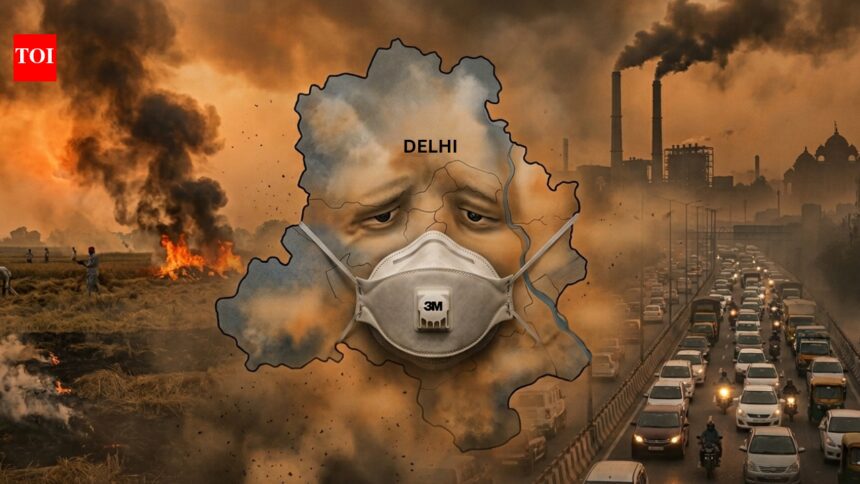

Delhi, the capital of India, is facing a severe air quality crisis, with pollution levels soaring and the Air Quality Index (AQI) reaching 226, categorizing it as “Poor.” The Commission for Air Quality Management (CAQM) has activated Stage-I of the Graded Response Action Plan (GRAP) due to “unfavorable meteorological conditions.” This situation has become a recurring pattern in the city’s fight against air pollution.
Despite implementing various pollution control measures—such as the odd-even vehicle policy, round-the-clock online monitoring, mechanical road sweeping, and strict enforcement of GRAP guidelines—the city struggles to maintain air quality. These measures act largely as emergency responses rather than as long-term solutions. The critical question remains: Is there a sustainable solution to Delhi’s pollution crisis, or are its residents destined to live with perennial poor air quality?
The Geography of a Natural Pollution Trap
Delhi’s geographical positioning plays a significant role in its pollution challenges. Unlike coastal cities like Mumbai or Chennai that benefit from sea breezes, Delhi is situated in the Indo-Gangetic Plain, bordered by the Himalayas to the north. This topography inhibits the free movement of air masses, particularly during winter months. From October to February, low wind speeds combined with a phenomenon known as “temperature inversion” create conditions that trap pollutants close to the surface.
Understanding Thermal Inversion
Temperature inversion occurs when the normal decrease of air temperature with altitude reverses. In this phenomenon, cold, dense air settles near the ground, while warmer air sits above, creating a “lid” that traps pollutants. This scenario is critical for understanding why pollution spikes during winters, as emissions from various sources accumulate rather than disperse. Research by the Council on Energy, Environment and Water (CEEW) indicates that these stable atmospheric conditions are primarily responsible for the pronounced winter pollution spikes in the capital.
The Source Puzzle: What is Polluting Delhi’s Air?
The public often attributes Delhi’s pollution primarily to stubble burning, especially during October and November. While this factor contributes to air quality issues, scientific assessments reveal that pollution results from multiple overlapping sources. The CAQM’s Unified Emissions Inventory and Source Apportionment Study (2023–2024) consolidates insights from various research institutions like IIT Kanpur and TERI.
Key contributors include:
- Secondary Particulates: Formed by chemical reactions between gases like nitrogen oxides (NOx), sulfur dioxide (SO₂), and ammonia (NH₃), these particles pose health risks as they can penetrate the bloodstream through the lungs.
- Vehicular Emissions: Vehicles, particularly diesel ones, are leading contributors to pollution, emitting high levels of NOx and particulate matter. Older vehicles are disproportionately responsible for this contribution.
- Stubble Burning: While often highlighted in media, stubble burning’s impact is intensified under thermal inversion conditions. Other forms of combustion, including domestic solid fuel use and waste burning, also play roles.
- Dust: Frequently overlooked, dust from vehicular movement, construction activities, and bare soil significantly contributes to pollution levels. According to the Central Pollution Control Board (CPCB), dust can reduce into smaller particles that remain suspended in dry conditions.
- Other Sources: Additional pollution sources encompass waste burning, emissions from diesel generators, cremation activities, and airport operations.
The GRAP Conundrum: Mitigation vs. Solution
The Graded Response Action Plan serves as Delhi’s emergency response protocol, triggered by various AQI categories and encompassing measures such as construction halts and vehicle restrictions. However, GRAP has faced criticism for its reactive nature. A 2025 policy assessment by CEEW highlights three main shortcomings: delayed activation of measures, temporary relief that leads to rebound pollution, and significant economic disruption for daily wage earners.
In essence, GRAP treats symptoms rather than addressing the underlying pollution causes. Unless baseline pollution levels are consistently reduced, the city will remain vulnerable to air quality crises during adverse weather events.
The Path Forward: Beyond Emergency Measures
Long-term solutions necessitate a year-round reduction in emissions. Scientific and policy frameworks propose a multifaceted approach:
-
Transition to Clean Transport: Expanding electric vehicle use and enhancing public transport, while phasing out old diesel vehicles, can reduce the transport sector’s 23% contribution to pollution.
-
Industrial Decarbonization: Transitioning to cleaner fuels and enforcing stricter emissions standards for various industries is essential.
-
Dust Control: Implementing mechanized road sweeping and stringent dust suppression measures at construction sites is crucial, particularly since dust accounts for up to 27% of PM2.5 levels in summer.
-
Addressing Secondary Particulates: Reducing NOx and SO₂ emissions through stricter fuel standards and agricultural reforms is vital for controlling these harmful particulates.
-
Regional Coordination: Addressing pollution in Delhi requires cooperation with neighboring states. Coordinated crop management and shared enforcement mechanisms are essential for tackling pollution as a unified regional issue.
Can Delhi’s Air Actually Improve?
There is evidence that improvement is feasible. During the COVID-19 lockdowns of 2020, the city saw significant drops in pollution levels, illustrating that human actions largely drive pollution and that immediate improvements can be achieved. However, the challenge lies in sustainably balancing economic growth and urban development with environmental responsibilities.
The CAQM report (2023-2024) highlights that while average PM2.5 levels have decreased since 2016, progress has plateaued since 2019, signaling that existing policies may be reaching their limitations. Thus, structural reforms are necessary to achieve meaningful improvements.
From Crisis Management to Structural Change
Delhi’s pollution crisis is not merely a natural occurrence but the result of various factors, including geographical limitations, meteorological conditions, and ineffective policies. The city’s current focus on managing peak pollution events must shift to reducing overall emissions across all sectors. Without a systemic change in approach—from reactive measures to sustained structural reform—initiatives like GRAP will remain temporary fixes to a larger, persistent problem. The question is whether Delhi is prepared to commit to the extensive changes required for clean air.