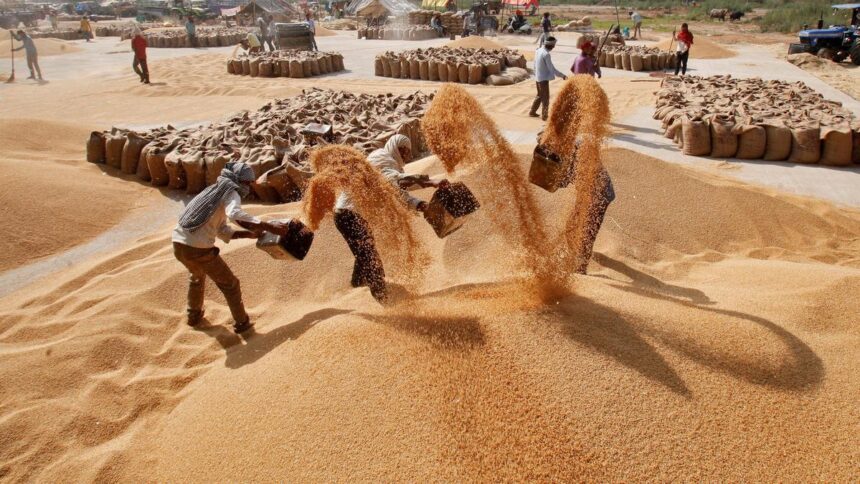

The government expressed “cautious optimism” regarding wheat production for the 2025-26 season, stating that output remains stable and resilient due to increased acreage, improved farming practices, and better seed varieties, despite localized weather-related challenges.
In a statement addressing media reports about the wheat production outlook, the Ministry of Agriculture clarified that the current season is characterized as mixed but resilient, influenced by climatic adversities paired with strong adaptive measures taken by farmers.
According to the government’s second advance estimate, wheat output is projected at 120.21 million tonnes for 2025-26, up from 117.95 million tonnes in 2024-25. This estimate was made prior to weather disruptions, including unseasonal rains and hailstorms in March and April that affected crops. Stakeholders are anticipating further updates from the government, especially in light of decreased procurement levels in key states like Madhya Pradesh, Uttar Pradesh, and Rajasthan.
The Roller Flour Millers Federation of India (RFMFI) released its third “Annual Wheat Survey Report 2026” on April 24, prepared by Agriwatch, estimating production at 110.65 million tonnes, an increase from 109.63 million tonnes in the previous year. Agriwatch’s Nalin Rawal noted that production could have reached 115.7 million tonnes, but crop damage resulted in a reduction of over 5 million tonnes from the initial assessment.
The Agriculture Ministry reported that wheat was sown over 33.46 million hectares, up from 32.80 million hectares previously, with no significant pest and disease issues reported during the season. The early and timely sowing of wheat contributed to this increase. The ministry indicated that the additional 0.6 million hectares planted during the 2025-26 season may help mitigate localized losses, although this admits to higher damage from crop issues than anticipated gains from expanded area.
The government acknowledged that unusually high temperatures in February caused heat stress, which adversely impacted grain filling duration and yield. Furthermore, the ministry highlighted that untimely rainfall and hailstorms near maturity may have led to localized damage in grain quality and yield, yet it maintained a cautiously optimistic overall production outlook due to several compensatory factors.
The ministry noted low weed infestation and the benefits of timely sowing, which allowed the crop to avoid terminal heat during grain filling. The report emphasized the increased varietal replacement rate (VRR), facilitating the adoption of high-yielding, climate-resilient varieties that are better suited to withstand heat and pest pressures.
In a related statement, RFMFI President Navneet Chitlangia urged that the industry seeks not protection but rather policy stability and discussions aimed at ensuring fair farmer prices, viability, and affordable consumer food. He called on the government to share regular cumulative national wheat stock data to enable informed decisions and mitigate market distortions. Additionally, he requested clearer information on Open Market Sale Scheme (OMSS) pricing, quantities, and schedules to avoid ad-hoc market releases. Chitlangia also proposed extending open export licenses for all wheat products without port or buyer restrictions and prioritizing support for value-added wheat products over raw grain.
As of April 23, wheat procurement was recorded at 164.32 lakh tonnes, a decline from 183.49 lakh tonnes the previous year, with total arrivals down 19% to 203.13 lakh tonnes. In Punjab, procurement reached 75.73 lakh tonnes, compared to 59.20 lakh tonnes last year; in Haryana, it was 65.16 lakh tonnes against 56.64 lakh tonnes; in Madhya Pradesh, 13.19 lakh tonnes versus 54.09 lakh tonnes; in Uttar Pradesh, 4.08 lakh tonnes compared to 5.51 lakh tonnes; in Rajasthan, 5.7 lakh tonnes down from 7.84 lakh tonnes; and in Bihar, 17,281 tonnes against 9,991 tonnes.
Despite a minimum support price of Rs 2,585 per quintal for the 2025-26 crop year (July-June), the average mandi price of wheat on April 24 was Rs 2,572 per quintal, as reported by the Agmarknet portal. In major wheat-producing states, average farmgate prices as of April 22 were reported at Rs 2,498 per quintal in Uttar Pradesh, Rs 2,402 in Madhya Pradesh, Rs 2,421 in Gujarat, and Rs 2,484 in Rajasthan. However, farmers in Haryana and Punjab were able to receive the minimum support price due to robust public procurement supported by strong mandi infrastructure.
Published on April 26, 2026.