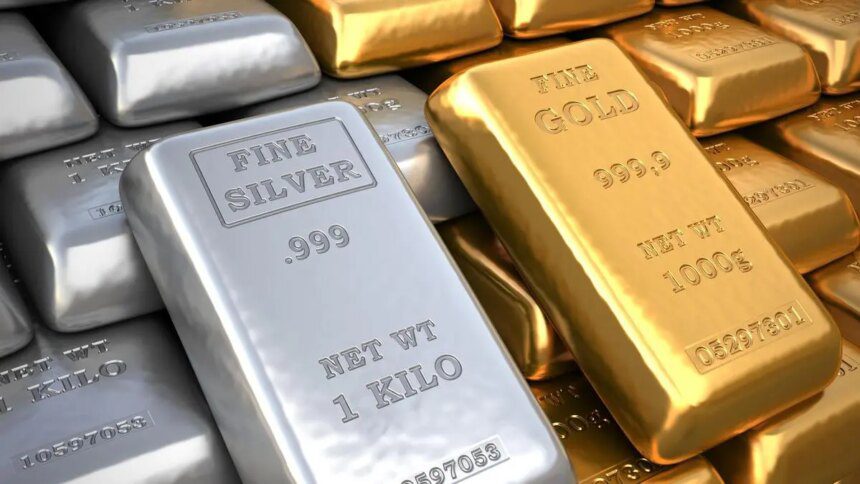

Gold and silver may experience selling pressure in the upcoming holiday-shortened week as traders monitor ongoing peace talks between the US and Iran, fluctuations in crude oil prices, and the Federal Reserve’s policy decisions, analysts indicate.
Domestic commodity markets will be closed on Friday in observance of Maharashtra Day.
“The focus in the coming week will be on the progress of peace talks between the US and Iran, and their potential impacts on oil, gold, and broader financial markets,” said Pranav Mer, Vice President of EBG – Commodity & Currency Research at JM Financial Services Ltd.
From a macroeconomic perspective, traders will keep an eye on monetary policy decisions from the US Federal Reserve, the Bank of Japan, the Bank of England, and the European Central Bank. Additionally, important US data regarding housing, Personal Consumption Expenditures (PCE) inflation, consumer confidence, and factory activity figures from major economies later in the week will also influence market sentiment.
Analysts noted that the Federal Open Market Committee (FOMC) meeting scheduled for April 29 will be the last chaired by Jerome Powell, making both the policy statement and the post-meeting press conference crucial for precious metal prices.
On the Multi Commodity Exchange, gold futures fell by Rs 1,910, or 1.23%, ending the week at Rs 1.54 lakh per 10 grams, while silver dropped Rs 12,506, or 4.9%, to settle at Rs 2.44 lakh per kilogram.
Analysts remarked that gold’s losses in the domestic market were somewhat mitigated by a weaker rupee, which fell approximately 1.4% over the past week.
In international markets, Comex gold declined by USD 138.7, or 2.8%, closing the week at USD 4,740.9 per ounce, while silver dropped USD 5.4, or 6.6%, to USD 76.41 per ounce.
“Gold prices retracted some of their recent gains last week after failing to surpass USD 5,000 per ounce and faced pressure from various factors, including profit-taking after a prior 10-12% increase over the previous four weeks,” Mer explained.
Additionally, the blockade of the Strait of Hormuz by the US-Iran conflict has contributed to crude oil prices rising above USD 100 per barrel.
Mer further noted that demand for the US dollar and Treasury bond yields remained robust. Stronger-than-expected reports on US retail sales, weekly jobless claims, and consumer sentiment have bolstered the dollar, negatively impacting gold and silver values.
He mentioned that activity among global central banks remains mixed, and uncertainty surrounding potential interest rate revisions amid rising commodity-driven inflation may contribute to volatility in bullion prices.
Looking ahead, analysts anticipate gold may find support at lower levels but could remain susceptible to further correction if the dollar remains strong and geopolitical tensions lessen. Silver is expected to be more volatile due to its dual role as both a precious and an industrial metal.
Any escalation in West Asian tensions, particularly regarding the Strait of Hormuz, or dovish signals from leading central banks could rekindle buying interest in these commodities, analysts concluded.
Published on April 26, 2026.