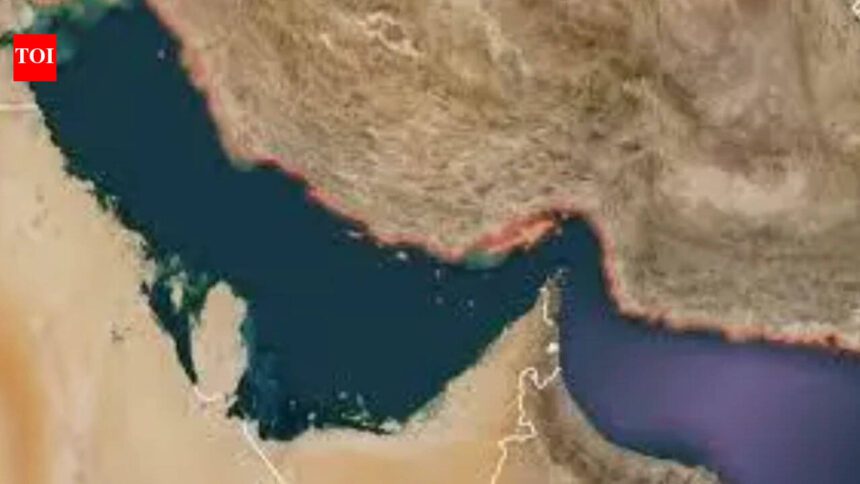

NEW DELHI: In light of the ongoing blockade of the Strait of Hormuz and the subsequent rise in crude oil prices, the Indian Navy has publicly released its maritime security strategy, articulated by Navy Chief Admiral D K Tripathi. This strategy identifies Hormuz as a “primary area” of interest, alongside other pivotal maritime chokepoints.
Maritime chokepoints in the Indian Ocean Region (IOR) are crucial nodes that significantly affect global trade and energy security. Notable chokepoints within the IOR include the Cape of Good Hope, Mozambique Channel, Bab-el-Mandeb, Suez Canal, Strait of Hormuz, as well as the Malacca and Singapore Straits, Sunda Strait, Lombok Strait, Ombai Strait, and Wetar Strait. The Straits of Malacca and Singapore provide essential links from the Indian Ocean to the South China Sea and the Pacific Ocean, facilitating the shortest maritime route from the Persian Gulf to East Asia and the West Pacific regions.
The Sunda Strait serves as an alternative route to Malacca and Singapore, measuring 50 nautical miles (nm) in length and 15 nm wide at its northeastern entry. However, larger vessels typically avoid this passage due to navigational hazards, depth limitations, and strong currents. The Ombai Strait is situated between the islands of Alor and Timor, while the Wetar Strait lies between Timor and Wetar Islands. Because of the distance, using these straits as alternatives to Malacca and Singapore is generally not favored.
As India enhances its economic and strategic engagements across maritime domains, the influence of external factors on its national interests is anticipated to increase. Consequently, the Indian Navy will be required to operate across a broader geographical area. The maritime domain, beyond the primary area of interest, has therefore been classified as a ‘secondary’ area according to the document.
The Indian Navy’s primary areas of maritime concern include India’s coastal regions and maritime zones, the Arabian Sea, Bay of Bengal, Andaman Sea, Laccadives Sea, and their adjacent areas; the Persian Gulf and its littoral regions; the Gulf of Oman, Gulf of Aden, Red Sea, and adjacent areas; the southwestern Indian Ocean, including island nations in the IOR, and the eastern coast of Africa. This includes key chokepoints such as the six-degree channel and the 8/9-degree channels, as well as the Straits of Hormuz, Bab-el-Mandeb, Malacca, Singapore, Sunda, Lombok, Ombai-Wetar, the Mozambique Channel, and the Cape of Good Hope.
Beyond energy considerations, the maritime domain serves as a primary conduit for imports vital to India’s food security, public health, and industrial capacity. In 2025, India met 73% of its fertilizer needs through domestic production, yet remains dependent on imports for muriate of potash (MOP) and heavily reliant on overseas sources for diammonium phosphate (DAP). Annually, approximately 16 million tonnes of edible oil are imported via sea routes, with India’s maritime infrastructure and activities integral to its economic growth and prosperity, the report highlighted.