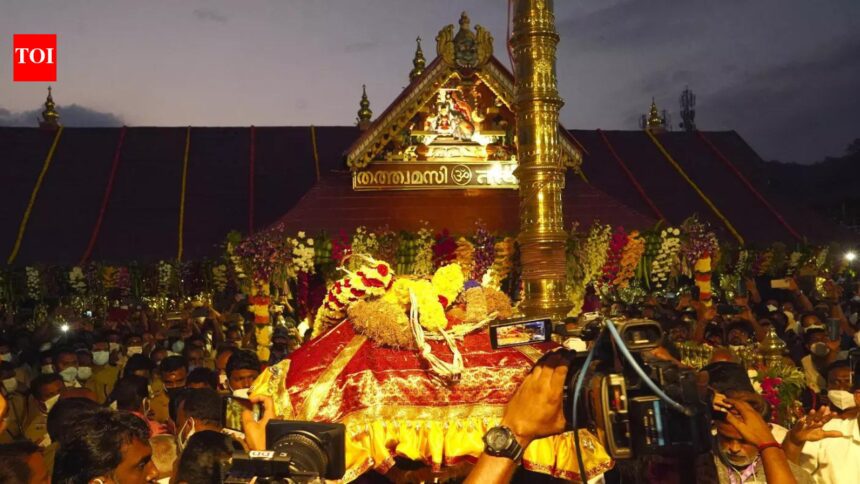

NEW DELHI: Justice B.V. Nagarathna, a member of the Supreme Court bench led by Chief Justice Surya Kant, addressed the contentious issue of ‘fundamental rights versus faith and belief’ in a hearing on Tuesday. She remarked that individuals who do not adhere to a religion or its practices lack the standing to challenge their validity in court.
During the proceedings, senior advocate V. Giri, representing the Sabarimala Ayyappa Thanthri, contended that devotees cannot disregard the customs associated with the concept of ‘Naishtik Brahmachari’ (eternal celibacy) attributed to Lord Ayyappa. Justice Nagarathna stated, “A non-believer has no business to question customs or beliefs associated with a temple and its deity.”
Further deliberating on the implications of distinguishing religious practices from secular activities, Justice Nagarathna questioned why the court should probe whether a given practice constitutes an essential part of a religion. This stance diverged from the 2018 Supreme Court ruling that annulled the prohibition on women aged 10 to 50 from entering the Sabarimala temple, deeming it non-essential to the religious practice.
Senior advocate Gopal Subramanium supported Justice Nagarathna’s viewpoint, asserting that while secular aspects of religious institutions can be subject to judicial review, religious practices enjoy constitutional protection unless they infringe upon public order, morality, or health.
Justice Ahsanuddin Amanullah noted that the court should assess whether a practice is secular or religious on a case-by-case basis. Justice P.B. Varale raised the question about whether advancements in technology and education should allow a community to reform certain religious practices collectively. Justice Joymalya Bagchi also inquired if sacrosanct religious practices should impede discussions within a community aimed at reforming those practices.
In response, Giri emphasized that worshippers approach a temple driven by belief and faith in the deity, asserting that they cannot question the customs associated with the deity worshipped by the community, which is responsible for enacting any changes.
Justice R. Mahadevan commented on the distinction between belief and practice, stating, “Faith is faith. Practice is different, yet it is based on faith.”
Arguing on behalf of a religious association, senior advocate J. Sai Deepak criticized the majority ruling in the Sabarimala case for equating the entry ban on menstruating women with the practice of ‘untouchability.’ He clarified that Article 17 of the Constitution, which abolishes untouchability, only addresses social or caste-based discrimination and does not encompass ritualistic purity.
Deepak further maintained that religious spaces dedicated to specific deity forms that restrict access to particular classes or groups, without reference to caste, should not be considered violations of Article 17.