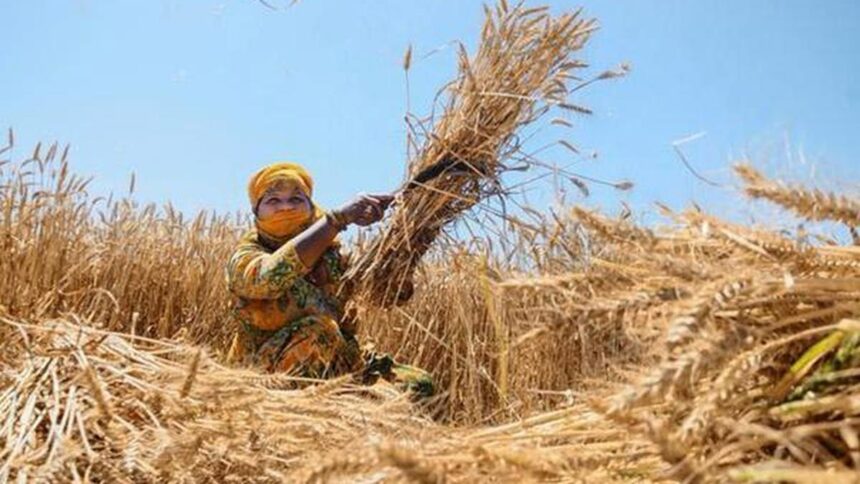

With approved relaxations in the quality of wheat for procurement from Punjab, the Indian government’s wheat procurement process is expected to gain additional momentum, even as overall purchases to date are nearly 40 percent lower compared to the previous year. Similar relaxations implemented earlier for Haryana have already shown positive impacts in that state.
As of April 16, total wheat procurement has reached 51.34 lakh tonnes (lt) since the procurement season began on April 1, compared to 83.57 lt during the same period last year. Recent data indicates that procurement in Punjab has increased to 5.94 lt from 5.27 lt year-on-year, while Haryana has reported a rise to 37.74 lt from 29.89 lt last year. Daily procurement for April 16 was also higher, recording 3.48 lt in Punjab compared to 2.66 lt last year, and 8.91 lt in Haryana against 6.36 lt from the previous year.
In contrast, wheat purchases in Madhya Pradesh remain notably low at 3.43 lt, down from 40.08 lt, primarily due to a delayed start to the procurement season despite the Centre’s earlier approval for purchases to begin on March 15 instead of the usual April 1. The Madhya Pradesh government is offering an additional bonus above the Minimum Support Price (MSP) of Rs 2,585 per quintal to encourage procurement in the state.
Purchases in Uttar Pradesh have been reported at 1.62 lt, down from 3.42 lt last year, while Rajasthan has noted procurement of 2.52 lt, decreasing from 4.80 lt year-on-year.
In announcing the relaxations for Punjab, Union Food Minister Pralhad Joshi emphasized that the decision aims to alleviate hardships for farmers and prevent distress sales of wheat. The relaxations will take effect for the upcoming rabi marketing season (RMS) of 2026-27. The request for these relaxations arose due to untimely rainfall, leading to an assessment by teams dispatched to various districts.
Following revisions, the acceptable limit for ‘luster loss’ in wheat has been set at 70 percent across Punjab and Chandigarh. The limits for shriveled and broken grains have also been adjusted from 6 percent to 15 percent, while the combined cap for damaged and slightly damaged grains remains at 6 percent.
State agencies have been instructed to separately store and account for wheat procured under these relaxed specifications. Responsibility for any deterioration in stock quality during storage will fall on the respective state governments.
Unseasonal rains in March and April have contributed to increased moisture content in the wheat grains, affecting their quality and the procurement process due to shrinkage and luster loss.
Unchanged FAQ norms stipulate that wheat with moisture content exceeding 12 percent and up to 14 percent will be discounted at full value, while stocks containing over 14 percent moisture will be rejected. Within the overall limit for foreign matter (0.75 percent), poisonous weed seeds cannot exceed 0.4 percent, with specific limits for Dhatura and Akra (Vicia species).
Similar relaxations in procurement quality have also been applied in Rajasthan and Haryana, albeit with specific differences compared to Punjab.
Published on April 17, 2026