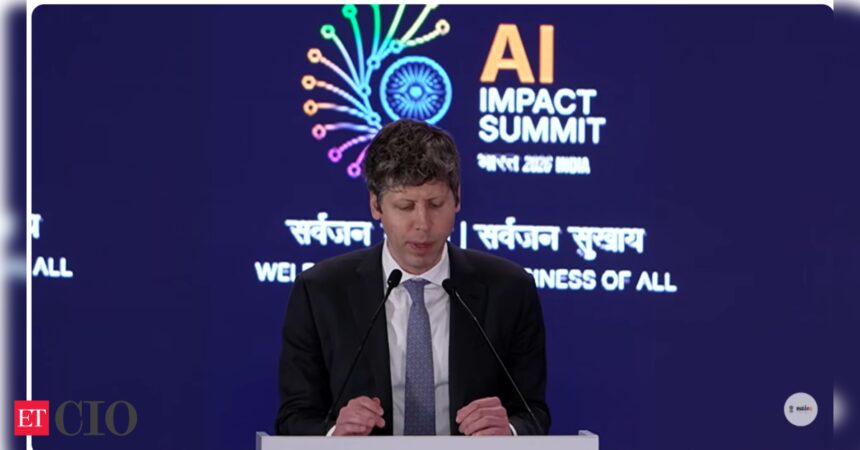

Speaking at the IndiaAI Summit, Sam Altman, CEO of OpenAI, put the spotlight on super intelligence. “On our current trajectory we are only a couple of years away from early versions of true super intelligence,” he said.
Artificial Superintelligence (ASI) is a hypothetical form of artificial intelligence that would surpass human intelligence in every domain, not just specific tasks. The term first articulated in 1965 by I.J. Good, ASI is often termed as the most advanced frontier of AI – others include rule-based AI, machine learning AI, deep learning AI, and generative AI.
If the predictions hold, “by the end of 2028, more of the world’s intellectual capacity could reside inside of datacenters than outside,” Altman said. Such systems, he added, could eventually perform roles traditionally reserved for humans at the highest levels. A sufficiently mature superintelligence, he said, could function as a CEO or conduct research at a level surpassing top scientists.
described the current moment in artificial intelligence as both historic and uncertain, praising India’s leadership in sovereign AI while outlining a future he believes could arrive far sooner than most expect.A democracy positioned to shape AI’s future
Altman took to the stage at the summit within a year of his last visit to India. A few years ago, his visit was characterised by his statement on India’s ability to compete [or lack thereof] on training the foundational models.
He opened his keynote by calling it “a treat” to witness the country’s momentum firsthand, noting that in just a year the pace of progress has been striking. He pointed to India’s emergence as a leader in sovereign AI initiatives and said it has been “great to watch” how quickly national-level ambition around the technology has taken shape.
He also highlighted user adoption trends, stating that more than 100 million people use ChatGPT every week. “India is also now the fastest-growing market for Codex, the company’s coding agent designed to help people develop software faster and better,” he said.Altman argued that the world’s largest democracy is uniquely positioned not only to build artificial intelligence but to influence how it evolves. In his view, leadership in AI will not simply be about technological capability; it will be about deciding what kind of future societies want.
Democracy versus concentration of power
Despite those projections, Altman stressed that how AI is distributed may matter more than how powerful it becomes. The democratization of AI, he argued, is the best path to ensuring humanity flourishes. By contrast, concentrating such capability in a single country or company could lead to harmful outcomes.
He framed AI as a tool that should extend individual human will rather than replace it. But enabling broad access, he acknowledged, requires new governance mechanisms —possibly designed with the assistance of advanced AI itself— to ensure fairness at scale and prevent imbalances such as unequal access to computing power.
Safety, he emphasized, must also be approached collectively. Resilience alone is not enough; dedicated safety systems will be required. No single AI lab or system, he said, can guarantee a positive future independently. He pointed to the possibility of extremely capable biological models or open-source systems that could create pathogens, arguing that defending against such risks will require a society-wide response.
Uncertainty as a defining feature
Altman repeatedly returned to uncertainty as a central theme. The future of AI, he said, is unlikely to unfold exactly as anyone predicts. Because of that unpredictability, he believes as many people as possible should have a stake in shaping outcomes.
He noted that many of the most important discoveries in history have occurred where technology and society meet—often with friction before co-evolution. With systems this powerful, he said, it is natural for people to demand clear answers, but humility is essential because even expert forecasts can be wrong.
He pointed to unanswered geopolitical questions as examples: how superintelligence might interact with authoritarian regimes, whether nations could use AI to wage new kinds of conflicts, and what new forms of social contracts might be required. These are issues, he said, that require deeper debate and understanding before the world is confronted with them unexpectedly.
Iteration, disruption, and growth
One strategic principle Altman emphasized was iterative deployment. Society, he argued, must experience each successive level of AI capability, integrate it, and decide collectively how to proceed before moving further. Gradual exposure, in his view, is essential for adaptation.
If progress continues at its current pace, he predicted sweeping economic effects. “Many goods and services could become cheaper while economic growth accelerates,” Altman said. Access to high-quality healthcare and education, he suggested, could expand dramatically, with government policy potentially becoming the main limiting factor on how far cost reductions go.
At the same time, he acknowledged that existing jobs will be disrupted as AI systems take on more tasks. Historically, he noted, technological change has always displaced some roles but ultimately created new and better ones.
Empower
people or concentrate power
Altman closed on a historical note, reflecting on how each generation builds on the tools of the previous one. The technological “scaffolding,” he said, keeps getting taller. People today can accomplish things their great-grandparents could never have imagined, and future generations may say the same about the tools being created now—especially artificial intelligence.
For that promise to be realized, he argued, people must be given agency. Sharing control inevitably means accepting that some things can go wrong, but he framed that as a fundamental trade-off of democracy: collective influence over the future.
That does not eliminate the need for regulation or safeguards, he added. Those are urgently required. “The next few years will test global society as tech continues to improve at a rapid pace. We can choose to empower people or concentrate power,” he concluded.