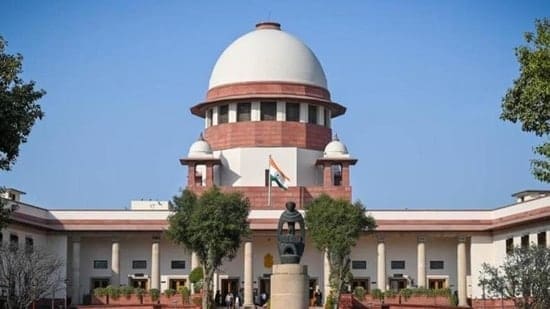

A three-member bench of the Supreme Court of India, led by Chief Justice of India Surya Kant, on Monday stayed its own November 20 order that had accepted a 100-metre height-based definition for the Aravalli range.
The court also decided to constitute a new expert committee comprising domain specialists to resolve key ambiguities surrounding the definition.
“We deem it necessary that the (old) committee’s recommendations and the directions of this court be kept in abeyance. The stay shall remain in effect till the constitution of the new committee,” the CJI said, while issuing notice in the suo motu case, returnable on January 21.
This comes after the Supreme Court of India has taken suo motu cognisance of issues concerning the definition of the Aravalli hills.
The Court said that before any implementation, a fair, impartial and independent expert assessment must be undertaken to provide definitive guidance. It observed that the existing definition of the Aravalli Hills and Ranges needed closer scrutiny to determine whether it had created a structural paradox—one that potentially expanded the scope of non-Aravalli areas and thereby enabled the continuation of unregulated mining, according to Live Law.
The Bench flagged several specific concerns for examination, including whether regulated mining would be permitted in the 500-metre gaps between hills, and if so, what precise structural parameters would be applied to ensure that ecological continuity remained intact.
The Court also said it was necessary to verify whether the claim that only 1,048 out of 12,081 hills meet the 100-metre elevation threshold was factually and scientifically accurate, and whether a detailed geological enquiry was required to settle the issue.
On November 20, the Supreme Court had accepted the recommendations of a panel constituted by the Ministry of Environment, Forest and Climate Change (MoEFCC), which defined the Aravalli Hills as any landform rising 100 metres or more above the local relief, along with its slopes and adjoining land.
Under this definition, an “Aravalli range” would consist of two or more such hills within 500 metres of each other, including the land between them.
This move was controversial, as it overruled objections raised earlier by the court’s own expert panel.
Environmentalists and opposition leaders argued that the height-based criterion could exclude over 90 percent of the Aravalli ecosystem, particularly lower hillocks, ridges, and scrub forests, from legal protection, potentially opening them up to mining and real estate activity.
Union Minister for Environment, Forest and Climate Change Bhupender Yadav welcomed the court’s directions.
“I welcome the Supreme Court’s decision to stay its earlier order on the Aravalli range and to constitute a new committee to study the issues. We remain fully committed to extending all assistance from the MoEFCC for the protection and restoration of the Aravalli range,” he said.
The minister emphasised that, as things stand, a complete ban on new mining leases and renewals of old leases continues to remain in force.
Senior advocate Prashant Bhushan described the move as positive, though procedurally unusual.
“Though this appears to be a suo motu review of its own recent judgment by the previous CJI-led bench, which is procedurally irregular, it is nevertheless a welcome step in the right direction,” he said.
Congress general secretary (communications) Jairam Ramesh said the court’s intervention offered temporary relief but warned that the larger battle remained.
“The Indian National Congress welcomes the Supreme Court’s directives on the redefinition of the Aravallis being pushed by the Modi government. The issue now requires deeper study. This redefinition had already been opposed by the Forest Survey of India, the Central Empowered Committee of the Supreme Court, and even the amicus curiae,” Ramesh said.
He noted that while the stay provided “a flicker of hope,” sustained resistance was needed to prevent the Aravallis from being opened up to mining, real estate, and other activities, and called for the resignation of the Union environment minister.
Former Rajasthan Chief Minister Ashok Gehlot also welcomed the decision, calling it vital for present and future generations.
“This is a question of our future. Delhi is already a gas chamber. If the Aravalli range disappears, how many more gas chambers will be created across the country?” Gehlot said, urging the government to heed expert opinion and avoid hasty decisions.
Environmentalists, activists, local communities, and opposition parties have consistently argued that the 100-metre height criterion undermines ecological protection by excluding vast stretches of the Aravalli landscape that play a crucial role in groundwater recharge, climate regulation, and air quality, particularly in north India.
The post SC stays its own order on Aravalli definition, to form new expert panel appeared first on Maktoob media.