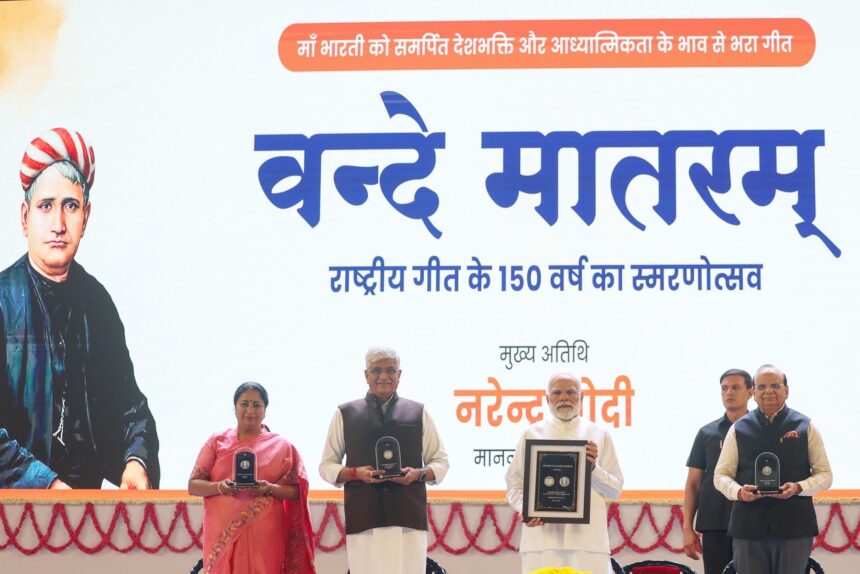
The recent debate concerning the mandatory recitation of “Vande Mataram” has drawn significant attention to various Muslim organizations, particularly those opposing the compulsory chanting on theological and constitutional grounds. Groups such as Jamiat Ulama-Hind, Jamaat-e-Islami Hind, and certain clerical organizations in Jammu and Kashmir have publicly expressed their dissent. Their position has been consistent: they do not object to individuals singing the song voluntarily, but they are against any state-enforced obligation, especially since some verses depict the nation as a goddess, which contradicts Islamic monotheism.
Despite their doctrinally founded reasoning, Muslim organizations have struggled to be perceived as credible moral agents in public discourse. Media narratives and political commentary often characterize their stances as indications of “separatism” or a lack of patriotism, framing Muslim dissent as a threat to national unity rather than recognizing it as a legitimate expression of freedom of conscience. This oversimplification transforms the discussion into a binary opposition between nationalism and communalism, depicting Muslim groups as political entities seeking confrontation rather than as communities asserting ethical positions.
This framing reflects a form of testimonial injustice, wherein the credibility of Muslim organizations is undermined due to prejudicial stereotypes associated with their identity. Their concerns are frequently interpreted through a majoritarian lens of patriotism rather than being addressed based on their theological arguments. For instance, when Jamiat Ulama-i-Hind argued that the compulsion to chant the song infringes upon both Islamic faith and constitutional rights, multiple media outlets responded by questioning why “only Muslims” oppose a national song, subtly implying ulterior motives rather than acknowledging their argument as a concern of conscience. This credibility deficit leads to a dismissal of their testimony, not due to the content of their claims but rather because of their identity.
This dominant narrative, in tandem with testimonial injustice, creates hermeneutical injustice. A majoritarian cultural perspective shapes the public understanding of patriotism, where national symbols are assumed to be neutral despite their religious implications. In this interpretive framework, objections grounded in monotheistic beliefs are often deemed illogical or incomprehensible. The majority’s reluctance to acknowledge the religious connotations of “Vande Mataram” results in a hermeneutical gap, where Muslim experiences and arguments diverge from the prevailing understanding of patriotism. Claims from Muslim organizations that portraying the country as a deity conflicts with Islamic theology are regarded as mere political statements, stripping them of their ethical substance. The public sphere lacks the intellectual tools to comprehend disagreements that are both patriotic and principled, devout and democratic. Consequently, Muslims face the dilemma of conforming to majoritarian standards or risking the perception of being anti-national.
This dynamic significantly impacts Muslim citizenship. When dissent is misinterpreted as disloyalty and moral convictions are equated with communalism, Muslims struggle to express their identity within the broader national context. They are compelled to conform to majoritarian epistemic standards to engage in public discourse. This misrecognition leads to a silence not enforced by legal means, but perpetuated through mechanisms like misinterpretation, delegitimization, and ongoing scrutiny of motives. Rather than being seen as individuals able to define their own loyalties to the nation, these processes reduce them to subjects of inquiry.
The opposition from Muslim organizations to the mandatory chanting of “Vande Mataram” exemplifies how epistemic injustice affects minority experiences in contemporary India. Their voices may be heard, but they are not recognized; their reasoning is overlooked. The issue at stake extends beyond a song—it concerns the conditions under which a minority community can articulate its presence, protest, and feel entitled to belonging within the nation.
Abrar Nazir is currently pursuing a PhD in political science at Thapar School of Liberal Arts and Sciences, TIET.
This article originally appeared on Maktoob Media.
Tags: Vande Mataram, Muslim citizenship, and epistemic injustice in contemporary India Extract 5 SEO-friendly keywords as tags. Output only keywords, comma separated.
Hashtags: #Vande #Mataram #Muslim #citizenship #epistemic #injustice #contemporary #India