On Monday, the Lok Sabha passed the Viksit Bharat – Guarantee for Rozgar and Ajeevika Mission (Gramin) Bill, 2025, which seeks to replace the Mahatma Gandhi National Rural Employment Guarantee Act (MGNREGA). The move sparked strong protests from Opposition members, who called for the legislation to be referred to a parliamentary standing committee.
As the Bill was introduced for passage, Opposition MPs marched into the Well of the House, shouted slogans, and tore papers after Speaker Om Birla stated that the proposed law had already undergone extensive discussion. The Speaker responded by admonishing the protesting members, reminding them, “The people have not sent you here to tear paper. The nation is watching you.” The Bill is now slated for discussion in the Rajya Sabha.
Key Opposition figures, including Congress MP Priyanka Gandhi Vadra, DMK’s TR Baalu, and Samajwadi Party’s Dharmendra Yadav, voiced their opposition to the legislation. They criticized the removal of Mahatma Gandhi’s name, describing it as an affront to the Father of the Nation and warning that the Bill would impose a heavier financial burden on state governments.
After the House adjourned, Priyanka Gandhi Vadra stated that the legislation threatens the foundational aspects of the rural employment guarantee scheme. “Anyone who reads the Bill will understand how the rural employment guarantee scheme is about to be dismantled. This law increases the funding burden on states that are already cash-strapped. MGNREGA is a lifeline for the poorest of the poor, and this Bill is anti-poor,” she remarked to reporters.
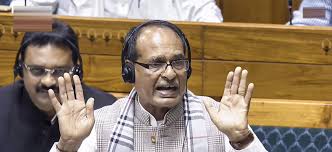
Union Agriculture Minister Shivraj Singh Chouhan defended the Bill, accusing the Congress of politicizing the issue. He stated that previous governments were overly focused on naming laws after leaders and questioned the NDA’s intent. Chouhan contended that MGNREGA had devolved into a “tool of corruption” and emphasized that the new legislation was drafted following consultations with relevant stakeholders.
Despite repeated calls for calm from the Treasury benches, Opposition members sustained their protests until proceedings were adjourned. The government asserted that the new law would establish a statutory framework in accordance with the vision of Viksit Bharat 2047, whereas the Opposition claims it dismantles a rights-based employment guarantee, undermining federal financial responsibilities.
Senior Congress leader Sonia Gandhi later joined the protesting MPs at Makar Dwar. Following the demonstration, Congress President Mallikarjun Kharge criticized the Modi administration for disrespecting Mahatma Gandhi and infringing upon the right to work. “The government has not only insulted the Father of the Nation, Mahatma Gandhi, but has also crushed the right to work that brought socio-economic transformation to India’s villages,” he expressed in a post on social media.
Kharge vowed to resist what he termed a “dictatorial move,” stating, “We will fight this both inside Parliament and on the streets.” Congress leader K. C. Venugopal described the passing of the Bill as an assault on democratic values. “Today, Parliament is witnessing the murder of democracy. By removing Mahatma Gandhi’s name from NREGA, the government is seeking to erase the ideology and values of the Father of the Nation,” he stated.
The proposed law stipulates a statutory guarantee of 125 days of wage employment in a financial year for every rural household whose adults opt for unskilled manual work. It also mandates that states create schemes aligned with the new Act within six months of its commencement.
The Bill proposes significant structural and financial changes. Unlike MGNREGA, which places the wage burden entirely on the Union government while states share only material and administrative costs, the new framework would require states to cover 40% of total expenses. Additionally, allocations would be determined annually by the Centre based on “objective parameters.”
A further major alteration is that only the Union government would have the authority to identify rural areas for the scheme, thereby minimizing the role of state governments in its execution. The draft retains the provision for an unemployment allowance if work is not provided within 15 days of an application, although the entire cost of this allowance would now fall to the states.
On Monday, NREGA Sangharsh, a collective of MGNREGA workers, urged that any amendments to the law be undertaken only after public disclosure and dialogue with workers, trade unions, labor organizations, and state governments. They alleged the Bill was introduced without prior public consultation and was not included in the government’s Tentative Legislative Agenda for the current session.
Tags: Lok Sabha passes VB-G RAM G Bill amid Opposition protests, demands for panel scrutiny Extract 5 SEO-friendly keywords as tags. Output only keywords, comma separated.
Hashtags: #Lok #Sabha #passesVBG #RAM #Bill #Opposition #protests #demands #panel #scrutiny