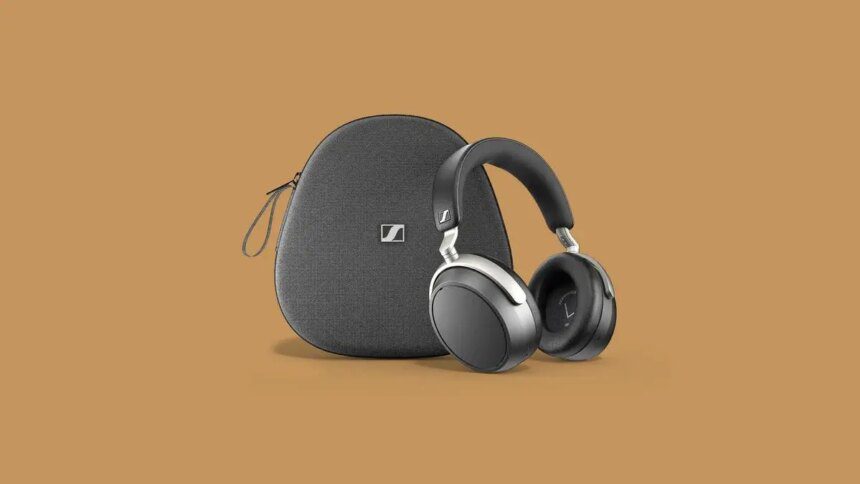

Sennheiser has spent 80 years shaping what premium personal audio sounds like, and its Momentum 4 80th Anniversary Edition was a reminder of that legacy. Now, the German audio brand is taking a more ambitious swing with the HDB 630 — a wireless headphone positioned squarely at listeners who expect studio-grade clarity without giving up everyday convenience. The question is whether this new flagship can deliver a truly audiophile-ready experience while fending off heavyweights such as Sony, Bose and Apple. After weeks of testing, it’s clear Sennheiser isn’t just playing catch-up — it’s raising the bar.
Design
The HDB 630 feels premium – the earcups are made of solid, high-quality plastic with faux leather on the headband and around the cushions. The fit is balanced, and the headband doesn’t cause discomfort even during long listening sessions. The ease and comfort while wearing it is consistent, and there’s no heat or sweat buildup near the earmuffs, even in tropical Chennai.
The plastic housings on the left and right earcups integrate touch controls for playback, volume adjustment and track navigation. In everyday use, the gestures felt precise and responsive, with no lag or mismatch between touch input and actions such as pausing or skipping tracks.
The bundle includes a hardshell case, USB-C charging cable, 3.5mm audio cable, a handy airline adapter and the HDBT 700 Bluetooth USB-C dongle, which enables higher-quality wireless playback.
Sound quality
The Sennheiser HDB 630 definitely gets the sound profile right – neutral and balanced, unlike the bass-heavy signature of premium headphones such as the Sony WH-1000XM5/XM6. The BTD 700 Bluetooth USB-C dongle unlocks a whole new possibility of advanced audio codec support, such as aptX HD and aptX Adaptive, in addition to the standard SBC and AAC codecs available over regular Bluetooth. This translates to overall better wireless audio quality, as well as low latency during gameplay. Noise cancellation was on point, a tad bit more refined than the adaptive noise cancellation on the Momentum 4.
Listening to Battle Symphony by Linkin Park, Chester Bennington’s soaring vocals sit cleanly above Mike Shinoda’s backing harmonies, with the synths, synth-bass and electronic pop elements neatly layered. The headphones maintain clear separation between vocals and instrumentation, giving the track welcome definition. Even with EDM tracks, the headphones keep the soundstage neutral, with enough depth to preserve a mix that stays close to the mastered version. This makes them a surprisingly capable reference option for occasional professional monitoring or mastering work.
The Parametric equaliser allows for more granular control of equaliser settings on the Smart Control Plus App, while the cross-feed feature is great for classic tracks with hard-panned mixes. It takes instruments concentrated on one channel and balances them out, creating a much more natural listening experience — as if I were listening to the track on a full-blown stereo system.
Together, these features add a welcome layer of customisability and polish that goes beyond what the Momentum 4 offered — enough to tempt even a budget-conscious audiophile like me.
Performance
The HDB 630, paired with the BTD 700 Bluetooth USB-C dongle, made streaming high-resolution audio genuinely worthwhile — all while keeping the setup fully wireless during testing. It also holds up well for gaming, with low-latency audio making a real difference in fast-paced moments, sometimes determining whether I was taken out or managed to land a shot in CS2.
The only drawback is practicality. I found myself forgetting the dongle plugged into different devices, which made it easy to misplace. A small lanyard loop or visual marker would help prevent that.
For the cleanest signal, the headphones also support USB-C and analogue wired input, with playback up to 24-bit/96 kHz. I ended up using the USB-C audio more often than expected, alongside the standard 3.5mm cable.
Call quality is solid. Talking to people on regular phone calls and Microsoft Teams was clear , and the mic system filtered background noise well enough to keep speech clean in most situations.
The app feels polished, and changes apply almost instantly from adjusting the graphic EQ, the parametric EQ to enabling bass boost, using crossfeed, managing multipoint pairing, controlling ANC modes and on or off controls | Photo Credit: Bijoy Ghosh
App features
Most features of the headphones can be controlled through the Smart Control Plus app. You can adjust the graphic EQ, fine-tune the parametric EQ, enable bass boost, use cross feed, manage multipoint pairing, control ANC modes and turn touch controls on or off. The app feels polished, and changes apply almost instantly.
Battery life
By far, the HDB 630 carries forward the Momentum 4’s legacy of 60-hour battery life per charge, running across an average 56 hours plus spread over 6 days before hitting 20 per cent.
Given the fact that this is a premium headphone, it has a quick-charge capability, delivering 7 hours of listening with just a 10-minute top-up does suffice for some extended playback during the day. The added advantage is that the USB-C can be used for charging as well as playing audio.
Verdict
The Sennheiser HDB 630 builds on the success of the Momentum 4, improving sound quality, customisation and connectivity, taking the wireless audiophile experience up a notch.
Despite competition from the likes of Apple AirPods Max, Bose QC Ultra, and Sony WH-1000XM6, the Sennheiser HDB 630 stands out by offering better tuning flexibility, a wider soundstage and multiple connection options — including USB-C audio, standard Bluetooth and the bundled BTD 700 low-latency dongle.
With stronger EQ control and improved noise cancellation over the XM5/XM6 range, it positions itself as one of the most capable wireless audiophile headphones available today.
Sennheiser HDB 630
Price – ₹54,990
Pros – Build quality, best in-class sound quality, multiple input options, battery life, deep customisation.
Cons – Expensive, dongle is easy to misplace.
Published on December 10, 2025