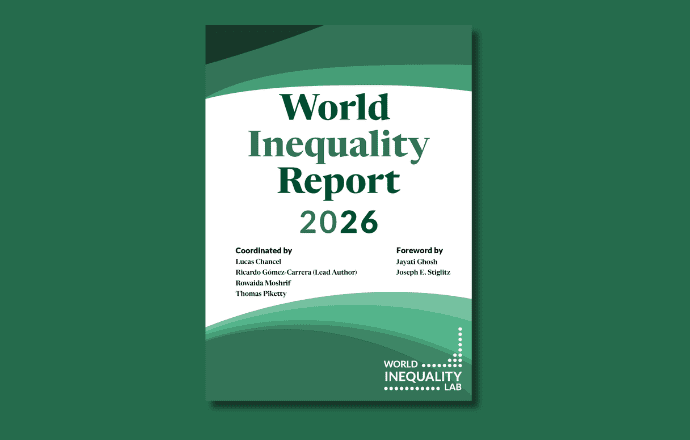

Fewer than 60,000 people, just 0.001% of the global population, now control three times more wealth than the poorest half of humanity, according to the World Inequality Report 2026, which warns that global inequality has reached “untenable” levels requiring urgent intervention.
Compiled by a network of 200 researchers, the influential report finds that the top 10% of global earners take home more income than the remaining 90% combined, while the world’s poorest 50% receive less than 10% of all earnings.
Wealth concentration is even starker, the richest 10% own 75% of all global wealth, compared with just 2% held by the bottom half. In nearly every region, the report notes, the top 1% is wealthier than the bottom 90% combined, with wealth inequality accelerating worldwide.
“The result is a world in which a tiny minority commands unprecedented financial power, while billions remain excluded from even basic economic stability,” wrote the report’s authors, led by Ricardo Gómez-Carrera of the Paris School of Economics.
The share of global wealth held by the top 0.001% has risen from nearly 4% in 1995 to over 6% today, while multimillionaires’ assets have grown at about 8% annually since the 1990s, almost twice the rate of growth experienced by the bottom half of the population.
The authors, including economist Thomas Piketty, argue that although inequality has long shaped the world economy, by 2025 it had reached a threshold demanding immediate global attention.
Reducing inequality, they stress, is essential not only for fairness, but also for economic resilience, democratic stability, and environmental sustainability.
Produced alongside the UN Development Programme, the report uses the world’s largest open-access database on inequality and significantly influences international policy debates.
In a preface, Nobel laureate Joseph Stiglitz reiterated the need for an international panel on inequality, similar to the IPCC for climate change, to monitor trends and issue evidence-based policy advice.
The report highlights how inequality of opportunity widens inequality of outcomes. For example, annual education spending per child in Europe and North America is more than 40 times higher than in sub-Saharan Africa, a gap far larger than the difference in GDP per capita.
Such disparities, the report warns, “entrench a geography of opportunity”. A proposed 3% global tax on under 100,000 centimillionaires and billionaires could generate $750 billion a year, roughly the same as the entire education budget of low- and middle-income countries.
The global financial system itself reinforces inequality, the report says. Wealthy countries borrow cheaply and invest abroad for high returns, functioning as “financial rentiers.”
As a result, about 1% of global GDP flows from poorer nations to richer ones annually, nearly three times the world’s development aid.
The report finds the gender pay gap remains pervasive: women earn only 61% of men’s wages per working hour in the formal economy, and only 32% when unpaid labour is included.
It also highlights the role of capital ownership in driving the climate crisis. Wealthy individuals contribute far more to carbon emissions through their investments than through personal consumption. The poorest 50% of people generate just 3% of emissions linked to private capital ownership, while the richest 10% are responsible for about 77%.
The report stresses that those who contribute least to climate change, largely in low-income countries, are the most vulnerable to climate shocks, while the highest emitters are shielded by their wealth.
According to the findings, inequality can be reduced through public investment in health and education, progressive taxation, and robust redistribution policies. Yet the report notes that the very richest often escape taxation altogether: effective tax rates rise for most people but “drop sharply for billionaires and centimillionaires,” who pay proportionately less than those with far lower incomes.
The authors conclude that reducing inequality is ultimately a question of political will. “The tools exist,” the report says. “The challenge is political will.”
The post 0.001% own three times wealth of half the world, World Inequality Report 2026 finds appeared first on Maktoob media.