Breaking India News Today | In-Depth Reports & Analysis – IndiaNewsWeekBreaking India News Today | In-Depth Reports & Analysis – IndiaNewsWeek
  • Home
  • Nation
  • Politics
  • Economy
  • Sports
  • Entertainment
  • International
  • Technology
  • Auto News
Reading: 21% of Indian Legislators Are Dynasts, Reveals ADR Report
Share
Breaking India News Today | In-Depth Reports & Analysis – IndiaNewsWeekBreaking India News Today | In-Depth Reports & Analysis – IndiaNewsWeek
  • Home
  • Nation
  • Politics
  • Economy
  • Sports
  • Entertainment
  • International
  • Technology
  • Auto News
© 2024 All Rights Reserved | Powered by India News Week
Trending Now: Stay updated with the latest breaking news from India and around the world
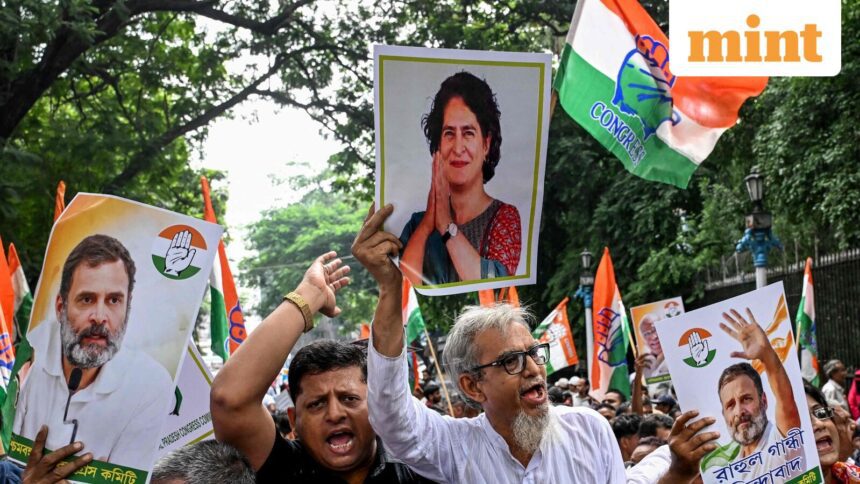
Congress activists carrying posters shout slogans during a protest rally in Kolkata on August 12, 2025, to condemn alleged electoral malpractices and the Special Intensive Revision (SIR) of electoral rolls.
Breaking India News Today | In-Depth Reports & Analysis – IndiaNewsWeek > Politics > 21% of Indian Legislators Are Dynasts, Reveals ADR Report
Politics

21% of Indian Legislators Are Dynasts, Reveals ADR Report

Politics Desk By Politics Desk September 21, 2025 4 Min Read
Share
SHARE

A recent report underscores the prominence of dynastic connections in Indian politics despite ongoing debates surrounding nepotism. The findings reveal that approximately 21% of the nation’s sitting Members of Parliament (MPs), Members of Legislative Assemblies (MLAs), and Members of Legislative Councils (MLCs) come from dynastic backgrounds.

According to a report released by the Association for Democratic Reforms (ADR), 32% of sitting MPs, MLAs, and MLCs affiliated with the Congress party are dynasts, followed by 22% from regional parties and 17% from the Bharatiya Janata Party (BJP). The analysis encompassed 5,203 elected representatives, with 1,106 identified as having familial political ties. The report highlights that dynastic representation is most pronounced in the Lok Sabha (31%) compared to state assemblies (20%).

Within the realm of national parties, ADR scrutinized 3,214 sitting MPs, MLAs, and MLCs, of which 20% were from political families. In contrast, smaller parties such as the Communist Party of India (Marxist) exhibited significantly reduced dynastic influence, with only 8% of representatives coming from dynastic backgrounds.

Political economist Arun Kumar notes, “India is a feudal country,” stating that both the political elite and the public view the concentration of power within families as acceptable. He cites the financial barriers of elections as another factor supporting dynastic candidates, as families often invest in their own political legacies.

Regional parties generally reflect the trends observed with national parties. The ADR report indicates that among 1,808 scrutinized sitting MPs, MLAs, and MLCs from these parties, 22% belong to dynastic lineages. For instance, parties like the Nationalist Congress Party (NCP) and the Yuvajana Sramika Rythu Congress Party (YSRCP) show impressive dynastic representation at 42% and 38%, respectively. Conversely, parties such as the All India Trinamool Congress and AIADMK have notably lower rates at 10% and 4%.

The report also highlights an intriguing aspect concerning female representation: nearly 47% of the 539 women MPs, MLAs, and MLCs analyzed come from political families, a figure significantly higher than their male counterparts at 18%. This trend varies across states; for example, in Jharkhand, 73% of women in politics stem from dynastic backgrounds. While dynasticism may facilitate entry for women, it simultaneously restricts opportunities for first-generation female politicians.

The data indicates that dynastic representation is more substantial at the national level, suggesting established political families dominate in securing visibility and prestige, whereas state politics may offer greater opportunities for newcomers. The ADR report posits that dynastic politics is not restricted to simple seat inheritance but represents a structural feature across various demographics.

The prevalence of dynasticism stems from India’s familial traditions that lend credibility to such candidates in the eyes of voters. Political parties frequently incentivize dynastic contenders during candidate selection, often without oversight.

Manisha Priyam, a political analyst, provides a counterpoint, arguing that while over 20% of representatives are dynasts, 80% are not. She emphasizes the complexities within regional party leadership, suggesting that figures like Akhilesh Yadav and Stalin have had to strive for their positions contrary to perceptions of entitlement.

The ADR, a non-profit focused on electoral reforms for over 25 years, has become a pivotal source for data on politicians’ backgrounds, including their financial standings and criminal histories, serving as an informant on the implications of dynastic politics in India.


TAGGED:Politics
Share This Article
Twitter Copy Link
Previous Article Karnataka forms SIT to probe 'deletion of votes' in Aland assembly seat Karnataka Establishes SIT to Investigate Alleged Voter Deletion in Aland Seat
Next Article 'Australia is a great opposition to test ourselves': Smriti Mandhana on learnings from series Smriti Mandhana: Testing Ourselves Against Australia for Valuable Insights
Leave a comment Leave a comment

Leave a Reply Cancel reply

Your email address will not be published. Required fields are marked *

Latest News

Government Bans X Accounts of Global Times, Xinhua News, and TRT World

June 11, 2026

Indian Space Agency Investigates Spacecraft Landing with Deceased Crew Members

June 11, 2026

Four Wrongfully Detained Indian Muslims Released in Thane After Protests

June 11, 2026

Toxic Work Culture Exposed at Zee: Employee Sharing Concerns Online

June 11, 2026

Indian Dog Rescued in Florida Believed to Be Killed by Alligator

June 11, 2026

Muslim Majlis-e-Mushawarat Raises Alarm on Hate Politics and Tech Encounters in India

June 11, 2026

You Might Also Like

B  Madhu Gopal
Politics

Exploring the Rich History of Visakhapatnam’s Naval Coast Battery

3 Min Read
GOP Unveils Bill to Avert Shutdown, Daring Democrats to Oppose
Politics

Democrats Intensify Oversight of FCC Chair Following Kimmel Suspension Controversy

3 Min Read
New Delhi, India - Dec. 30, 2024: Aam Aadmi Party (AAP) National Convener Arvind Kejriwal addresses a press conference in the presence of Delhi Chief Minister Atishi, at the AAP party office   in New Delhi, India, on Monday, December 30, 2024.  (Photo by RAJ K RAJ / Hindustan Times)
Politics

Delhi L-G Expresses Disappointment Over Kejriwal’s ‘Temporary Chief Minister’ Remarks About Atishi

5 Min Read
GOP Unveils Bill to Avert Shutdown, Daring Democrats to Oppose
Politics

Trump Requests Supreme Court Intervention to Dismiss Fed Board Member Cook

4 Min Read

About IndiaNewsWeek

IndiaNewsWeek is your trusted source for breaking news, in-depth analysis, and comprehensive coverage of India and the world. We deliver accurate, timely reporting across politics, economy, sports, entertainment, and technology.

contact@indianewsweek.com

Quick Links

  • Nation
  • Politics
  • Economy
  • International
  • Sports
  • Entertainment

More Sections

  • Technology
  • Auto News
  • Education
  • About Us
  • Contact
  • Privacy Policy

Stay Connected

Follow us on social media for the latest updates and breaking news.

Facebook
X (Twitter)
YouTube
Follow US
© 2026 IndiaNewsWeek. All Rights Reserved.
Welcome Back!

Sign in to your account

Lost your password?