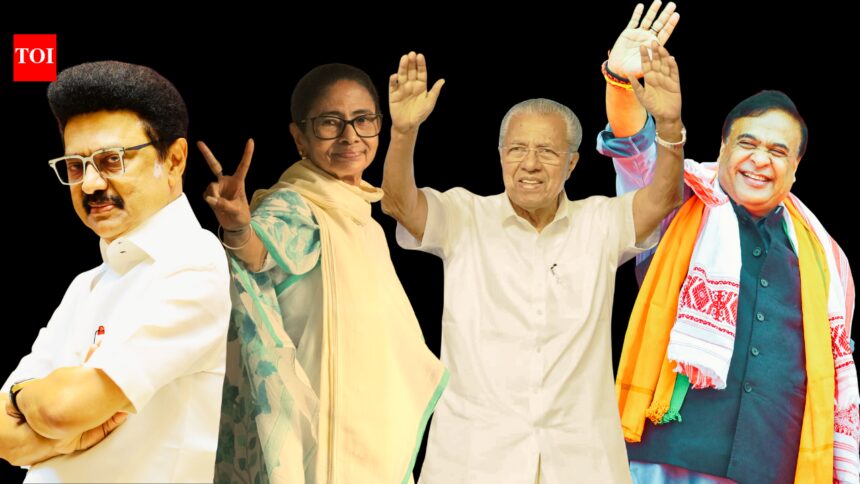

NEW DELHI: West Bengal may be on the verge of “poriborton” (change) as exit polls suggest a hung assembly, potentially ending Mamata Banerjee’s 15-year rule in the state. Most exit polls indicate a competitive race between the ruling Trinamool Congress (TMC) and the Bharatiya Janata Party (BJP).
In Tamil Nadu, one exit poll predicts that actor-politician Vijay’s Tamilaga Vettri Kazhagam (TVK) may disrupt the longstanding DMK-AIADMK duopoly by becoming the single largest party. However, most other polls still give an advantage to the DMK-Congress alliance.
In Assam, the BJP appears poised for a third consecutive victory, projected to significantly outpace the Congress, which continues to struggle in the northeastern state. Meanwhile, in Kerala, the CPM-led Left Democratic Front (LDF) may be on track to lose its unique distinction as the only Left government in the country. The ruling NDA in Puducherry is also expected to retain power with a solid win over the Congress-DMK coalition.
Exit polls released after voting in four states and one Union Territory (UT) provide an uncertain but revealing view of the electoral landscape, highlighting both entrenched incumbents and rising challengers. The official results are set to be announced on May 4.
Projections point to major shifts and continuity across regions, underscoring the diverse dynamics that shape voter behavior. In West Bengal, the trends suggest one of the most fiercely contested elections in recent history. The exit polls indicate that voter sentiment is almost evenly split between the TMC and BJP, with a poll of polls estimating both parties to have around 145 seats each in the 294-member assembly. Minor parties and independents are expected to hold only a marginal number of seats.
These projections indicate not only a competitive race but a potential structural shift in the state’s politics, with the BJP emerging as a serious contender against the TMC. The high voter turnout, around 90%—the highest since Independence—reflects strong engagement, particularly in districts like Purba Bardhaman, Hooghly, Nadia, and Howrah.
In Tamil Nadu, most exit polls suggest that the DMK-led alliance under Chief Minister M.K. Stalin is likely to retain power but with a reduced margin compared to the 2021 elections. This continuity would mark a significant shift in a state historically known for alternating between the two major Dravidian parties. The emergence of TVK introduces a new dynamic in the electoral landscape, with predictions suggesting that the party could influence multiple constituencies and potentially disrupt established voting patterns.
Contrastingly, Assam seems to be moving toward political stability, with exit polls indicating a significant victory for the BJP under Chief Minister Himanta Biswa Sarma. Projections estimate the BJP could secure around 90 seats, well ahead of the Congress, which is hovering around 30 seats.
In Kerala, the electoral contest is more complex, with exit polls showing a narrow advantage for the Congress-led United Democratic Front (UDF), predicted to win around 72 seats against the LDF’s projected 63. Variations among different polling agencies reflect a high level of uncertainty, with some indicating a potential majority for the LDF.
Lastly, exit polls for Puducherry suggest a clearer outcome, with the NDA, led by the AINRC-BJP coalition, expected to maintain its position against the Congress-DMK alliance. Strong voter turnout at 89.83% indicates high public engagement, while several constituencies are anticipated to be closely contested.
Across all five states, common themes emerge, such as the influence of new political entrants in Tamil Nadu and Puducherry, reflecting shifting voter preferences. The varying degrees of incumbency advantage or disadvantage illustrate the significance of regional narratives, particularly in West Bengal. Although exit polls provide valuable insights into the electoral mood, they are not definitive predictions, as last-minute voter behavior and polling methodologies can lead to varying results.
As counting approaches on May 4, it remains to be seen whether these exit poll trends translate into actual electoral outcomes or if unexpected results arise, further complicating the political landscape.