New Delhi: Long before Hindi cinema evolved into the star-driven, glitzy industry it is today, significant power resided elsewhere. An excerpt from Rajesh Khanna’s biography highlights the pivotal role film distributors played in shaping movies, often demanding considerable changes after reviewing only a few reels.
For many newcomers, this influence could either forge careers or end them. Rajesh Khanna, before the success of Aradhana, found himself at such a crossroads. As noted in Dark Star: The Loneliness of Being Rajesh Khanna, authored by Gautam Chintamani and published by Rupa Publications, “For many films, the distributor was the first hurdle; and for newcomers and unsuccessful actors like the pre-Aradhana Rajesh Khanna, it could very well be the ultimate obstacle.”
Interestingly, distributors were impressed overall with Aradhana (1969). The biography states, “The distributors absolutely loved the music and the film, and didn’t mind Khanna.” However, they raised concerns about a crucial creative decision—Khanna’s character addressing the heroine as ‘Maa’. They even offered director Shakti Samanta additional funding to reshoot this element and suggested replacing Khanna’s second role with another actor.
Director Samanta resisted this pressure. “Samanta didn’t budge, and finally the distributors gave in,” the book reveals, marking a historic decision.
In contrast to today’s simultaneous pan-India releases, Aradhana premiered in Delhi a week before its Bombay release. This early debut proved fortuitous. “It just took Aradhana’s screen time at its Delhi premiere for Rajesh Khanna to go from that newcomer with hidden promise to the next big thing,” the excerpt notes.
The transformation was rapid and profound. “By the time the first show ended, everyone in the theatre wanted to meet Khanna,” the excerpt recalls. Upon reaching Bombay, the film was already a blockbuster. “Half-a-kilometre-long lines in front of the box office were a common sight,” and Aradhana became one of the first films to enjoy a 100-week run in non-Hindi-speaking cities such as Madras and Bangalore (now Bengaluru).
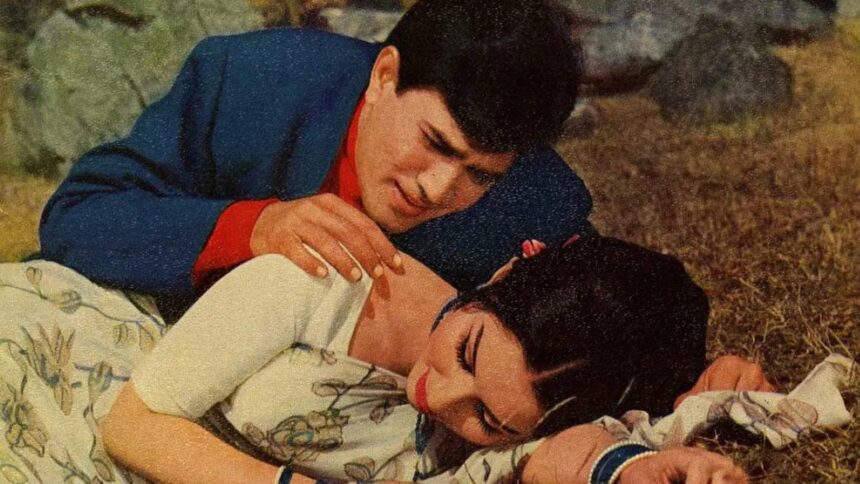
The biography also explores why the film resonated powerfully with audiences. Khanna had previously excelled in romantic and musical roles, with Aradhana heavily leaning into that strength. “At its heart, Aradhana was a love story,” the excerpt states, adding that the romance “wasn’t rushed, thereby giving Khanna enough time to do what he was good at.”
The result was immediate stardom. As the autobiography succinctly puts it, “It’s hardly surprising then that women instantly connected with him.”