“Nothing beats a Jet2 holiday”: those of us immersed in internet culture are familiar with this viral format of meme, the manically cheery beats, the techno-synth sounds embedded in our memory almost through osmosis, possibly against our will. Which is why the video it accompanies is so jarring.
The official account for the Chief Minister of Assam on December 30, last year, posted this audio clip to a sleekly edited montage of bulldozers razing down different buildings, mostly what look like homes. The video is filtered in pastel shades, camouflaging the sinister nature of the assignment, what can only be described as thinly-disguised ethnic cleansing. The video is blithely captioned “a warm holiday sendoff to the encroachers”, as the drone footage pans over demolitions reminiscent of the West Bank. An alarmingly frivolous tone to adopt, consider the cataclysmic consequences of these acts.
The government of Assam has been conducting these evictions consistently and with increasing frequency since it first assumed power in 2016. Tens of thousands of families have had their homes and public structures torn down, their livelihoods completely disrupted, and their entire lives suspended with no sign of resolution. The one common thread – the government has overwhelmingly targeted areas where there is a strong Bengali-Muslim presence. Using the guise of a variety of land and forest laws, the state has redrawn the boundaries of public land in order to selectively exclude this population. This effectively implies that people who have been living on the same land for entire generations are spontaneously and suddenly forced into the category of “encroachers”.
Investigating how the evictions have adversely affected the lives of the people, I visited 6 eviction sites over the last year — Hasilabeel, Dhalpur, Sonapur, Bandarmath, Mohanpur and Bilasipara. The first five were on account of ‘encroachment’ on government or forest land, and the last is being carried out for a state-run thermal power project, implying that the government has to compensate fairly for the acquisition of land. Along with homes, a majority of which were built under the aegis of the PM Awas Yojana or Indira Awas Yojana.
I witnessed the breaking down of government schools, madrassas, idgahs, mosques, and, in one instance, a tank built under the Jal Jeevan Mission. In at least two of these sites, the government has also prevented people from accessing graveyards, or, in the words of my field interlocutor, “They don’t even want to let the dead lie in peace.”
Across all the sites, Hindu houses were either left alone or provided with compensation.
The pattern of these evictions is repetitive. Evictees across these sites spoke to the unfairness of the demolition process. In each of these sites, the notice about the eviction was either not directly presented or announced a mere day or two before the scheduled demolitions.
“We were given the notice in the night, and told to leave first thing in the morning,” said Amir (name changed), a young local activist at Dhalpur. “Tell me, what do we save and what do we let go?”
Many of the evictees also had some kind of land record establishing their presence and title over the land. A 70-year-old Saddam, displaced in Hasilabeel and now forced to live in a tent, showed me a land revenue document that had been allotted to his grandfather in 1939. “Our ancestors were born here, we were born here, and now they tell us we are encroachers?” This makes the government rhetoric around the evictees being ‘illegal encroachers’ inaccurate and exceptionally dangerous.
Overwhelming police and CRPF presence also accompanies the evictions. Multiple evictees across multiple sites reported thousands of police officers arriving with the ubiquitous JCB, a lethal machine which has become synonymous with political demolitions in the country, in furtherance of what has been described as a “Bulldozer Raj”.

“I could not believe my eyes when I saw so many police officers. I think there were about 4000,” reported Rahela, a 24-year-old whose house had been bulldozed in “There were even female police officers, who beat me when I tried to salvage some things from my house.”
This account of police brutality came up again and again. Perhaps you remember the brutal and shocking murder of Moinul Haque in 2021, who was shot by the police and stomped on till he died for the simple crime of resisting the bulldozers. In the words of Samiul (name changed), a member of the All Assam Minority Students Union, “So many armed police officers, it leaves us unable to resist. It is like a war zone.”
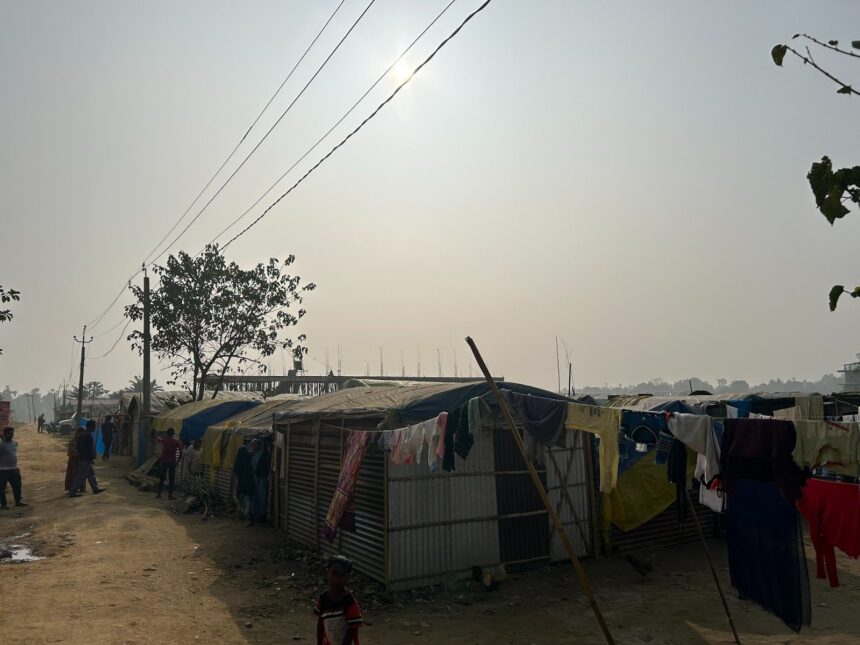
The government’s role seems to end at evictions; there is little to no support that they extend towards the evictees once they are rendered homeless. This has resulted in people being compelled to live like refugees on their own land. Mere metres away from the rubble of their homes, informal tent settlements have emerged across the different sites, with flimsy shelters built from straw, bamboo, tarpaulin and, if the evictee has been able to procure it, corrugated tin. These act as little protection from the elements.
“There is one hand pump, and two latrines. There are over 300 families. Tell me, is this any way to live?” Maryam, a 40-year old local at Hasilabeel, reflects on the challenges around sanitation for women in particular.
“We bathe 6 at a time because there is no space. We don’t let our young girls go out at night to use the latrines, because we are worried about their safety. When we bleed [menstruation], we mostly don’t have access to sanitary products, so we just sit and let it complete its cycle.”
I spoke to an ASHA worker who preferred to remain anonymous. “There were pregnant women when this camp was hastily put together. We had to deliver babies in these tents. The mothers are not receiving adequate nutrition. The fathers are not able to secure even daily-wage jobs because they have now been tarred with the brush of being ‘encroachers’. We are all starving.”

In two of the sites, Sonapur and Mohanpur, those evicted are living next to the river, braving the bitter winter amidst rising illnesses, especially among the children and the elderly. Finally, a majority of the school-going children have no access to any schooling anymore, and older male teenagers have been forced to pull out of school and leave the district in all these sites to find some work. I ask about the education of girl children.
“Now that they shut down the local schools, the nearest school is very far. Most of our girls have stopped going to school,” said the ASHA worker.
Hafizuddin (name changed), a middle-aged daily wage worker and former local representative at Bilasipara, invited us to witness the skeletal ruins of his house, a labour of love that he had invested three years saving up for, only to have it destroyed within a matter of minutes.
The ‘compensation’ he has received, which in itself is rare, does not even amount to half of the value of his properties. “I am Indian, and I want to see development as much as any citizen. But why is this development coming at the cost of our lives? What have we done?”
The UN defines ethnic cleansing as “a purposeful policy designed by one ethnic or religious group to remove by violent and terror-inspiring means the civilian population of another ethnic or religious group from certain geographic areas.” Given that the government has deliberately used lawfare to displace and drive out members of the Bengali-Muslim minority, these evictions fall squarely under the definition of ethnic cleansing.
The sinister aim of the state, which is reflected also in the popular (and hateful) discourse around Bengali-Muslims, is to systematically create unlivable conditions for this population, contributing further to their dehumanisation. The government of Assam is perpetuating the worst excesses of the Hindutva regime honed by the Centre. These unconstitutional and punitive evictions must come to an end. I am haunted by the words of Rahman (name changed), a middle-aged evictee who lost most of his belongings in the eviction: “Why do they try to kill us in a hundred tiny ways? Why don’t they just kill us in one go? That would be easier.”
Pakeezeh (Padmini) Baruah is a PhD candidate in anthropology at the National University of Singapore.
The post “Why don’t they just kill us in one go?”: Bulldozers and moral bankruptcy of Assam government appeared first on Maktoob media.