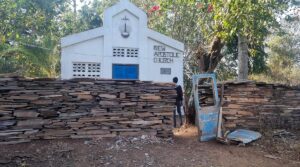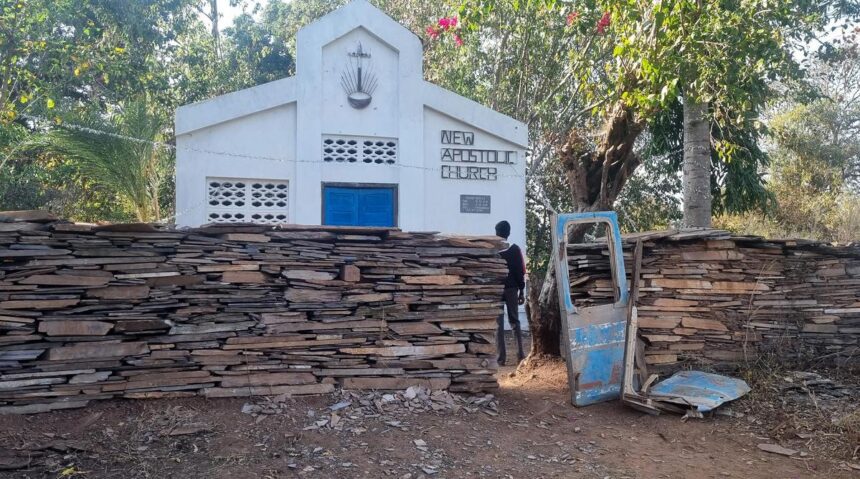
Violence erupted in Amabeda village of Kanker district in Chhattisgarh on Thursday following a dispute over a burial, resulting in several injuries and the destruction of two churches along with damage to various properties.
The conflict initiated in the Bade Tewda gram panchayat, around 150 km south of Raipur, after the burial of 70-year-old Chamraran Salam on private land owned by his family. Chamraran, who passed away on December 15 during medical treatment, was the father of local sarpanch Rajman Salam.
According to police reports, some villagers contested the burial, alleging it was conducted secretly and did not adhere to traditional tribal customs. There were claims that the sarpanch converted to Christianity, leading to accusations against the family for performing Christian burial rites and inciting protests.
The United Christian Forum stated that a mob incited villagers by asserting their right to exhume the body under the PESA Act, declaring that the land belonged to a local deity, which made a Christian burial unacceptable.
On Thursday, an Executive Magistrate ordered the exhumation based on complaints from villagers. Police indicated that the remains would undergo a post-mortem examination and that an investigation was underway. “Legal action will be taken based on the findings,” Kanker police stated, noting property damage during the clashes.
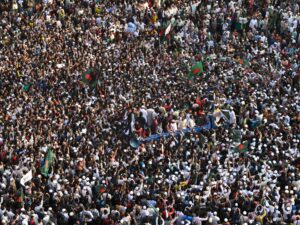
Tensions escalated into stone-pelting between groups, causing injuries to around 20 police personnel, including Additional Superintendent of Police Ahish Banchhor, as well as several villagers. Police employed lathi charges to disperse the crowd and restore order.
Officials intervened, facilitating a meeting between the opposing factions, resulting in the exhumation of the body and its removal from the village, which many locals opposed.
Additional Collector Anjor Singh Paikra mentioned that while some villagers believed the sarpanch had converted to Christianity, his father had remained a Hindu. He stated that “the sarpanch reportedly performed last rites in accordance with Christian beliefs, which led to strong protests from villagers.”
The president of the Chhattisgarh Christian Forum alleged that at least two churches were set ablaze, and homes belonging to Christian minority members were attacked during what he characterized as a riot-like situation.
District authorities reported that officials had been stationed in Bade Tewda for two days to prevent further violence. Injured villagers and police personnel were admitted to hospitals, and the situation was reported to be under control.
The United Christian Forum recorded 23 burial-related incidents in 2025, with 19 occurring in Chhattisgarh, two in Jharkhand, and one each in Odisha and West Bengal. This follows approximately 40 such cases reported in 2024, including 30 in Chhattisgarh and others in Jharkhand, Bihar, and Karnataka.
A recent report indicates that Christians are increasingly facing denial of burial rights on their ancestral land, fostering a climate of fear among pastors and families. Many villages lack designated Christian burial grounds, and historically shared community graveyards are increasingly restricted to Hindu use.
Families trying to bury relatives often encounter resistance, even in communities with a history of shared burial practices. In cases where Christian-only graveyards exist, they are often situated far from tribal settlements. Additionally, many families struggle with access to mortuaries, transportation, and the necessary time to pursue legal options while dealing with the urgency of decomposition at home, which hampers immediate complaints.
The National Coordinator of the United Christian Forum expressed that “it is becoming increasingly dangerous for Christians to practice their faith” in India, emphasizing that there have been “no convictions in any court of law” to substantiate claims of forced conversions.
He raised concern regarding official responses to violence, referencing that during a recent Christmas event hosted by the Catholic Bishops’ Conference of India, the Vice President of India, C P Radhakrishnan, dismissed incidents of violence against Christians as rumors.
The United Christian Forum called on the governments of Chhattisgarh and Odisha to implement a systematic compensation and rehabilitation plan for displaced Tribal Christians, which would include rebuilding homes and providing livelihood support. They also demanded departmental action against police personnel who fail to prevent or respond adequately to violence against religious minorities.
Additionally, they urged authorities to instruct every gram panchayat and urban local body to identify, notify, and maintain a religiously neutral ‘common graveyard’ accessible to all residents, including converts and minority communities, supported by formal orders and proper signage. They recommended the appointment of a district-level nodal officer to ensure immediate police protection during funerals where tensions may arise, cautioning that any obstruction of a lawful burial or attempts to exhume remains should result in prompt criminal action against complicit officials.
Tags: Two churches torched, several injured as burial dispute sparks violence in Chhattisgarh’s Kanker Extract 5 SEO-friendly keywords as tags. Output only keywords, comma separated.
Hashtags: #churches #torched #injured #burial #dispute #sparks #violence #Chhattisgarhs #Kanker