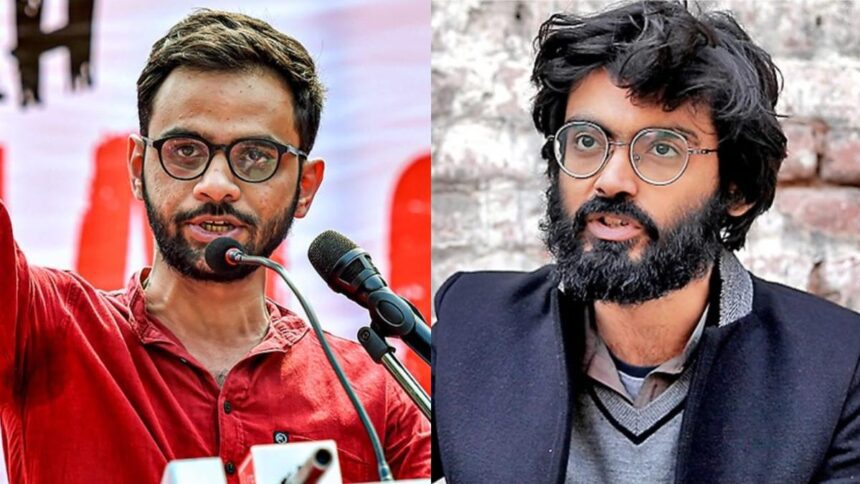
The Supreme Court’s recent decision to deny bail to Umar Khalid and Sharjeel Imam, while granting it to five co-accused in the Delhi violence conspiracy case, has elicited strong criticism from human rights organizations, families of the detained, legal experts, political leaders, and civil society advocates.
Aakar Patel, chair of the board for Amnesty International India, condemned the continued detention of Khalid and Imam as unjust and politically driven. “We welcome the court’s decision to grant bail to their co-accused, but it is shameful that Umar Khalid and Sharjeel Imam continue to be denied bail. They should not be in detention at all. They have been held for over five years without trial on politically motivated charges — these charges must be dropped, and they should be released unconditionally,” Patel stated.
Patel specifically criticized the Supreme Court’s imposition of a one-year restriction on filing new bail applications. “A blanket one-year ban on bail, without clear justification, unduly restricts detainees’ rights to regular judicial review of the lawfulness and necessity of their detention. This is particularly concerning given their prolonged pre-trial detention,” he added, emphasizing that justice cannot prevail while individuals remain imprisoned for years for exercising their right to peaceful protest.
Families of the detained expressed mixed emotions about the ruling. Khalid’s father, Syed Qasim Rasool Ilyas, stated, “Hope is the only thing that we have to carry forward now.” He criticized the lack of evidence against his son and questioned the court’s decision-making process, remarking, “In five years, the court could not find a single piece of evidence against them; there is no point in keeping them in jail.” He further emphasized his disappointment regarding the undefined rationale behind the court’s distinction of “qualitatively different footing” in its ruling.
Ilyas labeled the verdict unjust and emphasized, “Umar was not even in Delhi when the riots occurred. He has spent five years in jail without trial, and now he must wait another year to appeal for bail. This is injustice.” He also rejected the notion that the families would be divided by the selective bail outcomes, asserting pride in all activists fighting for justice.
Khalid’s partner, Banojyotna Lahiri, recounted Khalid’s reaction to the ruling, quoting him as saying, “I am really happy for the others who got bail! So relieved.” She noted Khalid’s acceptance of his situation: “Ab yahi zindagi hai (Now my life is here).”
Sharjeel Imam welcomed the release of the five co-accused but condemned the circumstances that have led to their prolonged detention, describing it as criminalization of protest. “I firmly believe that Umar and I are being punished for organizing what was probably the most significant mass protest in recent Indian history. This judgment criminalizes organized protests and equates disruption to terrorist acts,” he stated.
Imam also expressed concern for his elderly mother’s health, emphasizing his belief in the case’s eventual resolution. “Till then, I am pursuing my intellectual and academic journey as best as I can,” he added, quoting a line reflecting perseverance despite adversity.
Muzammil Imam, Sharjeel’s brother, raised questions about the court’s reasoning, highlighting the disparity in bail outcomes among the seven accused. He criticized the court’s interpretation of protest actions and described the judgment as disappointing, stating, “They have been in jail for years. I thought Sharjeel would be released. This judgment is extremely upsetting for us.”
Noorain, the wife of released activist Shifa Ur Rehman, shared sentiments of hope for others still detained: “Those who are sad today, we pray that they also receive good news in the days to come.”
Legal experts and public figures reacted strongly against the court’s decision. Senior advocate Prashant Bhushan labeled the refusal to grant bail to Khalid and Imam as “shocking, unfair, and unjust,” calling it a “shameful joke on the right to life and liberty.” Screenwriter Darab Farooqui described the Supreme Court’s actions as emblematic of injustice in India, while other commentators highlighted the disparity in treatment of Khalid compared to convicted offenders.
CPI(M) MP John Brittas argued that denying bail under the Unlawful Activities (Prevention) Act contradicts natural justice principles. The Association for Protection of Civil Rights (APCR) stated that while the release of five co-accused provided partial relief, it was overshadowed by the unjust continued detention of Khalid and Imam. Historian Janaki Nair expressed dismay over the denial of bail to her former students and emphasized their resilience in the face of oppression.
The article underscores ongoing tensions surrounding the treatment of Khalid and Imam, reflecting broader concerns regarding civil liberties and justice in India.
Tags: “Truth will ultimately prevail”: Sharjeel Imam, Umar Khalid speak as family and friends join outrage after bail denial Extract 5 SEO-friendly keywords as tags. Output only keywords, comma separated.
Hashtags: #Truth #ultimately #prevail #Sharjeel #Imam #Umar #Khalid #speak #family #friends #join #outrage #bail #denial