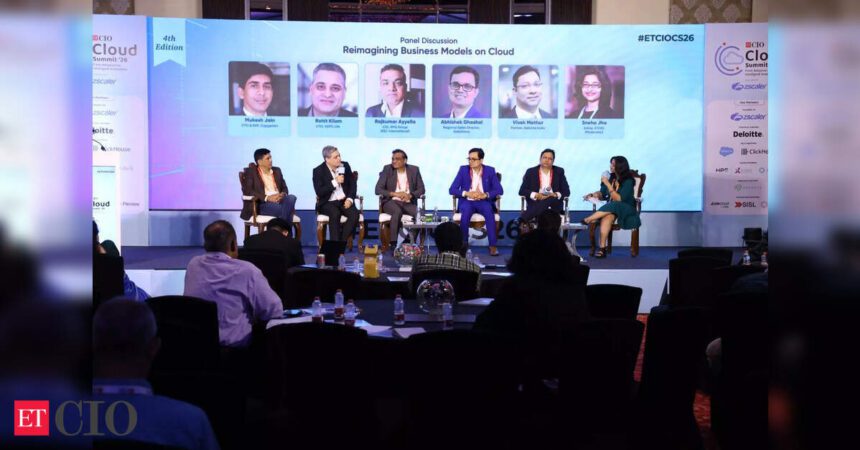
Rohit Kilam outlined HDFC Life’s evolution from cloud migration to adoption maturity, emphasising that accountability remains firmly with the enterprise. “When you move to the cloud, you’re not outsourcing accountability,” he said, noting that true value comes after the migration phase. For the life insurer, cloud has enabled scalable APIs, partner integrations and personalised product variants aligned to embedded and usage-based models. “Cloud helps us create APIs, connects and scale with large platforms,” Kilam said, adding that personalisation for specific customer cohorts is now a core capability rather than an experiment.
From the infrastructure and manufacturing lens, Rajkumar Ayyella highlighted that while last-mile connectivity may pose challenges, data remains central to operational efficiency. With terabytes of project, design and estimation data across oil & gas, railways, solar and T&D projects, standardisation and reuse are critical. “We have sunset a lot of projects into a single system so that we get the core data we can rely on,” he said, underlining how platform reuse and digital design tools reduce execution risk and improve approvals in capital-intensive environments.
Mukesh Jain said cloud success hinges less on migration metrics and more on monetisation discipline. He cautioned that many organisations struggle because leadership literacy and cross-functional ownership are weak. “If the business is not sure about the use case, how will I get that outcome?” he asked, stressing that ROI conversations must extend beyond cost optimisation to revenue enablement and customer expansion. Jain added that failure often stems from poor measurement. “Every activity or inactivity generates data—are you measuring it?” he said, pointing to continuous ROI tracking as essential for sustained executive support.
Abhishek Ghoshal noted that SaaS platforms such as CRM are no longer internal efficiency tools but revenue engines built on customer data. “It’s not just internal efficiency anymore—it’s about turning customer data into monetisable outcomes,” he said, citing upsell, cross-sell, embedded finance and API-led distribution as emerging patterns. Enterprises that succeed, he argued, operate with a product mindset—treating digital initiatives as standalone P&L opportunities rather than IT projects.Vivek Mathur emphasised that Indian boards are increasingly technology-literate and demand outcome-based dashboards rather than faith-based approvals. “The board itself has evolved,” he said, adding that cloud investments must be evaluated holistically—factoring in revenue scale, CapEx avoidance and ecosystem reach rather than narrow cost comparisons.
The panel converged on a common theme: platformization fails when organisations over-customise, fragment ownership or treat innovation as separate from core business. Cultural readiness, disciplined process design and product thinking were repeatedly cited as underestimated capabilities. As Kilam summed up, cloud maturity is not about infrastructure—it is about enabling differentiated customer experiences while retaining accountability. The future, the panel suggested, belongs to enterprises that think in platforms, measure rigorously, and monetise intentionally.