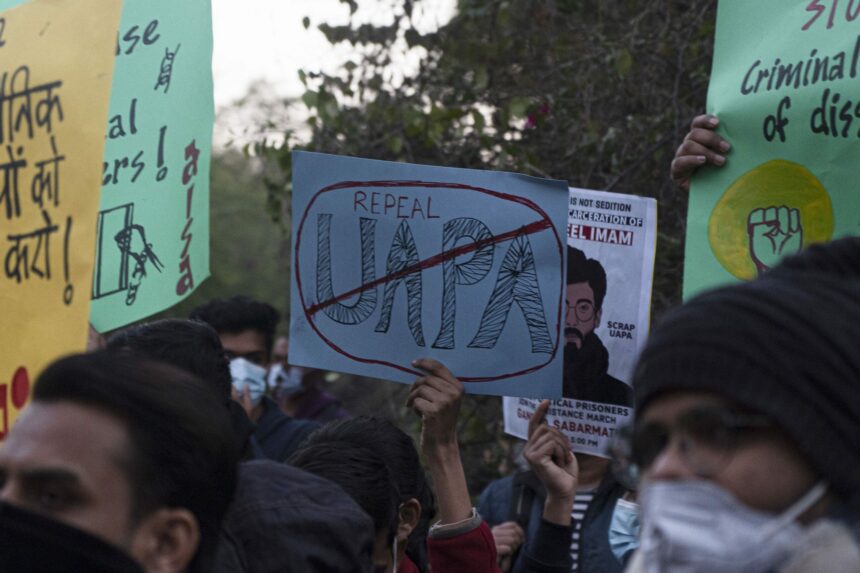
The Supreme Court on Thursday issued directions to all High Courts to examine the status of pending trials under the statutes such as the Unlawful Activities (Prevention) Act, where the burden of proof is reversed on the accused.
The apex court has also asked the High Court Chief Justices to ascertain the number of Special Courts designated to try these offences, and the appointments of Special Public Prosecutors.
Cases pending over five years have been directed by the top court to be given special focus, by ordering a day-to-day trial.
A bench comprising Justice Sanjay Karol and Justice N. Kotiswar Sing was ruling on appeals filed by the Central Bureau of Investigation challenging the bail granted by the Calcutta High Court in the 2010 Jnaneshwari Express derailment case, Live Law reported.
Supreme Court expressed that when the statute imposes a reverse burden, then the State must also ensure that the trial is expedited.
It said: “A constitutional democracy does not legitimise burdens by simply declaring them; it must ensure that those burdened are meaningfully equipped to bear them, even those who are accused of the worst offences imaginable. If the State, in spite of all its might presumes guilt, then the same State must also, with the employment of all the resources at its command, create pathways through which the accused can reclaim their innocence.”
The Bench noted that undertrials in such cases, particularly those from disadvantaged backgrounds, face formidable obstacles in rebutting presumptions when they are incarcerated, with limited access to evidence or legal resources, Live Law reported.
It went on to say: “Delay is an un-ignorable reality of the Indian criminal adjudication system which on its own raises significant issues, but when this delay is in cases such as the UAPA, where a reverse burden of proof is in place, it acquires a qualitatively different, and more insidious, character. Courts, bound by legislative intent and statutory language, ask for, even before the trial begins, the accused to be able to establish preliminarily, that they will be able to rebut the presumption against them. This doctrinal inversion becomes all the more pernicious on account of procedural delays and very liberty of a person becomes hostage to clogged dockets, overworked judges, a lax prosecution, repeated adjournments by members of the bar and much more. The institutions of justice must, therefore, act not as passive observers but as active guarantors of fairness: ensuring real access to counsel, enabling effective preparation of defence, and preventing the presumption from hardening into an irreversible verdict long before the trial ends. For if the system imposes an extraordinary burden yet denies the tools to discharge it, the promise of constitutionalism fades into symbolism. Ultimately, a democracy is judged not by how it treats the unquestionably innocent, but by how it safeguards the rights of those it suspects. In that moral balance, the justice system must ensure that even under a reverse burden regime, the accused is not abandoned to the weight of presumptive guilt but supported in the pursuit of truth and justice.”
The post Supreme Court warns of “procedural injustice” in UAPA cases, directs HCs to scrutinise trial delays, special courts appeared first on Maktoob media.