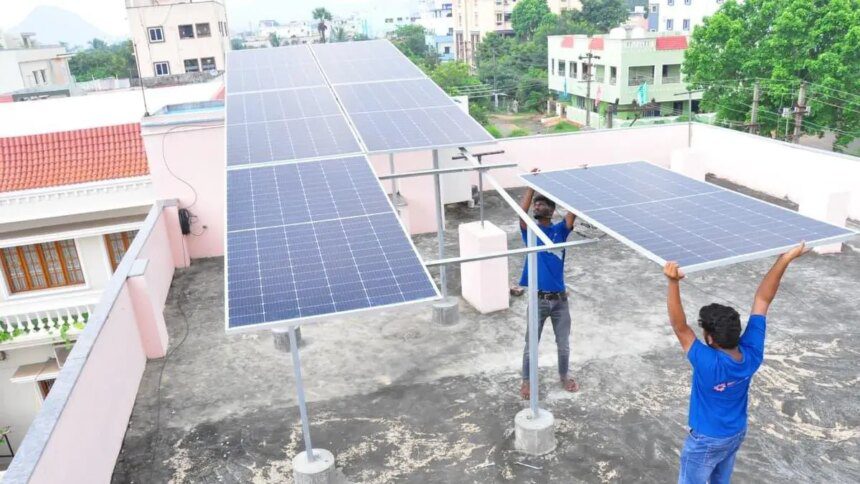
Hyderabad-based Freyr Energy, a rooftop solar installer, has marked over a decade in the industry. Managing Director and CEO, Saurabh Marda, recently shared significant growth projections during an interview with BusinessLine. In its first 10 years, Freyr Energy installed approximately 12,000 rooftop plants. However, it is anticipated to exceed 15,000 installations in the fiscal year 2025-26, with expectations to reach 30,000 in 2026-27. Last year, the company reported revenues of ₹165 crore and is projected to achieve ₹300 crore this year, largely fueled by the PM Surya Ghar: Muft Bijli Yojana scheme. Notably, Freyr Energy’s focus remains solely on installing rooftop solar systems for residential and small-scale enterprises.
These figures reflect a resurgence in the rooftop solar sector, which had previously remained dormant. As of the end of October, India’s total rooftop solar capacity reached 22.5 GW, constituting 17% of the nation’s overall solar installed capacity of 130 GW.
Warming India Drives Record Electricity Demand
Over the past decade, India’s average temperature has risen by 0.65 degrees Celsius above the 1991-2020 baseline, marking 2024 as potentially the hottest year on record. This persistent increase in temperature has resulted in unprecedented electricity demand, soaring to approximately 250 GW during the summer of 2024, primarily due to increased cooling requirements across residential, commercial, and industrial sectors.
A report titled ‘Breaking the Cycle: Can India escape the heat-power demand trap?’ by Climate Trends and Climate Compatible Futures notes that heatwaves accounted for 9% of India’s power demand during the summer of 2024, leading to emissions of 327 million tonnes of CO2.
Annual maximum temperatures have steadily risen across most Indian states, with increases ranging from 0.1 to 0.5 degrees Celsius over the past decade. Notably, 2024 has surpassed previous temperature records, averaging 0.65 degrees Celsius above the baseline and overtaking the high set in 2016.
The Indo-Gangetic region has experienced significant temperature increases, with summer peaks often surpassing 45 degrees Celsius. An astonishing 52.3 degrees Celsius was recorded in Mungeshpur (Delhi) in 2024, highlighting the intensity and duration of heatwaves.
States including Madhya Pradesh, Jharkhand, and Chhattisgarh have faced over 500 heatwave days within the decade, leading to sustained high electricity generation and prolonged stress on the power grid, according to the report.
Published on November 24, 2025