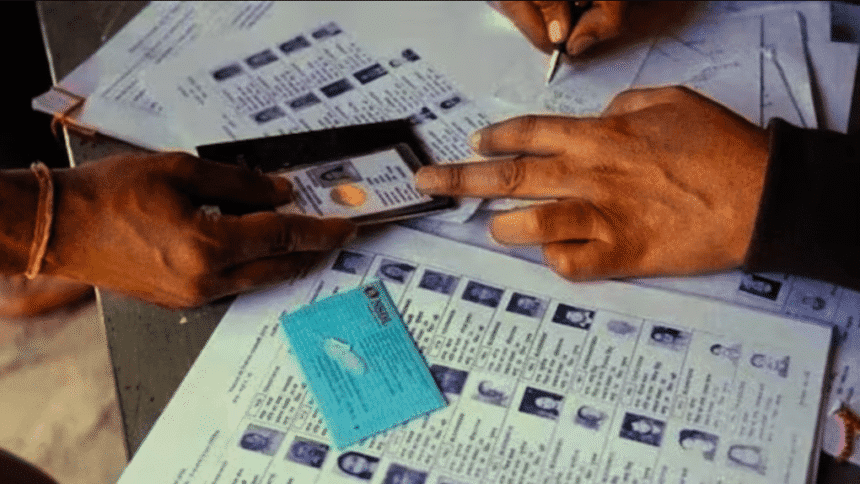
I spent the day with Kusum (name changed for anonymity), a mathematics teacher for Classes 10 and 12, primarily in a crowded Booth Level Officer (BLO) office rather than her classroom.
Her students are weeks away from critical pre-board examinations, yet she has not taught a single lesson in almost a month. As Kusum explained, her school has lost six staff members, including mathematics and physics teachers, to Special Intensive Revision (SIR) duties. This absence has disrupted daily lectures and her capacity to prepare revision modules or to record video lessons for her students.
“Higher secondary classes are suffering the most,” Kusum remarked. “We’re told to finish targets here, and meanwhile, students are left to figure things out on their own. I couldn’t even make video lectures as I had hoped.”
Urusa, a senior Anganwadi worker, met with me briefly as she was working from home that day due to the overwhelming SIR workload. Her study table was cluttered with forms, lists, and notes reflecting her hectic schedule.
She noted that her center continues to function mainly because ‘sahayaks’ (helpers) are holding it together during her absence. “Most of the main workers in our area are away on SIR duties. We’re all scattered in our own jurisdictions. The centers are operational, but only because of the helpers,” she explained.
Her exhaustion was evident in both her voice and her movements. At 52, she is considerably beyond the age at which such rigorous field duties should be imposed, particularly when these responsibilities fall outside the Integrated Child Development Services (ICDS) framework. Kusum, aged 48 and on lifelong medication for vertigo, also finds herself repeatedly assigned to SIR duties without respite, despite multiple rejected applications for relief.
The strain is becoming increasingly visible; Madhya Pradesh has recorded harrowing instances of BLOs collapsing under the SIR workload, including deaths attributed to heart attacks while on duty, alongside at least two suicides linked to overwork and pressure.
This systemic disruption affecting India’s education and childcare workforce for administrative work is not limited to Madhya Pradesh; it is occurring across states such as Uttar Pradesh, West Bengal, and Chhattisgarh, where the SIR is actively ongoing. The academic year and the physical well-being of frontline workers are at grave risk.
For many female workers like Urusa, anxiety is a constant: the fear of being overwhelmed, the fear of failing in their primary roles supporting mothers and children, and the fear of job loss due to not meeting SIR targets.
Ashok Agarwal, a lawyer practicing in the Supreme Court of India and the Delhi High Court and known for his advocacy regarding health, work, and educational rights, stated that the prolonged deployment of government teachers as BLOs is “a blatant and systemic violation” of the Right to Education (RTE) Act, 2009.
Section 27 of the RTE Act expressly prohibits deploying teachers for non-educational tasks, allowing only three essential exceptions: the decennial census, disaster relief, or election duties for local, state, or parliamentary polls.
He highlighted a crucial legal distinction at the center of this crisis: “The SIR of electoral rolls does not fall under the decennial census. It is an administrative process by the Election Commission to verify citizenship details, ensuring that no eligible citizen is left out and no ineligible person is included. It is not a valid reason to remove teachers from classrooms for an entire month.”
Agarwal emphasized that such diversions disproportionately harm students, particularly those from marginalized or below-poverty communities who rely entirely on government schools for education, mid-day meals, and a stable learning environment. Removing teachers for SIR duties disrupts learning and breaches the constitutional obligation to provide equitable and quality education.
In this context, the government’s focus on foundational literacy and numeracy (FLN) appears disingenuous, given that teachers commonly miss classes due to non-educational duties. These government schools already face challenges related to dropout and retention rates, as well as maintaining the essential 1:30 Pupil-Teacher Ratio (PTR).
Shivani Kaul, President of the Delhi State Anganwadi Workers and Helpers Union (DSAWHU), has noted that the stress from juggling dual responsibilities has recently led to tragic outcomes. She referred to alarming reports from Uttar Pradesh and other states, where numerous teachers and Anganwadi workers appointed as BLOs have encountered unbearable workloads associated with SIR.
Anganwadi workers are part of the Integrated Child Development Services (ICDS) scheme, mandated to provide critical services, including child nutrition, health checks, pre-school education, and maternal support. Their roles are clearly defined by ICDS guidelines and do not include census or election tasks, making their deployment for SIR duties a violation of their contractual obligations.
Kaul pointed out the inherent injustice in this situation: Anganwadi workers serve as honorary workers, not full employees, receiving a modest honorarium rather than a salary. Yet, despite their part-time status, they are often conscripted into non-ICDS responsibilities, including census and election work.
While SIR is a process dedicated to citizenship verification and not a decennial census, teachers and caregivers continue to be the primary choice for state administrations.
However, BLOs have proposed constructive alternatives to address this crisis. One BLO suggested, “Instead of assigning election duties to everyone, the government could deploy newly appointed government staff who are on probation to handle administrative tasks. This shift would ease the lifelong strain on experienced teachers and could resemble models like the ‘Agniveer scheme,’ allocating part of their service time to such roles.”
Another BLO recommended that the Election Commission appoint designated staff to manage election-related duties within its own department. Establishing a dedicated staff pool could bring structure and eliminate the burden of managing dual responsibilities, ensuring that frontline educators remain focused in their classrooms.
Mantasha Ahmed is an independent journalist based in Indore with five years of experience. She covers critical intersections between education, civil rights, social issues, and culture.
Tags: Pulled out of classrooms, pushed into bureaucracy: How SIR is breaking India’s teachers and anganwadi workers Extract 5 SEO-friendly keywords as tags. Output only keywords, comma separated.
Hashtags: #Pulled #classrooms #pushed #bureaucracy #SIR #breaking #Indias #teachers #anganwadi #workers