The Department of Financial Services (DFS) Secretary M. Nagaraju emphasized the necessity for new and larger banks to meet the goal of ‘Viksit Bharat’ (Developed India) by 2047. He proposed granting banking licenses to non-banking financial companies (NBFCs) and suggested upgrading small finance banks (SFBs) to universal banks.
In his remarks at a recent event, Nagaraju stated, “We have two or three means of having new banks. One is NBFCs; many of them could be considered for conversion into banks. The other is SFBs, which can also transition to universal banks.” However, inquiries into whether NBFCs might be willing to make such a conversion yielded skepticism from senior executives at major NBFCs who spoke anonymously.
Currently, Indian NBFCs operate under different regulatory standards compared to traditional banks. Many large NBFCs are associated with major corporate entities, such as Bajaj Finance, Tata Capital, L&T Finance, Aditya Birla Finance, and Piramal Finance. Historically, the Reserve Bank of India (RBI) has been reluctant to issue banking licenses to corporate groups.
A senior executive from a large NBFC noted that the RBI’s regulatory stance towards NBFCs has intensified in recent years, almost aligning them with banks. He highlighted the need for a “glide path” to lower promoter stakes and meet various banking regulatory requirements. Yet, he mentioned that many upper-tier NBFCs are run by corporate houses that the regulator has shown hesitation towards regarding banking licenses. “If there is a fresh thinking on granting corporate houses bank licences, then Reliance and Tatas would be the first to apply,” he added.
For smaller NBFCs, the inclination to convert to banks is limited due to operational size and capital constraints. While Sundaram Finance might be considered a candidate among large NBFCs, most remain satisfied with their current non-banking status.
An additional internal challenge for some large NBFCs is the RBI’s guideline that requires promoters to hold at least 40% of a bank’s paid-up voting equity capital, locked in for five years after commencing operations. “Why would we want to reduce our stake by converting into a bank? As an NBFC, we are profitable, have a large scale and come with a clean slate,” another executive remarked.
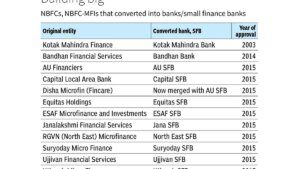
Kotak Finance stands as the sole example of a pure-play NBFC transitioning smoothly into a bank. The RBI has, however, recently denied banking applications, including that of Annapurna Finance, indicating reluctance to issue new licenses.
Many existing SFBs were originally microfinance institutions (MFIs), with only AU SFB and Capital SFB being exceptions. Should NBFCs decide to convert to banks, they would require a glide path to establish a liability base, as most do not currently accept deposits.
“Building liabilities is not an easy task as, historically, NBFCs have not done it,” stated Vivek Iyer, a partner at Grant Thornton. He emphasized that the retail segment’s size and customer base would be pivotal in determining the success of any liability structure. Additionally, customer service expectations for deposit accounts differ significantly from credit provision, necessitating a change in mindset.
On ownership structure, Iyer suggested a glide path or possible allowance for a non-operating holding company structure to facilitate this transition. Prakash Agarwal, partner at Gefion Capital, noted that regulators might eventually reconsider granting banking licenses to corporates as supervision frameworks strengthen.
Despite ongoing reluctance from the RBI to grant licenses to corporate groups, analysts suggest that if entities can align their promoter roles with strategic investor functions while keeping voting rights and related-party transactions tightly managed, a shift in policy may occur.
The profitability model for NBFCs relies on higher margins but struggles with higher borrowing costs. Analysts maintain that as NBFCs scale, they encounter limitations that banks do not face due to their lower cost of funds.
In summary, as seen with Kotak Finance’s successful transition and the favorable developments of several NBFC-MFIs into SFBs over the past decade, the landscape for NBFCs presents significant opportunities, including a potential pathway toward acquiring banking licenses.