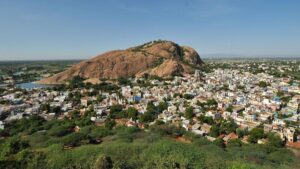
The Hazarath Sultan Sikkandar Badhusha Avuliya Dargah has appealed to the Madras High Court’s Madurai bench, challenging a single judge’s order that mandates the lighting of a lamp at a stone pillar on Thiruparankundram Hills. Representing the Dargah, Senior Advocate T. Mohan asserted on Monday that the minority community has faced significant challenges in peacefully enjoying land granted to them in 1920, as reported by Live Law.
Mohan stated, “It can’t be that the minority community is put to so much difficulty to enjoy their land given to them in 1920 and daggers drawn at every stage to defend ourselves against these incursions.” Recently, the Tamil Nadu government’s Fact Checker refuted claims that a Hindu temple on Thiruparankundram Hill had been converted into a dargah, clarifying that allegations based on similarities in architectural style were unfounded.
The division bench, which included Justice G. Jayachandran and Justice K.K. Ramakrishnan, was reviewing several appeals, including those from the Dargah management against a single judge’s order requiring temple authorities to light a lamp at a stone pillar (deepathoon) outside the Dargah’s land. The single judge determined that lighting the lamp would not violate the rights of the Muslim community.
The Tamil Nadu government has also appealed the single judge’s December 4 order that quashed prohibitive measures under Section 144 of the CrPC in a contempt petition. Another appeal challenges the December 9 order that mandated the personal appearance of senior officials, including the Chief Secretary and Union Home Secretary.
Mohan argued that previous judicial rulings, particularly one that prohibited animal sacrifice at the hills, had imposed restrictions on essential services like toilets, electricity, and water supply on Dargah land. “Prayers at the Nellithope area, which belongs to the Dargah, were curtailed on the ground that they might affect footfall to the Kasi Viswanathar temple,” he added. He cautioned that increased crowds could potentially obstruct access to the Dargah.
Mohan also claimed that the Dargah was not initially included in the proceedings and was only added later without a fair chance to present its arguments. He noted that despite the bench’s lack of interest in procedural issues, such unfairness could invalidate the order. He criticized the single judge for limiting the Dargah’s timeframe for filing counter affidavits from the stipulated eight weeks to just three days.
He maintained that objections regarding maintainability were not addressed and cited an instance where he was disconnected during video conferencing. Mohan highlighted concerns that the judge formulated a new argument suggesting that the Dargah aimed to seize land, a claim he robustly denied. He stated, “You cannot sustain a weak petition by borrowing someone else’s pleadings. That amounts to post facto justification.” He stressed the importance of focusing on proprietary rights rather than minor disputes over distances.
In addressing remarks about motivations to oppose lamp-lighting being driven by “vested interests,” Mohan pointed out that the petitioner did not disclose his affiliation with the Hindu Makkal Katchi, which was later revealed through social media. He emphasized that communal harmony in Madurai had traditionally been preserved and external influences were seeking to incite tensions.
He argued that claims of custom must be established in civil court, referencing prior judgments. “When my community asserts a custom, we are directed to civil court. When others assert a custom, writ courts issue directives,” he asserted.
Senior Advocate R. Shunmugasundaram, representing the Hindu Religious and Charitable Endowments (HR&CE) Department, informed the court that the Commissioner was open to hearing from devotees regarding representations.
Senior Advocate A.K. Sriram, representing opponents of the lamp-lighting, contended that the single judge did not properly evaluate the merits of the temple Executive Officer’s order and erroneously dismissed it for lack of jurisdiction. He noted that the petitioners failed to specify when the practice of lighting the lamp began, while expert opinions from 2013 indicated compliance with temple guidelines.
Countering, Senior Advocate N. Jothi, representing the Joint Commissioner of HR&CE, cited Section 4 of the Tamil Nadu Temple Entry Authorisation Act, which grants powers to trustees. He argued that the stone pillars were historically used for illumination by ascetics and any changes would violate statutory protections.
Jothi remarked that petitioners approached the High Court on the same day they submitted their representation to temple authorities, not allowing time for administrative review. He emphasized the need for the department to remain secular in managing diverse faiths.
Another counsel for the Dargah criticized the single judge’s conclusion regarding the lack of impact on the Dargah and contested the notion of a “Dargah campus,” asserting it is not legally defined. He reiterated that disputes including title and custom necessitate civil adjudication rather than resolution through writ procedures.
While the bench acknowledged the legality of judicial site inspections, it expressed interest in demarcating boundaries to prevent future disputes. Dargah counsel argued against issuing declarations in writ jurisdiction that would enforce practices absent for centuries.
The court sought submissions detailing Thiruparankundram’s multicultural significance and inquired if an ASI notification would address the matter. Counsel responded that any action must comply strictly with the law.
Tags: “Minority community put to hardship since 1920”: Thiruparankundram Dargah tells Madras HC Extract 5 SEO-friendly keywords as tags. Output only keywords, comma separated.
Hashtags: #Minority #community #put #hardship #Thiruparankundram #Dargah #tells #Madras