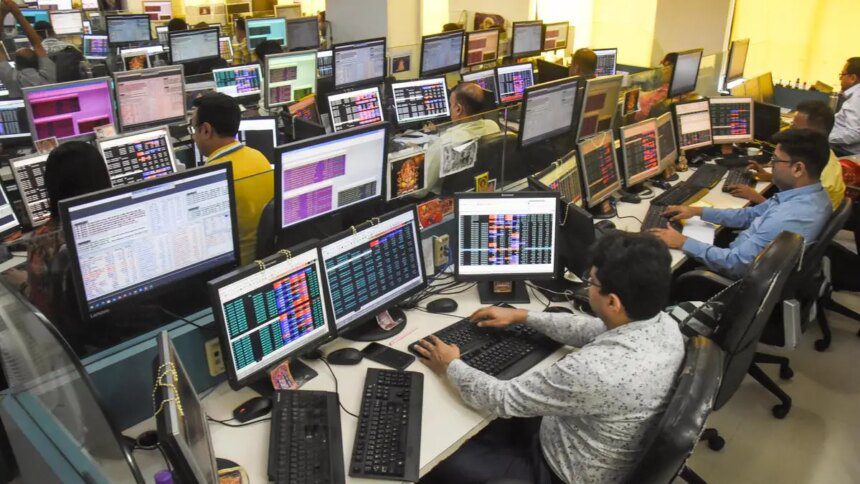
The National Stock Exchange continues to lead this segment, accounting for nearly 97 per cent of total MTF financing
“Throughout the year, MTF exposure has grown steadily, supported by strong market confidence. The National Stock Exchange continues to lead this segment, accounting for nearly 97 per cent of total MTF financing,” said CareEdge.
Conversely, Bombay Stock Exchange, despite operating on a significantly smaller base, experienced a 2.1 per cent y-o-y contraction in the previous month. This trend reversed in November 2025, when its MTF book increased by 8.9 per cent y-o-y sequentially to ₹0.03 lakh crore, suggesting a modest recovery.
Looking ahead, the normalisation of regulatory adjustments, combined with ongoing investor interest, is likely to maintain healthy volumes and strengthen growth prospects in the MTF market, the rating agency has predicted.
How it works
MTF is nothing but buying stocks by paying only part of the total value while the balance is being funded by a broker for which one has to pay an interest. The interest rate varies from brokerages to brokerages and will apply from T+1 day. It is also based on the plan they opt from the broker. A trader can either keep the position open or take delivery of the stock by paying the full amount with interest.
Only a corporate member with a net worth of at least ₹3 crore is eligible to offer margin trading facility to its clients after obtaining approval from the exchanges. Besides, only Group I stocks — highly-liquid with low-impact cost — are eligible.
Using MTF is advantageous during the bull market. When the share price rises, traders easily benefit from the leverage, without paying much from his/her pocket.
Risks
However, during volatile and bearish market condition, this will cause huge losses, as one has to pay interest in addition to suffering capital loss.
A brokerage will have a trigger or threshold price, which is calculated based on the initial margin price and market condition at which you bought the stock. During volatile period or downtrend, the threshold will be close to the buying price. If the share price hits the trigger price, the broker will check if the client has any funds within the system. If sufficient funds are available, it will first use them to maintain the position. However, if the client has little funds, then the broker will automatically square off the MTF position to prevent further losses for both brokerages and clients.
According to brokers, the recent sharp slide in some small-cap and micro-cap stocks was due to margin pressure.
An investor should also keep it in mind that MTF position is not allowed during a bonus/split corporate action. The investor will receive notification about the deadline up to which the position can be held. The position would be squared off automatically if the investors keep open the position when ex-date deadline approaches. However, the dividend will be credited into investors’ accounts even if the share is pledged with broker.
So, MTF is best-suited for experienced traders, who understand market risks and margin trading. Short-term investors, who can withstand market volatility, looking to capitalise on quick price movements can also benefit from this. However, beginners, risk-averse and long-term investors can stay away from this.
Brokerages should also assess each client’s capabilities and their experiences in the market before lending. They should avoid blindly extending loans to all and sundry, though that may give short-term benefits to them but would spoil the overall structure of market.
Published on December 12, 2025