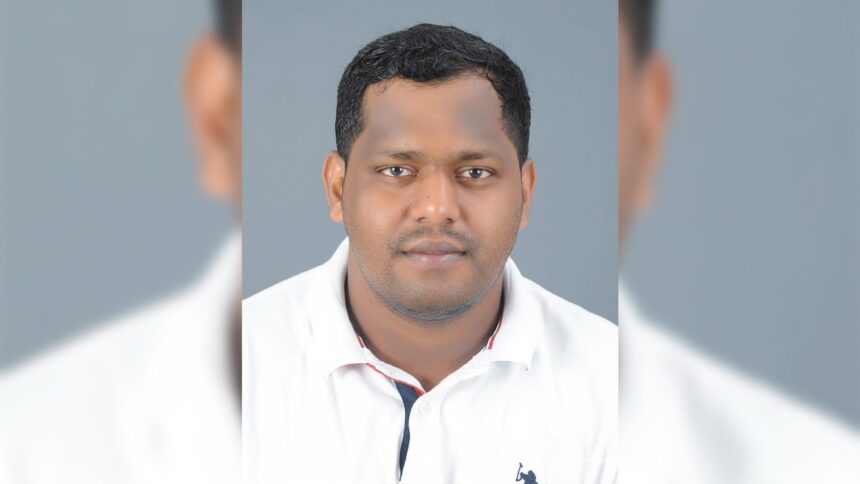
When Abdul Jabbar saw the video of the blood-soaked Ram Narayan Baghel, a native of Chhattisgarh who was beaten to death in Walayar after being accused of being a Bangladeshi by a mob, he was reminded of his own brother Ashraf, who was similarly lynched by a Hindutva mob on the streets of Mangaluru, with no one coming to help him.
Abdul Jabbar was certain of one thing: what happened in his brother’s case should not be repeated in the case of the Dalit migrant worker, Ram Narayan Baghel, and justice must be ensured.
That conviction marked the beginning of three sleepless days, during which he relentlessly worked to secure justice for the victim’s family and to ensure that no one else is lynched in such a manner again through strict legal action.
Jabbar said he could not sit still even for a moment after that and immediately travelled from Ernakulam, where he works as a software developer, to the Thrissur Medical College.
When he reached the mortuary, Jabbar said he was shocked to find that only Ram Narayan’s cousin and a friend were present, both largely unaware of the seriousness of the situation. He said he explained to them that this was a hate crime and needed to be addressed accordingly, despite the language barriers between them.
Jabbar alleged that when he reached the spot, the police behaved rudely and treated them as culprits rather than as supporters of the victim.
According to him, the police appeared eager to “get rid of the case” quickly by collecting ₹25,000 from the family to cover ambulance expenses and immediately sending the body back to the victim’s hometown.
“This is how simply you are handling a case in which a Hindutva mob beat an Indian Dalit citizen to death shouting ‘aren’t you a Bangladeshi?’,” Jabbar asked the police, refusing to allow the body to be taken away.
Maruvakk Monthly editor Ambika, in her article published in Madhyamam daily, also described the incident and asked, “When it is evident from the video that this is a case of hate crime, why did the police fail to recognise its seriousness?”
“Perhaps, if Jabbar had not intervened there at the right time, the body would have been sent to Chhattisgarh and the seriousness of the case would have been lost,” she asserted.
Jabbar said advocate Nikhil and Samudhaya Munnani leader Mani joined them after he contacted PUCL Karnataka advocate Manisha, along with leaders from CPI(ML) Red Star and the Solidarity Youth Movement.
An action committee was subsequently formed, with Jabbar serving as its convener. The committee planned a protest in front of the Thrissur Municipal Corporation.
As the victim’s family, including his mother, wife, and children, travelled to Kerala, they reached an extremely exhausted state, both physically and mentally, after boarding and getting down from three trains in the general compartments. Arrangements for their stay and food were made at the Welfare Party office.
The action committee demanded compensation of ₹25 lakh from the Chief Minister’s Disaster Relief Fund, insisting that it should not be less than ₹10 lakh. They also demanded that mob lynching provisions under the law be invoked, that the Tehseen S. Poonawalla guidelines be fully implemented, including the formation of a Special Investigation Team and victim compensation, and that the Scheduled Castes and Scheduled Tribes (Prevention of Atrocities) Act be applied.
In Tehseen Poonawalla v. Union of India (2018), the Court warned that the state must resist majoritarian impulses and avoid mirroring the logic of mob justice.
The Supreme Court issued comprehensive preventive, remedial, and punitive guidelines to the Union and State Governments to curb mob violence and lynching. These guidelines remain binding under Article 141 of the Constitution and have been referenced in subsequent cases for compliance monitoring.
Revenue Minister K. Rajan later held a meeting with the committee, during which all their major demands were accepted.
The Chief Secretary was assigned the responsibility of implementing the Tehseen S. Poonawalla guidelines, Section 132 of the Bharatiya Nyaya Sanhita was added to the case, and a compensation of ₹10 lakh was sanctioned from the Chief Minister’s Disaster Relief Fund. The demand that the body be transported to Chhattisgarh at government expense, by air and accompanied by family members, was also accepted.
Jabbar said he refused to leave the mortuary until these assurances were given. He noted that the victim’s family had been unaware of their rights and the legal process, making his presence there all the more crucial.
“We never got justice in my brother Ashraf’s case. That is why I became involved in this,” Jabbar said, stressing, “What happened to my brother should not happen again.”
He recalled that in Ashraf’s lynching case, no Special Investigation Team was formed, no victim compensation was provided, and the Tehseen S. Poonawalla guidelines were not implemented. Although a charge sheet was filed within 90 days, 15 of the accused were granted bail, with only six remaining in jail, as the government failed to pursue appeals seriously.
Jabbar said his involvement was driven by the belief that such violence can happen anywhere, to anyone, at any time. He stressed that victims are often killed without even understanding why they are being attacked, as was the case with both Ram Narayan and his brother Ashraf.
Noting the chilling similarity, Jabbar recalled the brutality of his brother’s murder, saying that after injuring Ashraf, one of the attackers went home, returned with chilli powder, and rubbed it into his wounds.
It was that pain and anguish, he said, that drove him to stand outside the Thrissur Medical College mortuary.
“Such cruelty does not arise overnight but is the product of years of sustained hate campaigns by the Sangh Parivar,” he said.
Expressing shock that it took four days for the government to act, he urged the authorities to remain vigilant, stressing that the case must be handled with the utmost seriousness and should compel the government to act firmly against hate campaigns and stop the spread of mob lynching across the country.
“This is the result of communal hatred, and it must be stopped,” he said, emphasising, “It is our duty to raise this issue, because it can happen to anyone. We believed Kerala was different, but this has shown that Kerala is also part of this reality.”
Jabbar and Ashraf are the sons of Kunjeethu and Rukhiya of Moochingad, Parappur, in Malappuram district. Ashraf, who had mild mental health issues and was working in Mangaluru, was beaten to death by a Hindutva mob on April 27 this year.
The post-mortem report from Wenlock District Hospital revealed that Ashraf died from internal bleeding and shock due to deep injuries to his head, limbs, back, buttocks, and genitals, caused by wooden logs and blunt force trauma.
Following his death, the perpetrators circulated a claim that Ashraf had shouted “Pakistan Zindabad” during the match, in an apparent attempt to ‘justify the lynching’. Many rejected the “Pakistan Zindabad” claim, calling it a fabrication by Hindutva groups to rationalise communal violence.
A coalition of civil rights organisations on Saturday released a fact-finding report on the mob lynching of Mohammed Ashraf at Kudupu in Mangaluru, calling the incident a “betrayal of the promise of the Constitution” and accusing authorities of apathy and bias in their response to the killing.
The post Haunted by his brother’s lynching, Kerala Muslim man steps in to secure justice for lynched Dalit migrant appeared first on Maktoob media.