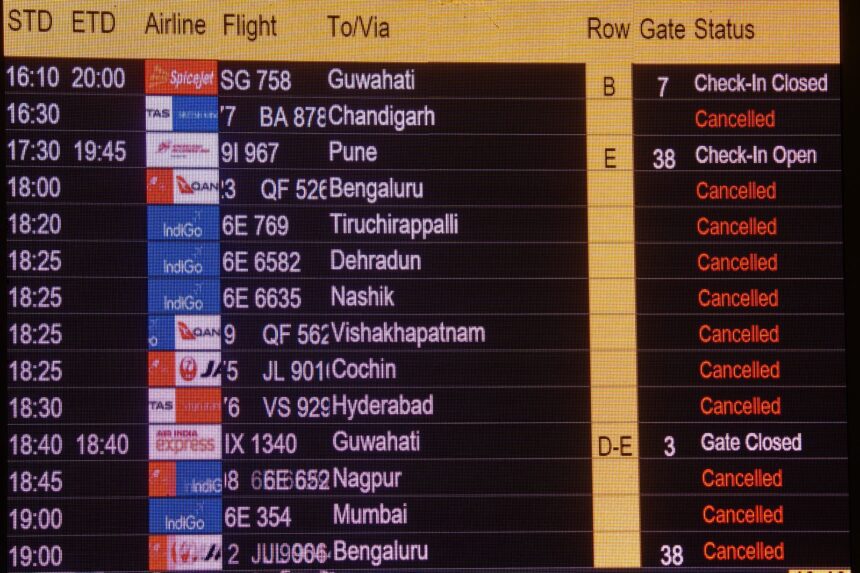
The Government of India has ordered a high-level inquiry into the massive disruption caused by IndiGo’s large-scale flight cancellations, the Ministry of Civil Aviation announced on Friday, after thousands of passengers were left stranded across airports nationwide.
IndiGo, India’s largest airline, experienced a complete operational breakdown triggered by severe pilot-rostering issues, forcing the cancellation of more than 400 flights on December 5.
Airports across the country witnessed chaotic scenes, with delays stretching beyond 12 hours, crowds of frustrated passengers staging protests, and several travellers reporting misplaced baggage. The airline’s on-time performance plummeted to 8.5 percent on Thursday, deepening the crisis.
The ministry said it had implemented several emergency operational measures and expected IndiGo’s flight schedules to stabilise by December 6. The DGCA approved IndiGo’s request for exemptions from night-duty restrictions for pilots and temporarily relaxed flight-duty norms by allowing weekly rest periods to substitute for leave.
The Ministry of Civil Aviation also established a 24×7 control room to monitor the situation in real time, coordinate immediate corrective steps, and ensure faster responses to emerging issues.
To support stranded travellers, the ministry instructed all airlines to issue regular and accurate updates through improved online systems so that passengers could monitor real-time flight status from their homes.
The ministry further directed airlines to issue automatic full refunds for cancelled flights without requiring passengers to raise requests, arrange hotel accommodation for those stranded due to long delays, provide lounge access and assistance to senior citizens and persons with disabilities, and offer refreshments and basic services to all passengers affected by prolonged delays.
The ripple effects of IndiGo’s operational collapse were felt across major airports. In Lucknow, the Chaudhary Charan Singh International Airport suffered disruptions for the second consecutive day.
In Madhya Pradesh, 85 IndiGo flights were cancelled on Friday alone. At Indore’s Devi Ahilya Bai Holkar Airport, 49 movements, including 25 departures and 24 arrivals, were affected. Bhopal’s Raja Bhoj Airport reported that 18 of IndiGo’s 28 scheduled movements for the day had been cancelled. Jabalpur, Khajuraho, and Gwalior airports also recorded significant disruptions, with several incoming and outgoing flights grounded.
The uncertainty caused by the cancellations also affected medical travel. Several hospitals in Hyderabad, a key destination for medical tourism, said that patients from other states had postponed essential visits due to cancellations and inflated airfares.
On Friday afternoon, IndiGo issued a public apology on X, assuring passengers that all cancelled flights would be refunded.
IndiGo CEO Pieter Elbers issued a public apology on Friday evening after more than a thousand flights were cancelled, calling it the airline’s “most severely impacted day” in terms of disruptions. Elbers said that IndiGo had cancelled “more than half” of its daily flight operations, making it the worst single-day breakdown in the carrier’s history.
He acknowledged that the crisis would continue into Saturday but said the airline expected fewer than 1,000 cancellations. According to him, full normalisation of operations is expected between December 10 and 15, although he cautioned that recovery would take time given IndiGo’s massive scale of operations.
IndiGo operates around 2,300 domestic and international flights every day.
Later, Civil Aviation Minister Ram Mohan Naidu said that IndiGo’s operational collapse was already “on the verge of getting resolved,” adding that the major backlog at metro airports such as Delhi, Mumbai and Chennai had largely been cleared.
He said other affected airports would also be cleared by Friday night and that IndiGo would resume operations with limited capacity from Saturday, gradually increasing flights over the next few days.
Naidu stressed that while full restoration would take a bit longer, passengers should begin experiencing smoother operations starting Saturday.
The minister was categorical that responsibility for the crisis lay squarely with IndiGo.
He said the new Flight Duty Time Limitations norms had not caused disruptions for any other airline, making it clear that the fault was not with the ministry. When asked whether IndiGo would face action or penalties, Naidu replied that action was certain, emphasising that the government prioritises passengers’ interests and would ensure that such incidents do not recur.
Meanwhile, SpiceJet Chairman and Managing Director Ajay Singh said that the airline was assisting during the crisis by operating 100 additional flights to help accommodate stranded passengers.
The post After IndiGo’s worst-ever operational collapse, Union govt orders inquiry; CEO says recovery by mid-December appeared first on Maktoob media.