“I don’t feel judged. But I do feel guilty — twice. First, because I could not save Hind Rajab. Second, because I sent Yousef and Ahmad into what became a trap,” says Mahdi Aljamal, who was responsible for coordinating the rescue of the 6-year-old Palestinian girl on 29 January 2024.
What began as an eight-minute mission turned into an agonizing day-long effort, culminating in a devastating outcome. Hind Rajab’s call recording to the Palestine Red Crescent Society (PRCS) dispatchers, made from a car filled with deceased relatives, has become a haunting testament to the ongoing violence in Gaza amidst a fragile ceasefire.
Hind was attempting to escape her home in a car with relatives when it was targeted by Israeli forces. Layan Hamada, Hind’s cousin and at that time the only other survivor in the vehicle, made the initial call to dispatchers. Following a series of gunshots, Layan’s scream is heard until her voice falls silent. Forensic Architecture reports that a total of 64 gunshots can be heard fired in just six seconds.
After some time, Hind picks up the phone, pleading with dispatchers for help. Aljamal, while coordinating the rescue operation, had to listen to the heartbreaking exchange between dispatchers and Hind.
“It was one of the hardest days in my entire career with the PRCS. But the truth is that Hind Rajab’s voice is the voice of all Gazan children. I have lived through hundreds of cases—children crying for help, women begging for rescue, elderly people trapped and terrified,” Mahdi recounted.
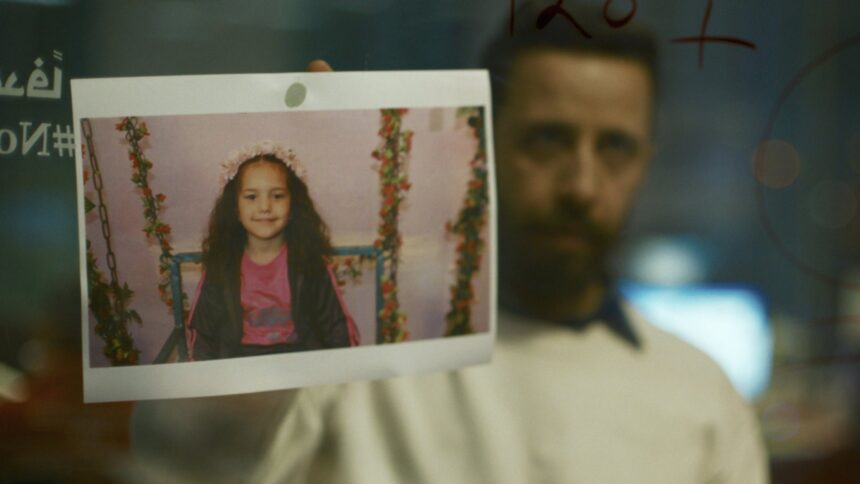
The harrowing hours inside the PRCS headquarters, following Hind Rajab’s call, are artistically portrayed in “Voice of Hind Rajab,” a docufiction film by Oscar-nominated director Kaouther Ben Hania. The film intertwines actual recordings with reenactments of the first responders’ attempts to save her, garnering the Silver Lion Grand Jury Prize at the Venice Film Festival—where it received the longest standing ovation in the festival’s history. It is also Tunisia’s official submission for the 98th Academy Awards.
In a WhatsApp response after a brief meeting in Doha, Aljamal explained, “As the Acting Head of Disaster Risk Management at PRCS HQ, responsible for both the West Bank and Gaza, I was the main contact for coordinating ambulance movement in Gaza. All communication with the ICRC, the Ministry of Health, and other national and international entities fell under my purview.”
“The events of 29 January 2024 did not alter my working procedures, but they changed my life. The killing of Hind Rajab, the Hamada family, and our team members, Yousef and Ahmad, shattered something within me. I resigned the very next day, 30 January 2024, because I could no longer bear the weight of that office,” he stated.
“I began to resent everything associated with that day: my office, my laptop, the VHF radio, even my chair. I could no longer look into the eyes of my team, my line manager, or my colleagues in Gaza. I reached a point where I could not continue,” Mahdi Aljamal told Maktoob.
Journalists have documented a total of 335 bullet holes on the car found with Hind and her six relatives. The bodies of two PRCS paramedics, Youssef Zeino and Ahmed Al-Madhoun, who disappeared on the night of the call, were discovered in their ambulance approximately 50 meters away two weeks later.
During a panel at the Doha Film Festival, both the filmmaker and the actors asserted that their work serves not only as a reminder but as a call to action to alleviate the suffering of children in Gaza. The film team was accompanied by Hind Rajab’s mother and the PRCS crew depicted in the film. Alongside Aljamal were Omar A. Alqam, who first attended to Rajab’s call, Rana Hassan Faqih, who communicated with Rajab until the end, and Nisreen Jeries Qawas, among the last to speak to Hind Rajab before she quieted.
Medics Became Targets
“Hind Rajab is but one of the 20,000 children killed in Gaza,” Qawas, director of mental health and psychosocial support at PRCS, stated. She highlighted the danger faced by paramedics: “They undertook the mission knowing it was a 50-50 chance of survival or death. They knew the risks. Yet, they did not say, ‘No, I won’t go.’”
During the panel discussion, Rana Hassan broke down in tears, while Omar described the entire episode as “difficult,” yet emphasized their commitment to the work.
The PRCS has frequently been targeted by Israeli forces during the two-year period of violence in Gaza, which has resulted in the deaths of over 70,000 Palestinians, primarily women and children. Ambulances, medical personnel, and rescue workers were shot at while attempting to provide aid. In March of this year, at least 15 Palestinian medics and rescue workers who went to southern Gaza for a rescue mission were shot dead when Israeli forces opened fire on their vehicles. Their bodies were found in a mass grave nine days later, having gone missing for days.
“That day was particularly challenging because my own team was directly involved in the operation. I was listening to Hind’s voice, witnessing Rana’s tears, Omar’s emotional response, and seeing Nisreen attempting to comfort both the team and Hind’s mother. Simultaneously, I had to maintain professionalism over personal emotion,” Mahdi recalled.
“The fear I always had—that sending an ambulance could lead to losing the crew—became a harsh reality. We lost two paramedics, Ahmad and Yousef, whom I knew personally. That day, everything changed.”
“I coordinated the mission because the situation necessitated it. While communication with the ICRC and other organizations is crucial, it never guarantees safety. This reality is one I will carry with me forever,” he concluded.
The post Hind Rajab’s voice still haunts Palestine Red Crescent dispatchers appeared first on Maktoob media.
Tags: Hind Rajab’s voice still haunts Palestine Red Crescent dispatchers Extract 5 SEO-friendly keywords as tags. Output only keywords, comma separated.
Hashtags: #Hind #Rajabs #voice #haunts #Palestine #Red #Crescent #dispatchers