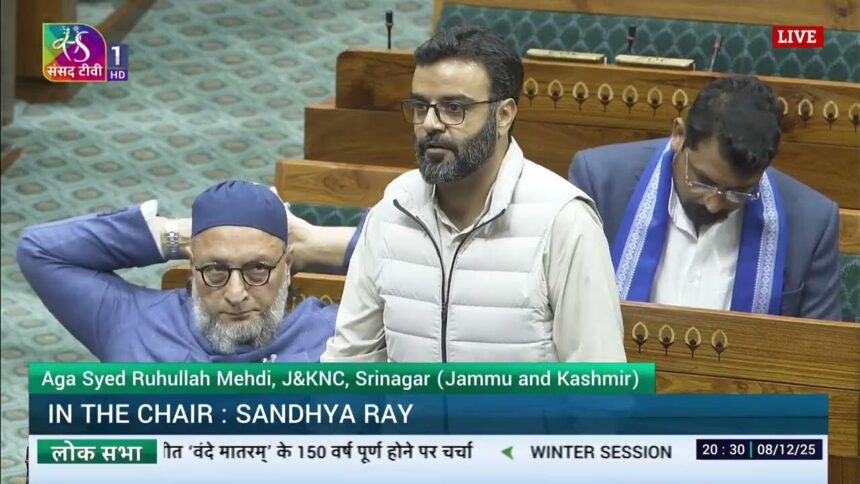
Srinagar MP Aga Syed Ruhullah Mehdi launched a fresh attack on the Union government, accusing it of weaponising patriotism, policing Muslim identity, and carrying out targeted actions under the guise of nationalism and law enforcement.
Speaking during the discussion on the 150th anniversary of Vande Mataram, Ruhullah said that attempts to compel citizens to sing the song amounted to an assault on religious freedom and a dangerous rewriting of citizenship.
“Patriotism cannot be forced, regulated, or verified through cultural rituals,” he said, arguing that linking loyalty to a song rooted in religious imagery excludes and stigmatises minorities.
“You cannot demand worship in the name of nationalism,” he said.
Ruhullah stressed that India’s Constitution gives every citizen the right to their faith and conscience, and the State cannot impose symbolic conformity.
“Nationality may change, governments may come and go, but my faith does not change. No one has the right to compel me to worship any deity or to prove my patriotism by singing a song.”
In another strong remark, he said, “We as citizens of India do respect the national song but no one can compel us to prove our love for the nation or chant the song. We will respect it in its entirety, we can even stand in its respect, but you cannot force us to say it with you.”
He added, “We fought for the freedom of this nation from the outsiders, and if the need arises, we can also fight tooth and nail for our freedom in this nation against you if you stop us from exercising our fundamental rights.”
His remarks echoed sentiments shared earlier by AIMIM’s Asaduddin Owaisi. Still, Ruhullah’s intervention was distinct for its focus on how cultural nationalism is being weaponised against Muslims, particularly in states witnessing crackdowns and demolitions.
He also accused the government of using national symbols to distract from real issues.
In his combined intervention, Ruhullah argued that the push to enforce Vande Mataram and the parallel demolition drives were not isolated events, but part of a broader political strategy for shifting attention from unemployment and inflation, constructing Muslims as “perpetual outsiders,” framing dissent as disloyalty, and using cultural nationalism to avoid accountability.
He concluded his speech saying, “When a government cannot answer questions on jobs, inflation or governance, it turns to identity. Songs become tests. Demolitions become justice. And Muslims become suspects.”
The post “Muslims fought for freedom of the nation… can also fight for freedom within,” says Aga Ruhullah in Lok Sabha appeared first on Maktoob media.