A meeting between leaders of the Communist Party of China (CPC) and the Rashtriya Swayamsevak Sangh (RSS) General Secretary Dattatreya Hosabale at the RSS headquarters on Tuesday has sparked political controversy, prompting the Congress party to decry it as a ‘change of colours.’
The meeting, which lasted approximately half an hour, was a courtesy call initiated after the CPC delegation sought to connect with the RSS leadership. News agencies reported that no formal agenda was discussed during the interaction.
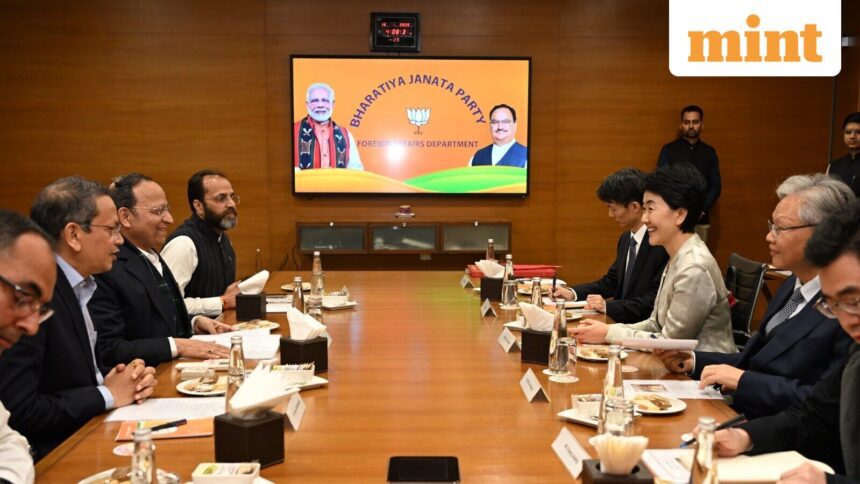
Prior to this, CPC leaders met with BJP General Secretary Arun Singh and Foreign Affairs Department Convener Vijay Chauthaiwale at the BJP headquarters, in what was described as a ‘routine exchange.’
“A delegation of the Communist Party of China under the leadership of Ms. Sun Haiyan, Vice Minister, IDCPC, visited the BJP head office today. During the discussion, Arun Singh Ji, the party’s General Secretary, engaged in a detailed conversation about enhancing inter-party communications between the BJP and CPC. Chinese Ambassador to India Xu Feihong also attended,” Chauthaiwale wrote on X.
These meetings take place amid Beijing’s claims over the Shaksgam Valley in Jammu and Kashmir. Last year, the RSS chose not to invite diplomats from China, Pakistan, and Turkey to a lecture series led by Sangh chief Mohan Bhagwat, a move interpreted as connected to Operation Sindoor.
Congress leader Pawan Khera criticized the BJP’s ties with China during a press conference in New Delhi, arguing that those who previously vowed to confront China have instead welcomed it with open arms. He asserted that the BJP has engaged with the CPC even when not in power and that RSS members had traveled to China for training.
“The BJP has taught even a chameleon how to change its colours. Those who promised to show ‘red eyes’ to China have instead rolled out a ‘red carpet’ for it. The BJP has had meetings with the CPC, and even when they were not in power, they visited China and held discussions; RSS members went there for training,” he stated.
Khera clarified that while the Congress does not oppose political engagement with foreign entities, it objects to what it perceives as the BJP’s duplicity and hypocrisy. He emphasized concerns about the implications of these private meetings for the country.
Khera also accused Prime Minister Narendra Modi of being “afraid of China,” highlighting perceived inconsistencies in the government’s approach, such as discouraging the use of Chinese products while awarding contracts to Chinese firms.
The Congress leader raised questions about whether critical issues, including the Shaksgam region and developments during Operation Sindoor, were discussed in meetings with Chinese representatives. He referenced claims from a senior Army officer that China has supported Pakistan militarily and questioned why Prime Minister Modi engaged with China under these circumstances.
On Monday, the Chinese Foreign Ministry’s spokesperson Mao Ning rejected India’s claims to the Shaksgam Valley. “You are in power, and you held meetings at the party office, so we want to know—if not publicly, then at least behind closed doors—did you show the ‘red eye’? Did you raise the issue of Shaksgam? What happened during Operation Sindoor? A senior Army officer indicated that China was collaborating with Pakistan to supply weapons, including PL-15 missiles. Even so, Modi ji began traveling on China’s terms,” Khera stated.
General Upendra Dwivedi, Chief of Army Staff, reaffirmed on Tuesday that India does not recognize the 1963 boundary agreement between Pakistan and China concerning the Shaksgam Valley. He emphasized that India considers the agreement illegal and does not accept any activities in that region. Regarding the China-Pakistan Economic Corridor (CPEC), he stated that India views the initiative as an illegal action initiated by both nations.