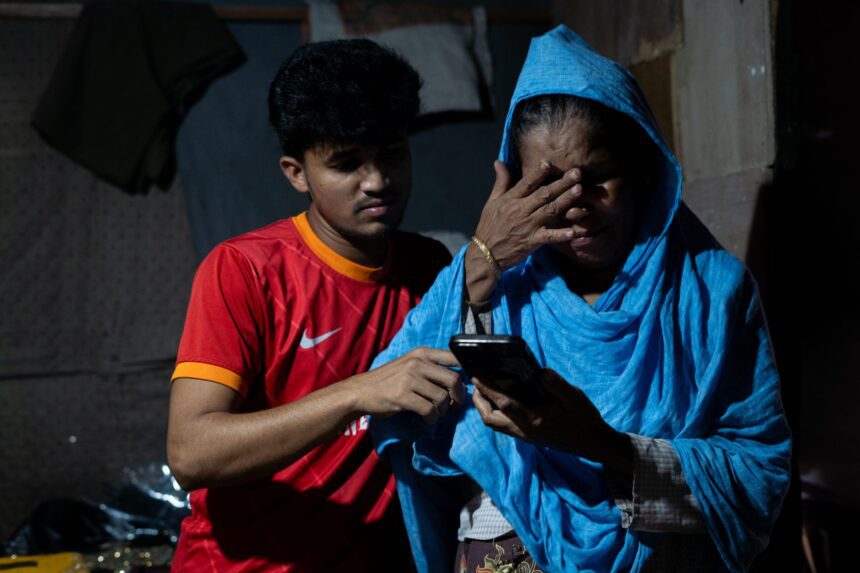
The Supreme Court on Tuesday questioned how individuals who enter India illegally can insist on the application of due legal process for their removal, as it heard a Public Interest Litigation (PIL) alleging that several Rohingya people were deported without following prescribed procedures.
A Bench of Chief Justice of India Surya Kant and Justice Joymalya Bagchi was hearing a plea alleging the “custodial disappearance” of Rohingya persons who were reportedly in Delhi Police custody and whose whereabouts are now unknown. The petition sought that any deportation be carried out strictly in accordance with the law.
CJI Surya Kant asked the petitioner’s counsel how intruders who “cross a fenced border, dig a tunnel, and enter India illegally” could then claim entitlement to notices, food, shelter and other protections. “Do we want to stretch the law like this?” he asked, responding to the counsel’s allegation that five Rohingya people had been deported without due process.
The Bench also questioned whether the Centre had ever granted these individuals refugee status. “Where is the order by the Government of India declaring them as refugees? ‘Refugee’ is a well-defined legal term, and there is a prescribed authority to declare it,” the CJI observed.
The counsel clarified that she was not seeking refugee status for them but was raising a case of disappearance from custody.
The CJI said the matter would be tagged with other pending petitions concerning Rohingya individuals in India.
When the court asked whether the larger objective was to secure legal status for people who had entered India unlawfully, the counsel responded that the law prescribes a clear memorandum on how deportation must be carried out, and that trafficking people out of the country would pose a greater security risk.
The Bench, however, pushed back, “If you don’t have legal status to stay as a refugee in India, and you are an intruder… If an intruder comes, do we give them a red-carpet welcome and provide all facilities?”
The counsel answered, “Not at all,” but maintained that deportation must follow due process.
CJI Kant further asked whether she agreed that such persons should be sent back. The counsel replied that they should indeed be returned, but only “in accordance with due process of law.”
Expressing surprise at the demand for full legal protection for those who entered India unlawfully, the CJI said, “We also have poor people in this country. They are citizens. Are they not entitled to certain privileges and amenities? Why not concentrate on them first? Even if someone has entered illegally, we cannot use third-degree treatment unless they are involved in a crime.”
When the counsel insisted that this was precisely her concern, the CJI disagreed, stating,“That’s not what you are asking for. You are asking for a writ of habeas to bring them back.”
He also cautioned that granting such relief could create logistical challenges and set a precedent, stating, “If it is done for one set of people from one country, another set from another country will demand the same.”
Solicitor General Tushar Mehta argued that the petition had been filed by a PIL litigant “and not by the aggrieved themselves.”
Journalist Abuzar Mohd Abuzar Choudhary criticised the CJI’s remarks on X, writing, “How can the head of the judiciary be so insensitive and immoral? The petition only sought that any deportation be carried out through due process so that basic human rights would be protected.”
Many observers argue that although India is not a party to the 1951 Refugee Convention, it is still bound by the customary international law principle of non-refoulement and by the ICCPR, which India has ratified. Both prohibit sending any person, regardless of immigration status, back to a place where they face a real risk of persecution, torture, or death.
By questioning whether people who enter illegally are entitled to due process, such as show-cause notices, judicial review or basic humanitarian protections, and by placing national security and citizens’ welfare above individual risk assessments, the Court’s stance is seen by many as effectively endorsing refoulement and arbitrary detention.
The Rohingya, a Muslim minority from Myanmar’s Rakhine State, have faced decades of systematic discrimination, denial of citizenship, military violence, mass displacement, and what UN investigators have described as genocidal intent.
The post “Do we give them a red-carpet welcome?” : CJI Surya Kant questions plea on illegal deportation of Rohingya refugees appeared first on Maktoob media.