Enterprise AI is at a crossroads.
The technology works. Investment is flowing. Pilots are everywhere. And yet, across industries, CIOs are confronting a quiet but persistent reality: artificial intelligence moves fast—but transformation only endures when people move with it.
In an era where AI is advancing faster than organizations can absorb it, the real challenge for CIOs is no longer access to technology—it is alignment. Alignment between systems and skills. Between experiment and impact. Between speed and trust. And most critically, between innovation and people.
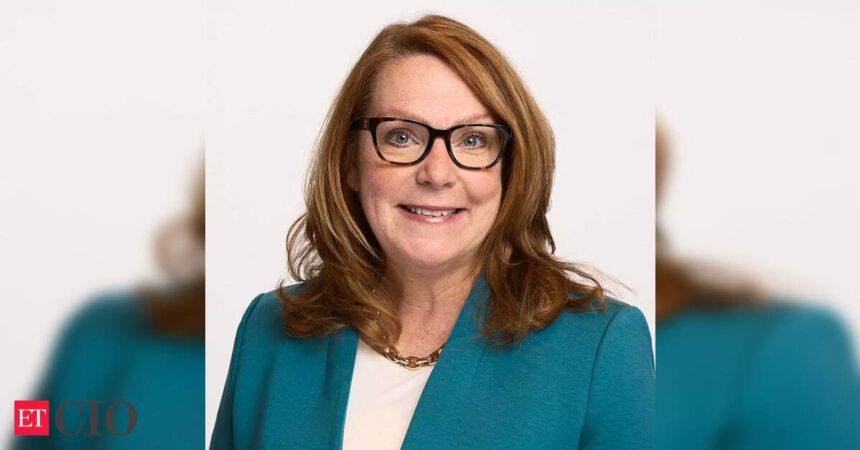
Few leaders see this tension as clearly as Kim Basile, Chief Information Officer of Kyndryl. As CIO of Kyndryl, the world’s largest IT infrastructure services provider, Kim Basile operates at the intersection of scale, complexity, and continuous change. From enabling citizen-led AI development to designing a future-ready workforce across more than 60 countries, her mandate extends well beyond modernization—it is about building belonging, governance, and readiness into the fabric of enterprise IT. Basile operates at a scale where misalignment between people and platforms quickly becomes systemic risk.
In many enterprises, AI is still treated as a technical rollout rather than a workforce transformation. At Kyndryl, AI is not being pushed top-down as a technology mandate—it is being deliberately democratized, governed, and operationalized across 73,000 employees. The company’s People Readiness Report, based on insights from 1,100 business and technology leaders across eight markets, reveals a stark divide between organizations experimenting with AI and those actually extracting value from it.In this interview, Basile argues that the next chapter of enterprise AI will be won—or lost—on culture, not code. She explains why belonging is a prerequisite for innovation, how CIOs must balance acceleration with adoption, and why responsible AI governance is becoming inseparable from leadership credibility. Most importantly, she reframes the CIO role itself—not as a custodian of systems, but as an architect of readiness in an era where technology is no longer the long row to hoe.
True innovation stems from diverse voices. We should listen to hear them. What have you learned about cultivating diversity- not just in demographics and gender but in perspectives, leadership styles, and problem-solving approaches – in global tech teams?KIM BASILE: At Kyndryl, we believe true innovation begins with a strong sense of belonging—where people feel valued, supported, and empowered to contribute authentically. Diversity only translates into innovation when individuals feel safe bringing their perspectives forward.
Cultivating that environment in global teams requires leadership grounded in empathy, trust, and shared success. We focus on making risk-taking safe, encouraging collaboration, and ensuring that skills and strengths are visible across roles and geographies. Our culture and systems are designed to connect customer needs with the unique talents of our workforce, enabling people to contribute where they create the most impact.
Continuous learning is central to this approach. Development goals are directly aligned with strategic priorities, and skill-building is embedded into daily work—not treated as a separate activity. This prepares our teams for rapid technological change while reinforcing a collective sense of purpose. When people grow together, innovation follows naturally.
The Kyndryl People Readiness Report 2025 highlights the tension between rapid AI adoption and workforce preparedness. What advice would you offer CIOs managing the tension between innovation and employee readiness?
KIM BASILE: At Kyndryl, we measure innovation not by how quickly technology is deployed, but by how effectively people are brought along. Sustainable transformation requires trust, alignment, and a shared sense of purpose—without those, even the most advanced technologies fail to deliver value.
Our 2025 People Readiness Report identifies a group we call AI pacesetters—organizations that go beyond experimentation. These leaders integrate AI across the enterprise rather than limiting it to isolated pilots. They pair technology adoption with strong governance and disciplined change management, ensuring accountability and clarity at every stage.
Equally important is workforce enablement. AI pacesetters invest in accurate skill inventories, targeted reskilling programs, mentorship, and certifications. They involve employees early, communicate transparently, and build cultural alignment around change.
A common mistake we see is treating AI as a purely technical deployment. In reality, success depends on cultural transformation—supported by strong data foundations, prepared talent, and structured change management. When organizations balance technological acceleration with human adoption, innovation becomes measurable, durable, and scalable.
As an early adopter of Microsoft Copilot, Kyndryl is now enabling employees to build their own AI agents by 2026. How do you ensure governance, security, and quality in a citizen-development model?
KIM BASILE: Our approach to citizen-led AI innovation is built on trust, discipline, and transparency. We combine deep data expertise with a customer-first, vendor-neutral mindset to ensure every innovation aligns with ethical, legal, and regulatory expectations.
At the core is our comprehensive AI governance framework, which includes the Kyndryl AI Policy, the AI Management System, and a robust set of enablement resources. The AI Policy applies to all employees and contractors, clearly defining how AI can be used in both internal operations and customer engagements.
The AI Management System introduces a risk-based review and approval process, supported by a centralized AI System Inventory that tracks all approved solutions. This allows us to scale citizen-built AI agents safely and responsibly.
We also provide a centralized AI at Kyndryl portal, where employees can access policies, training, templates, and best practices. Our Responsible AI principles—established even ahead of regulations like the EU AI Act—set a high bar for privacy, security, and ethical use.
By continuously mapping evolving global regulations to our internal policies, we maintain consistency while allowing regional flexibility. This disciplined yet empowering approach enables innovation while protecting customers—and we measure its impact through improved collaboration, faster decision-making, and enhanced customer experience.
As you democratize AI for 73,000 employees, how are you rethinking workforce design? What defines a future-ready Kyndryl technologist-technically, culturally, and ethically?
KIM BASILE: We see workforce design as a strategic lever, not an HR exercise. Building future-ready technologists requires technical depth, adaptability, and cross-functional fluency.
I often describe our approach as a three-lane highway. First, we invest heavily in upskilling from within. Second, we bring in domain specialists who introduce new perspectives. Third, we support early-career professionals who challenge assumptions and drive innovation.
A cornerstone of this strategy is the Future-Proof Workforce Academy, which delivers personalized learning paths, role-based curricula, and skills assessments through partnerships with platforms like Pluralsight. Employees are encouraged to pursue certifications, engage in experiential learning, and take on stretch assignments and project rotations.
But technical skills alone are not enough. Digital fluency must be paired with leadership and human skills—communication, critical thinking, emotional intelligence, and problem-solving. Our programs intentionally blend these capabilities with training in AI, data literacy, and security awareness.
Transparency underpins everything. Through our Global Skills and Career Framework, employees clearly understand the skills required for their roles and the career paths available to them. Our Kyndryl Compass performance system aligns individual growth with shared success and reinforces responsible AI principles such as transparency, accountability, and fairness.
A future-ready Kyndryl technologist is technically fluent in AI and automation, culturally collaborative and customer-centric, and ethically grounded in responsible innovation. That combination is what prepares our workforce to lead in the decade ahead.
If you were to write a playbook on the future of the CIO role, what would the first three chapters be titled?
KIM BASILE: Innovation moves at the speed of culture, trust, and skills. CIOs must appreciate this key aspect of diving technology innovation. So I would write the first three chapters with these underlying themes.
Chapter 1: Leading with Purpose—Empowering People and Building Belonging
The CIO must be a steward of culture as much as of technology. This chapter focuses on building trust, fostering inclusion, and aligning technology strategy with the human core of the organization.
Chapter 2: Orchestrating Innovation—Balancing Acceleration with Workforce Readiness
CIOs must integrate emerging technologies like AI thoughtfully, supported by governance, change management, and continuous workforce enablement.
Chapter 3: Designing the Future Workforce—Blending Technical Mastery with Adaptive Skills
Tomorrow’s leaders need more than expertise—they need agility. This chapter explores how CIOs can build teams that are technically strong, cross-functionally fluent, ethically grounded, and ready to thrive in constant change.
NOTE: This interview is the concluding part of a two-part interview. For the first part, go to: Reinventing IT at scale: What Kyndryl CIO Kim Basile learned as Customer Zero