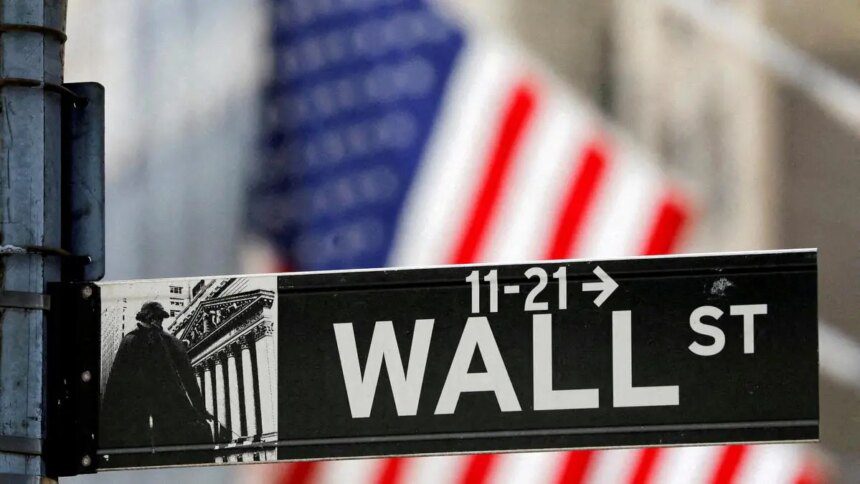

President Donald Trump’s return to the White House changed the political calculus around mergers and acquisitions, reviving companies’ desire for dream deals that had become difficult to pull off. Now, corporate America is on the clock.
The rout by the Democrats in the midterms is creating a sudden sense of urgency in boardrooms, with executives wondering if they might have one last chance to pull off a transformational transaction while M&A-friendly regulators remain in place under Trump.
Conversations with top advisers suggest the result is already prompting companies to ask whether they should move fast to bring big strategic moves forward. There’s a realization that a resurgent Democratic Party could work to frustrate the kind of blockbuster dealmaking that’s built up steam during Trump 2.0. and powered record revenue on Wall Street.
Kevin Foley, co-head of investment banking at JPMorgan Chase & Co., one of the world’s top advisory firms, said companies should be ready to transact through another complicated operating environment.
“The biggest risk may be assuming that, sooner or later, things go back to normal,” New York-based Foley said. “Standing still is always an option, but when industries are changing this fast, it’s the wrong one.”
Fernando Rivas, a senior Wells Fargo & Co. banker, put it more starkly at an industry conference in Boston on Thursday when he said a “now or never” mentality will return to drive M&A in the near term.
Trump’s two terms have accounted for an outsized share of the biggest deals. More than half of all announced transactions worth at least $50 billion and involving a US company over the past two decades have come while he was president, according to analysis of Bloomberg-compiled data.
This year alone has seen landmark combinations in mission-critical sectors like power and technology, such as this month’s record-breaking $100 billion-plus takeover of laser maker Lumentum Holdings Inc. by Marvell Technology Inc. Elsewhere, the Department of Justice cleared Paramount Skydance Corp.’s $110 billion acquisition of Warner Bros. Discovery Inc. without antitrust remedies.
There’s a particular urgency to get going with these more complex transactions. Megadeals can take months to negotiate and even longer to clear regulatory reviews around the world. Companies that wait until a 2028 presidential campaign is in full swing to move ahead with such deals risk seeing them become political footballs at the stump.
“If you have a major transaction that is going to take time to put together and get through the process, you really have to start working on it now and probably announce it by the middle of 2027,” said Paul Nary, assistant professor of management at the University of Pennsylvania’s Wharton School. “There isn’t that much time left.”
Balance Shift
A major test case for mega M&A in the new landscape could be the potential combination of Elon Musk’s SpaceX and Tesla Inc., which would be among the biggest and most politically sensitive corporate tie-ups ever attempted and reveal the extent of the billionaire’s influence with Trump as the balance of power in Washington begins to shift.
Bloomberg News has reported that Musk, who spent almost $500 million supporting Republican candidates in key midterm races, is pushing to announce a merger of his two largest companies by the first half of 2027. But things have become more complicated; shares in both SpaceX and Tesla have slumped amid concerns that a Democrat-led Congress will probe Musk’s business and political dealings and, more broadly, look to slow the artificial intelligence boom he has consistently championed.
While Democrats will not take control of the DOJ or Federal Trade Commission, leaving the administration’s merger enforcers in place, gaining control of both chambers will give the party new ways to interrogate large and sensitive M&A through hearings, investigations and subpoenas — as well as stoking public scrutiny of companies and regulators.
Several large deals in the pipeline, and even some that have completed, could become early targets for the new-look Congress from January.
DoorDash Inc.’s $17 billion takeover of Instacart parent Maplebear Inc. has drawn criticism from prominent Democrats including New York City Mayor Zohran Mamdani, who said the deal would mean “higher prices, harsher exploitation and greater economic inequality.” Lawmakers including Senators Ed Markey and Richard Blumenthal, meanwhile, have targeted NextEra Energy Inc.’s $67 billion purchase of Dominion Energy Inc., warning it could reduce competition and raise costs for consumers. And Senator Cory Booker has vowed congressional oversight to dissect the Paramount-Warner Bros. deal, which closed last month.
“Congress has limited time and resources, so it’s not going to investigate every transaction,” said Paul Humphreys, global co-head of industrials at law firm Freshfields. “I would expect the focus to be on particular themes, especially affordability and accountability.”
“Congress has the ability to call executives in, issue subpoenas and put a transaction under a political spotlight — even after it has been cleared,” Humphreys said.
AI Fade
A fading AI trade offers a more immediate challenge for dealmakers that have used the buildout of the technology to steer some of the largest transactions of the second Trump term. Data centers were on the ballot in multiple states during the midterms, with voters ultimately delivering an emphatic rebuke to their rapid expansion across the US.
Markets, which had already been contending with anxiety over the enormous capital expenditure around AI, are now also factoring in the prospect of tougher restrictions on the digital infrastructure that supports it. The Philadelphia Stock Exchange Semiconductor Index — a barometer for chip companies — last week suffered its biggest one-day drop since the Covid pandemic hit in March 2020.
The slump has brought the Marvell-Lumentum deal into sharp relief. Both companies have tumbled since the midterms, adding another variable to an all-stock transaction with a strategic rationale that rests heavily on continued investment in data centers and AI connectivity.
Some Wall Street firms boosted their ranks of politically connected staffers in a wager that better access to, and understanding of, the Trump administration would be crucial to pushing through big deals. The midterm results could upend that and force banks to begin building bridges with Democrats sooner than expected.
“Dealmakers had started to understand how to navigate the Trump White House and its approach to M&A,” said Nary at Wharton School. “After the blue wave, they’re now going to need a congressional strategy as well.”
Published on November 8, 2026
You are an experienced Indian business news editor writing an original, value-added article for an Indian audience. Using the source material above, produce a NEW article that is more useful than the original — not a reworded copy.
MANDATORY STRUCTURE — include ALL of these even if the source is short (expand thin sources with relevant factual context to meet the minimum length):
- A 2-3 sentence summary paragraph up front (the key takeaway).
- At least THREE body sections, each introduced by a descriptive
subheading grouping related facts.
- A
What This Means
- A
Frequently Asked Questions
Rules:
- Preserve all key facts, figures, quotes, names and dates accurately. Do not invent data.
- Add relevant Indian market/sector context the source lacks.
- Minimum 500 words. Short paragraphs.
- Output ONLY the finished HTML article body. No preamble, no “here is the article”, no meta-comments.