
Summary of Misinformation
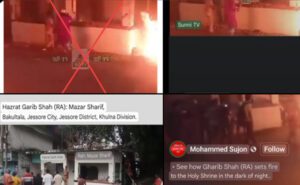
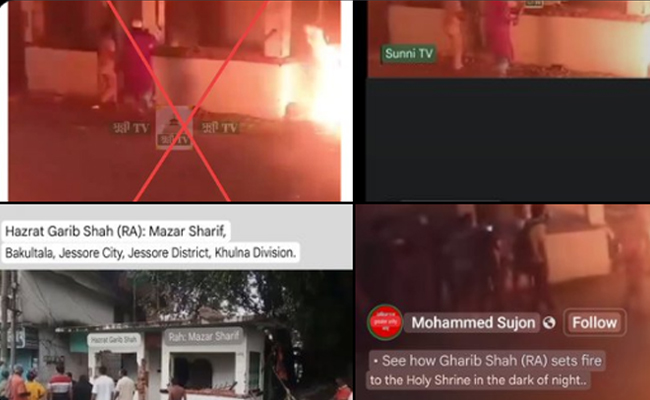
Recent claims circulating on social media allege that a video shows a Hindu temple being burned in Bangladesh, purportedly as a response to ongoing communal tensions. This claim has been debunked by fact-checker Mohammed Zubair, who confirmed that the video actually depicts the Mazaar Sharif of Hazrat Gareeb Shah in Jessore, which was attacked five days prior.
Understanding the Context
The incident surrounding the attack on Hazrat Gareeb Shah’s Mazaar Sharif reflects the complexities of religious identity and communal relations in Bangladesh. The shrine is dedicated to a revered Sufi saint and holds significant cultural importance for local communities, irrespective of their religious backgrounds. Misinformation like the claim regarding a Hindu temple can escalate tensions and provoke unnecessary fears among different religious communities.
The Role of Social Media in Propagation of False Narratives
Social media platforms have become fertile ground for the spread of misinformation, especially concerning sensitive topics like religion and communal violence. Instances such as the one involving Zubair’s fact-check highlight the rapidity with which false narratives can gain traction. Users often share content without verifying its authenticity, leading to increased polarization and hostility. The mislabeling of the Mazaar Sharif incident underlines how visual media can be manipulated for sensationalism or political gain.
Fact-Checking Initiatives and the Importance of Accuracy
Fact-checking organizations play a crucial role in combating misinformation. In this case, Mohammed Zubair’s intervention helped clarify the truth, demonstrating the importance of verifying information before sharing. As political commentary and reporting increasingly overlap, fact-checking can help maintain journalistic integrity, allowing audiences to make informed opinions based on accurate information. The need for diligence in verifying events becomes ever more pressing in environments marked by communal sensitivities.
Why This Matters
For Indian readers, the ramifications of such misinformation extend beyond the borders of Bangladesh. The interplay of communal tensions in South Asia evokes historical sensitivities in India, where similar conflicts have occurred. Misrepresentation can stoke sectarian emotions, impacting diplomatic relations and border tensions. The political landscape in both countries is deeply intertwined, and events in one can have immediate repercussions in the other. Understanding these narratives is crucial for fostering inter-religious harmony and ensuring peace in the broader South Asian region.
Frequently Asked Questions
What was the misinformation about?
The misinformation claimed that a video showed a Hindu temple being burned in Bangladesh, but it was actually footage of the Mazaar Sharif of Hazrat Gareeb Shah in Jessore, which had recently experienced an attack.
Who debunked the claims about the video?
The claims were debunked by Mohammed Zubair, a notable fact-checker, who clarified the context of the video and its true subject.
What is the significance of the Mazaar Sharif?
The Mazaar Sharif of Hazrat Gareeb Shah is an important Sufi shrine in Jessore, holding cultural and religious significance for many, transcending communal lines.
How does misinformation affect community relations?
Misinformation can exacerbate communal tensions, leading to distrust and hostility among different religious communities, which is particularly concerning in multi-religious societies like India and Bangladesh.